Where’s My Slide Rule?

Thank you, Donald Trump.  Watching your show on Monday and Tuesday was like a canteen of cold clean water to a man dying of thirst in the desert.  I feel I’ve been paid back for any trouble I’ve taken on your behalf in the last four years.  Hallelujah and amen.

Okay now it’s up to Trump and his merry band of madmen to fix Washington and fix the country and do that list of a million impossible things that he said he’s going to do.  Have at it, boys.  Give ‘em hell.

So, what’s for me to talk about tonight?  Well, I’ve got to talk about what’s chasing around my head tonight.  First off, I’m grumbling about how damn cold it is today.  The heating system at the Compound is undersized.  Or maybe the insulation should be the focus.  When the outside temperature dips below zero Fahrenheit, it won’t hold a set point above seventy.  And that’s too bad because I hate being cold inside my own home.  Camera Girl holds me directly responsible because I never put the weatherstripping around two of the external doors.  I explained to her that these small insulation problems are only a minor part of the problem and that I’m addressing the problem holistically by spending considerable time thinking deeply about all the ways that a solution can be reached.  I’ve considered the thermodynamic aspects of the problem.  The psychological ramifications of the fear of cold.  The physiological mechanisms by which the human body adapts to hypothermia.  The cultural involvement of cold in the human industries that are called clothing and shelter.  The quantum meaning of absolute zero.  And finally, the latest bill from the heating oil company.  All these things I showed her and admonished her to have patience and faith in my stewardship of the Compound’s Overall Heat Transfer Coefficient (U).  None of this registered with her at all.  She made certain primitive Sicilian gestures with her face and hand that I won’t dignify with detail.  Suffice it to say they were not helpful in the least.  I’m going out tomorrow for other reasons.  But I may also pick up some weatherstripping.  Maybe.

I was recently in a discussion about General Relativity with a friend.  The question of the curvature of space came up.  I told him I’ve never been convinced of the idea that mass curves space-time.  I stated that what is the difference if gravity bends the path of light and matter when it comes close to an object like the sun but space is unaffected?  How would we know the difference?  After all, how the hell can you bend something that isn’t even there?  It’s empty space.  Now sure, particles are always popping into existence because of quantum effects.  But by definition those things aren’t empty space they’re matter.  So how the hell can something that’s nothing bend?  Anyway, after the argument got us nowhere, I got hold of a book on general relativity and started reading it.  But my mathematical skills have degraded so I’ve had to break out a book on vector analysis to try and remember what tensor notation means.  Oh, my aching head.  I had an old advanced calculus test from my undergraduate days that would be very helpful on some points but then I remembered I threw it out (stupidly) about thirteen years ago when I moved.  I was going to buy it used and was amazed how expensive text books have gotten.  Yikes!

So anyway, I’m ensconced with the Kronecker delta, the curl and the Laplacian.  And I think I’ve made a big mistake.  I predict by the end I’ll have nothing but a murky idea of the meaning of the proofs of relativity but no explanation as to why we would think of space as being curved.  I think the idea that space is curved is just a figure of speech.  The reality is “space’ goes on endlessly in every direction.  I don’t think it loops back around behind us or anything like that.  It just keeps going.  It’s the same as physicists saying that the beginning of the universe was the Big Bang.  Well, what about five seconds before that?

So here I am with my cave man cosmogeny and cosmology trying to relearn Einstein’s equations (at my age!).  Well, why not?  Trump’s fixing the country.  The least I can do is straighten out the theoretical physicists.  Camera Girl! Where’s my slide rule?
I Can’t Wait to Get Started!

I was reading a chapter in a mathematical survey that I bought a long time ago (Mathematics: Its Content, Methods and Meaning by A. D. Aleksandrov, A. N. Kolmogorov, M. A. Lavrent’ev).  It was a section in the non-Euclidean Geometry chapter called something like “Real Space.”

The author was trying to make the point that since gravity bends light and light rays were the closest thing to perfect straight lines that you could claim that parallel lines can intersect and triangles can have more or less than 180 degrees in real space.  And to get away from the idea of straight lines in empty space (no matter present) he said that the concept of space only exists in the context of it containing matter.

And I stopped to think whether that seemed to follow.  I never usually question the meaning of empty.  My basic visualization of reality is that the universe is the void of the Bible augmented by really small golf balls bouncing around in it.  Empty space to me is wherever there aren’t any golf balls at that moment.  Now granted, I’ve heard that particles are always appearing into and disappearing out of existence in the “quantum vacuum.”  And I know that many physicists characterize the universe as just a bunch of “fields” of the various elementary particles; the electron field and the Higgs field, etc.  But I don’t understand why we can’t imagine empty space.  I mean I know that at any time a quark or a gluon or some other ephemeral exotic particle can show up anywhere but why is it so hard to say. “Right now, right here is empty space because nothing is there.”

I guess I’ll have to read more deeply.  After all, if the empty space between galaxies (and everything else) is always and ever more rapidly expanding as the universe itself inflates at an accelerating rate, it seems logical to me that there’s more and more “empty space” everywhere.

And so, I propose the following thought experiment:

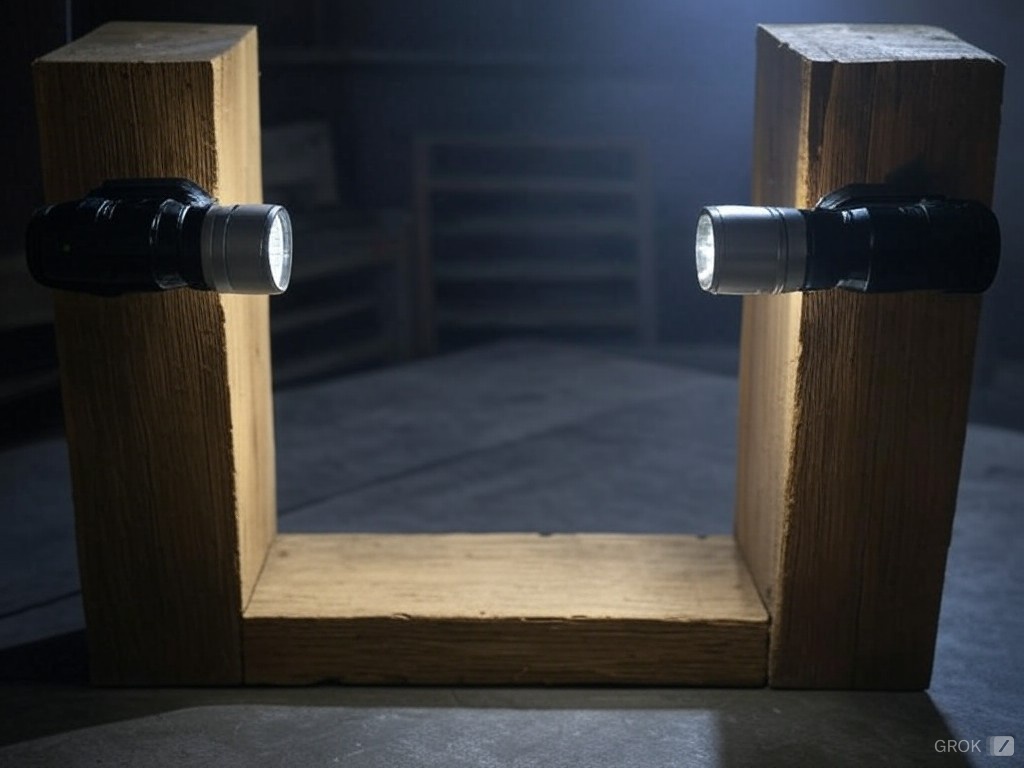
I posit that using the James Webb Space Telescope, we find a spot in the sky where there aren’t even any really, really old galaxies hanging out.  There’s nothing along that line of sight.  I then take two flashlights (or “lasers” if anyone insists) and using a protractor and some really straight two by fours I line them up parallel to each other in the direction of that cosmic empty spot and turn them on.  Why wouldn’t those two beams continue on to the end of the universe exactly the same distance apart?  Now, sure, a few photons here and there might be deflected by a some randomly situated gas molecules or by the odd quantum vacuum quark that appeared for a femtosecond along the line of sight but for the most part the laser beams should continue on forever and ever, amen.

So, if that is the case.  What’s the problem with imagining empty space (mostly) with my two flashlight (or laser) beams going out and out and out forever?  And forever parallel.  After all there’s nothing close enough to really bend those light beams.  Now to prove this result there will need to be someone on the other end of the universe to do the measurement.  This presents something of a problem.  However, there may be a solution (well, a thought solution anyway).  It’s a well-known part of the Big Bang Theory that there should be equal amounts of matter and anti-matter in the universe.  But here we are with basically none to be found.  I theorize that at the end of the universe is the anti-matter we’ve been looking for (just like those ‘droids).  Granting this, then there should be an anti-matter me at the end of the universe.  Let’s call him anti-photog.  Now assuming he’s extremely long-lived (which anti-matter life forms always are) and that he thinks precisely as I do, he’ll be waiting for those two beams of light and he will measure the angle between the beams and find them to be parallel and thereby prove the Euclidean (or in his case anti-Euclidean nature of empty space.  Then he can send a return beam back in our direction (somehow) and we will have the answer.  Of course, the sun and probably the Milky Way Galaxy will have long ago been absorbed by the local super massive black hole and cosmic lichens will possibly be the only form of life remaining but that’s how science works sometimes.  You have to take the good with the bad.

So, Lobachevsky, Gauss, Riemann and all you other “non-Euclidean” geometricians (I’m looking at you A. D. Aleksandrov, A. N. Kolmogorov and M. A. Lavrent’ev!) shouldn’t put too much stock in all this curved space hand-waving.  Until the results of this wonderful research of mine are available, they should sit tight.  Estimates for the return trip signal are still being calculated but I’m sure it won’t be too bad.  I’ll be starting my crowdfunding page to buy the lasers and the two by fours very soon.  I’ve still got my third-grade protractor somewhere around here so I don’t need that.  I can’t wait to get started!

Update:

I asked an AI image generator to reproduce my thought experiment rig

It came up with this!

This may take a while.

Throwing Light on Dark Matter

I was rooting around on X and I saw a link to a review of a physics book, “Quantised Accelerations: From Anomalies to New Physics” by Michael McCulloch that Hans G. Schantz reviewed on his substack.  What caught my attention was that this book attempts to explain the observed higher velocity of stars on the outer edges of galaxies without resorting to “dark matter.”

I confess that the review describes concepts of quantum behavior that I am unqualified to evaluate but I liked the analogy of dark matter to the mythical existence of planet “Vulcan” to explain the perturbations of the planet Mercury that was required before relativity was proposed by Einstein.

It makes sense to me that before accepting that the majority of matter in the universe is indetectable it would make sense to probe a little deeper into all of the effects of the physical phenomena we’ve already confirmed.

This one is for those who enjoy contemplating the brain-twisting weirdness of the very large and the very small.

Guest Contributor – TomD – 13MAR2024 – Astrophysics Reconsidered

Tom | Flickr

TomD

Thought you’d like this quote from: https://www.yahoo.com/news/may-misunderstood-universe-nobel-prize-213014590.html

For a long time, scientists believed they understood how fast the universe is growing — but the more they learn, those theories seem to be expanding as fast as the universe itself.
Basically, the “Hubble constant” measures the speed at which the universe is expanding. The only problem? Different instruments keep providing different values for it, giving rise to what’s known as the “Hubble tension.”
It raises an interesting possibility: that, as Nobel Prize-winning physicist Adam Riess explains in a NASA blog, much of what we thought we knew about the universe may have been wrong.

No fooling!

Guest Contributor – TomD – 26FEB2024 – Cosmological Cannibalism

Tom | Flickr

TomD

Just stumbled on this, from Popular Mechanics:

A Theory Says Our Universe Keeps Expanding Because It’s Eating Baby UniversesDarren Orf
Mon, February 26, 2024 at 7:00 AM CST

Theory Says Our Universe Is Eating Baby Universes Javier Zaya

The cosmological constant, which explains how and why the universe is expanding, has been previously described by astrophysicists as “the worst prediction in the history of physics” due to its deviation from observations.

  • This has led astrophysicists to explore other avenues for explaining why the universe’s expansion is accelerating.
  • A new paper published in December of 2023 suggests a novel idea that our universe is absorbing baby universes—and was even absorbed itself in its early years.

The biggest mystery in the Standard Cosmological Model is dark energy—the stuff that is “presumably” the engine behind the acceleration of the universe and which makes up 65 to 70 percent of the entire universe. Dark energy forms the backbone of the idea of the “cosmological constant”—first conceived by Albert Einstein in his General Theory of Relativity to refute the conception that the universe was actually static and not expanding or contracting.
When researchers in the 1990s discovered that the universe was not only expanding, but accelerating in its expansion, Einstein’s “universal constant” (which he labeled lambda, or Λ) became surprisingly relevant again. When plugged into equations used to understand the growth of the universe after the Big Bang (known as the Friedmann equations), scientists arrived at the modern “cosmological constant.” However, there’s a couple problems—scientists have never actually observed dark energy (hence the “dark” moniker) and the cosmological constant is pretty lousy at explaining observed phenomena.
Because science abhors a epistemological vacuum, astrophysicists have instead explored other theories that could explain what’s happening in the universe. In one of those theories, published in the Journal of Cosmology and Astroparticle Physics in December of 2023, University of Copenhagen astrophysicist Jan Ambjørn and Yoshiyuki Watabiki at the Tokyo Institute of Technology explore a novel idea that doesn’t require the yet-undiscovered dark energy to explain the acceleration of the universe, and negates the need for a cosmological constant as well.

Instead, this new paper argues, our universe is actually swallowing up ‘baby universes’ as it expands.
“The main finding of our work is that the accelerated expansion of our universe, caused by the mysterious dark energy, might have a simple intuitive explanation,” Ambjørn tells LiveScience, “the merging with so-called baby universes, and that a model for this might fit the data better than the standard cosmological model.”
The idea is deceptively simple—as our universe grows, it absorbs other universes in its path, thereby “accelerating” its boundaries. Perceived by our telescopes, this would look like an increased acceleration of universal expansion. When Ambjørn and Watabiki ran the calculations for this ‘baby universe’ theory, the calculations fit more closely with real-life observations than those using the Standard Cosmological Model, the researchers claim.
The paper also attempts to answer another mystery of the early universe called “cosmological inflation,” wherein the early universe rapidly expanded for some unknown reason. A current theory suggests that a hypothetical field, called the “inflation field,” drove this expansion, but this new paper suggests another mechanism could have been at work.
“The fact that the universe has expanded…in a very short time, invites the suggestion that this expansion was caused by a collision with a larger universe, i.e. that it was really our Universe which was absorbed in another ‘parent’ universe,” the paper reads. “It is difficult to judge if such a scenario could take place in a way that would actually solve the problems inflation was designed to solve, but one interesting aspect of such a scenario is that there is no need for an inflation field.”
This isn’t the only theory that boldly eschews the need for a cosmological constant. In July of 2023, another paper argued that the expansion of the universe could simply be a mirage caused by the evolution of electrons and protons over immensely long time scales.
For now, no alternative theory has dethroned dark energy and the cosmological constant as the best explanation of the universal acceleration. But it’s always important to keep a cautiously open mind—especially in science as cutting-edge as universal expansion. Sometimes interesting and helpful ideas can come from very odd place. Never say never.

Getting Rid of Dark Energy and Dark Matter

A theory has been proposed that allagedly explains the missing cosmological dark energy and dark matter by instead invoking the non-conservation of energy associated with the so-called expanision of the universe.  Some physicist in Russia named H. R. Fazlollahi has written a paper that outlines his idea on how this non-conservation would account for the missing energy.

Now, my tensor calculus is more than a little bit rusty (in point of fact, it’s extinct) so I won’t pretend to know what the details of his math show.  Instead I’ll fall back on my contempt for scientists that invent a universe where 90% of the mass and energy are invisible and indetectable in order to explain the data they observe.

So two cheers for Fazlollahi and here’s hoping that some of the brighter lights in the physics community start to look a these discrepancies with a more discerning eye.  Either that or let them go find jobs in something they’re more qualified to do like delivering the mail.

G-Block Superactinide Bling

Since Valentine’s Day is coming up I told Camera Girl to be on the lookout for any man jewelry she could get for me made of unbihexium

Unbihexium is a hypothetical stable super heavy element with an atomic number of 126.  Now granted it’s never been detected anywhere either naturally or at CERN but a good wife should always use her shopping acumen to assist all of her husband’s purchasing goals.  So I’ve told her to be on the lookout for a star sapphire mounted in a pinky ring of unbihexium.  And I told her it wouldn’t hurt if there was a spiral galaxy at the center of the star.  Hey we all can dream right?

Unbihexium is supposed to exist at the magic number for stable super heavy elements.  Apparently some astrophysicists are theorizing that the existence of very heavy elements in second generation stars points to the existence of super heavy elements being produced in some kind of ultra-ultra super duper supernova events that would be needed to produce these elements.

I know, I know I should be talking about Iowa or Joe Biden but as you know I’m trying to put off suicide for the foreseeable future.  So, unbihexium!