I was reading a chapter in a mathematical survey that I bought a long time ago (Mathematics: Its Content, Methods and Meaning by A. D. Aleksandrov, A. N. Kolmogorov, M. A. Lavrent’ev). It was a section in the non-Euclidean Geometry chapter called something like “Real Space.”
The author was trying to make the point that since gravity bends light and light rays were the closest thing to perfect straight lines that you could claim that parallel lines can intersect and triangles can have more or less than 180 degrees in real space. And to get away from the idea of straight lines in empty space (no matter present) he said that the concept of space only exists in the context of it containing matter.
And I stopped to think whether that seemed to follow. I never usually question the meaning of empty. My basic visualization of reality is that the universe is the void of the Bible augmented by really small golf balls bouncing around in it. Empty space to me is wherever there aren’t any golf balls at that moment. Now granted, I’ve heard that particles are always appearing into and disappearing out of existence in the “quantum vacuum.” And I know that many physicists characterize the universe as just a bunch of “fields” of the various elementary particles; the electron field and the Higgs field, etc. But I don’t understand why we can’t imagine empty space. I mean I know that at any time a quark or a gluon or some other ephemeral exotic particle can show up anywhere but why is it so hard to say. “Right now, right here is empty space because nothing is there.”
I guess I’ll have to read more deeply. After all, if the empty space between galaxies (and everything else) is always and ever more rapidly expanding as the universe itself inflates at an accelerating rate, it seems logical to me that there’s more and more “empty space” everywhere.
And so, I propose the following thought experiment:
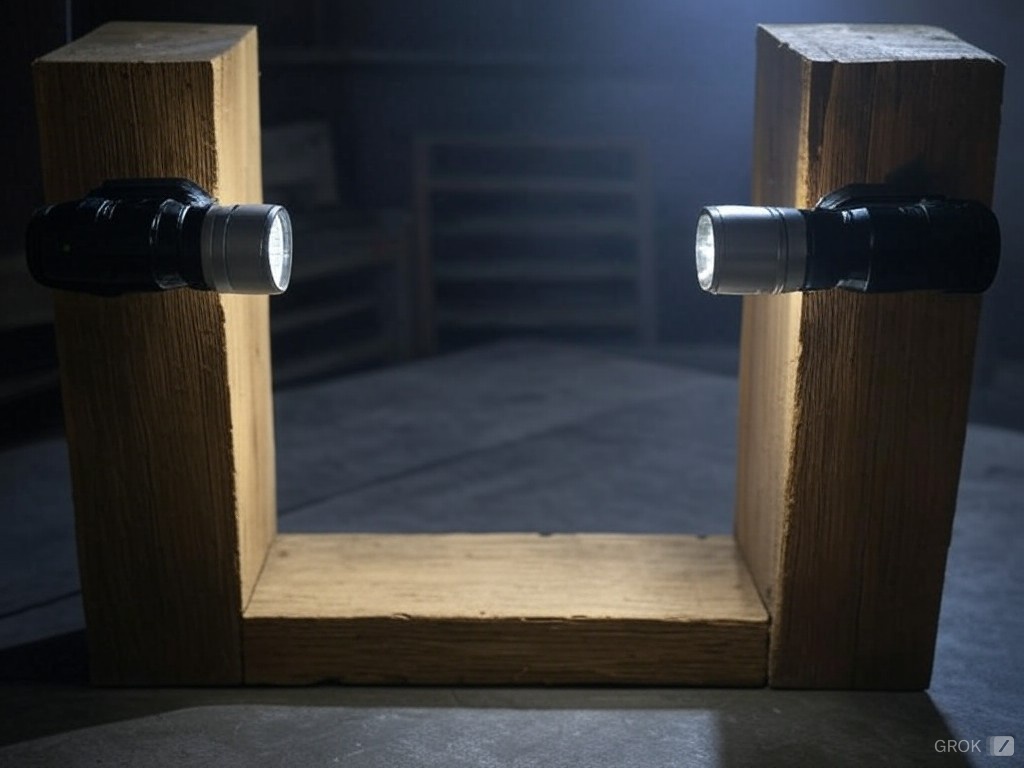
I posit that using the James Webb Space Telescope, we find a spot in the sky where there aren’t even any really, really old galaxies hanging out. There’s nothing along that line of sight. I then take two flashlights (or “lasers” if anyone insists) and using a protractor and some really straight two by fours I line them up parallel to each other in the direction of that cosmic empty spot and turn them on. Why wouldn’t those two beams continue on to the end of the universe exactly the same distance apart? Now, sure, a few photons here and there might be deflected by a some randomly situated gas molecules or by the odd quantum vacuum quark that appeared for a femtosecond along the line of sight but for the most part the laser beams should continue on forever and ever, amen.
So, if that is the case. What’s the problem with imagining empty space (mostly) with my two flashlight (or laser) beams going out and out and out forever? And forever parallel. After all there’s nothing close enough to really bend those light beams. Now to prove this result there will need to be someone on the other end of the universe to do the measurement. This presents something of a problem. However, there may be a solution (well, a thought solution anyway). It’s a well-known part of the Big Bang Theory that there should be equal amounts of matter and anti-matter in the universe. But here we are with basically none to be found. I theorize that at the end of the universe is the anti-matter we’ve been looking for (just like those ‘droids). Granting this, then there should be an anti-matter me at the end of the universe. Let’s call him anti-photog. Now assuming he’s extremely long-lived (which anti-matter life forms always are) and that he thinks precisely as I do, he’ll be waiting for those two beams of light and he will measure the angle between the beams and find them to be parallel and thereby prove the Euclidean (or in his case anti-Euclidean nature of empty space. Then he can send a return beam back in our direction (somehow) and we will have the answer. Of course, the sun and probably the Milky Way Galaxy will have long ago been absorbed by the local super massive black hole and cosmic lichens will possibly be the only form of life remaining but that’s how science works sometimes. You have to take the good with the bad.
So, Lobachevsky, Gauss, Riemann and all you other “non-Euclidean” geometricians (I’m looking at you A. D. Aleksandrov, A. N. Kolmogorov and M. A. Lavrent’ev!) shouldn’t put too much stock in all this curved space hand-waving. Until the results of this wonderful research of mine are available, they should sit tight. Estimates for the return trip signal are still being calculated but I’m sure it won’t be too bad. I’ll be starting my crowdfunding page to buy the lasers and the two by fours very soon. I’ve still got my third-grade protractor somewhere around here so I don’t need that. I can’t wait to get started!
Update:
I asked an AI image generator to reproduce my thought experiment rig
It came up with this!
This may take a while.