Books and Bugs

So, today’s post is about nothing.  I’m involved in a bunch of random things right now.  I’m reading two novels.  I’ve got Jim Butcher’s latest Harry Dresden book “Twelve Months” and I’m also reading a very old book called “Buddenbrooks” by the German author Thomas Mann.  And you couldn’t hope to find two more completely different stories if you tried.  But I have an interest in reading both.  But the Dresden book flies by while Mann’s description of the 19th century events in the lives of the merchant family Buddenbrook is a task that I peck away at a few pages at a sitting.  The translator saw fit to preserve the large chunks of French that Mann incorporated in the speech of some of his characters.  And the religiosity and the local customs of Northern Germany are curiosities for a modern American reader.

I’m also involved in a microscopic inspection of the flora in the fields.  I mentioned in an earlier post that I couldn’t find any preying mantis egg sacs in the yard this year and assumed that the mantids that I introduced into the yard in the last couple of years weren’t capable of surviving New England winters.  Well, either that isn’t correct or the native populations are making their appearance this year.  In two different areas of the yard on two different species of flowering plants (cone flowers and day lilies) I found the specimens photographed below.
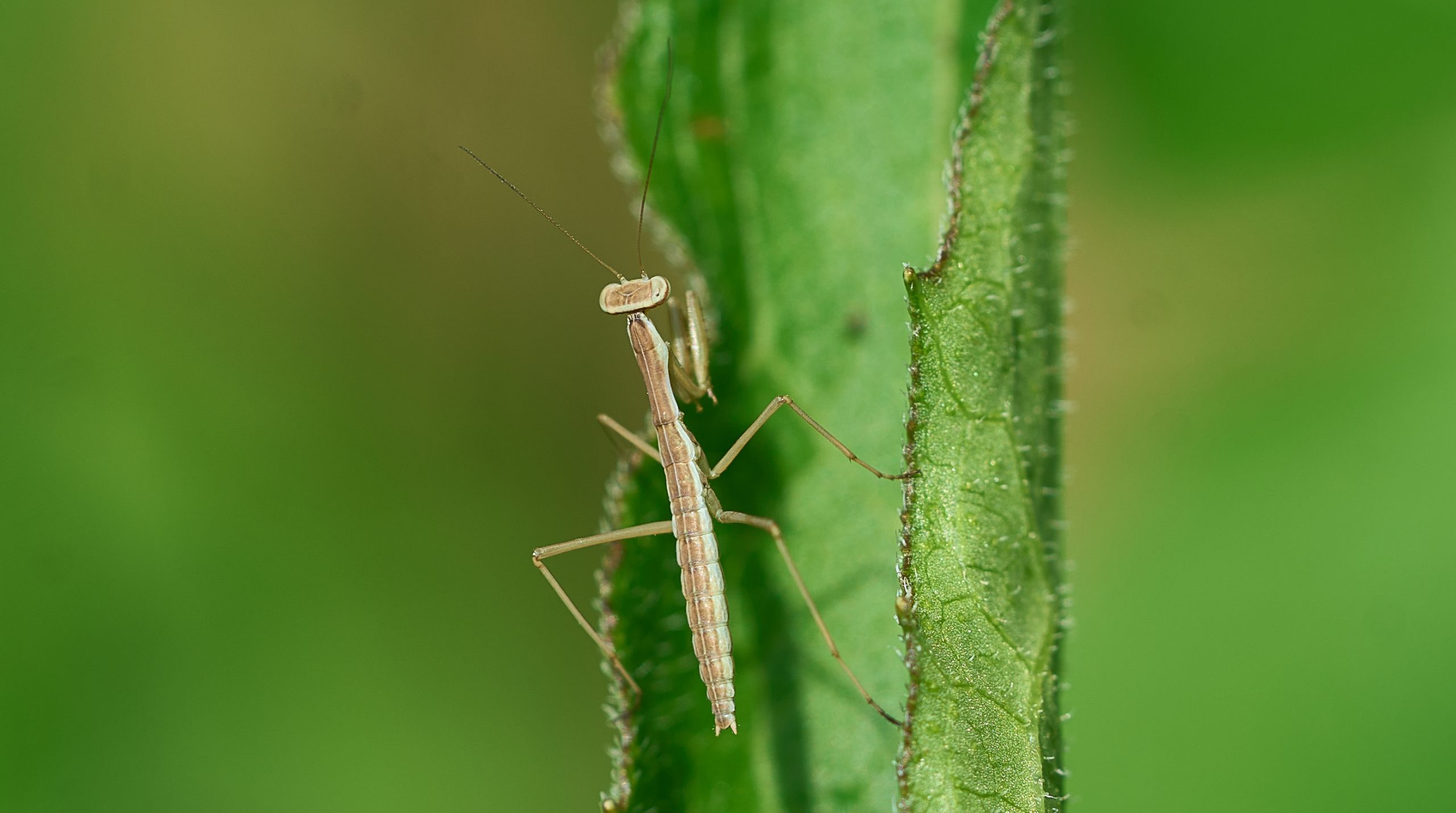
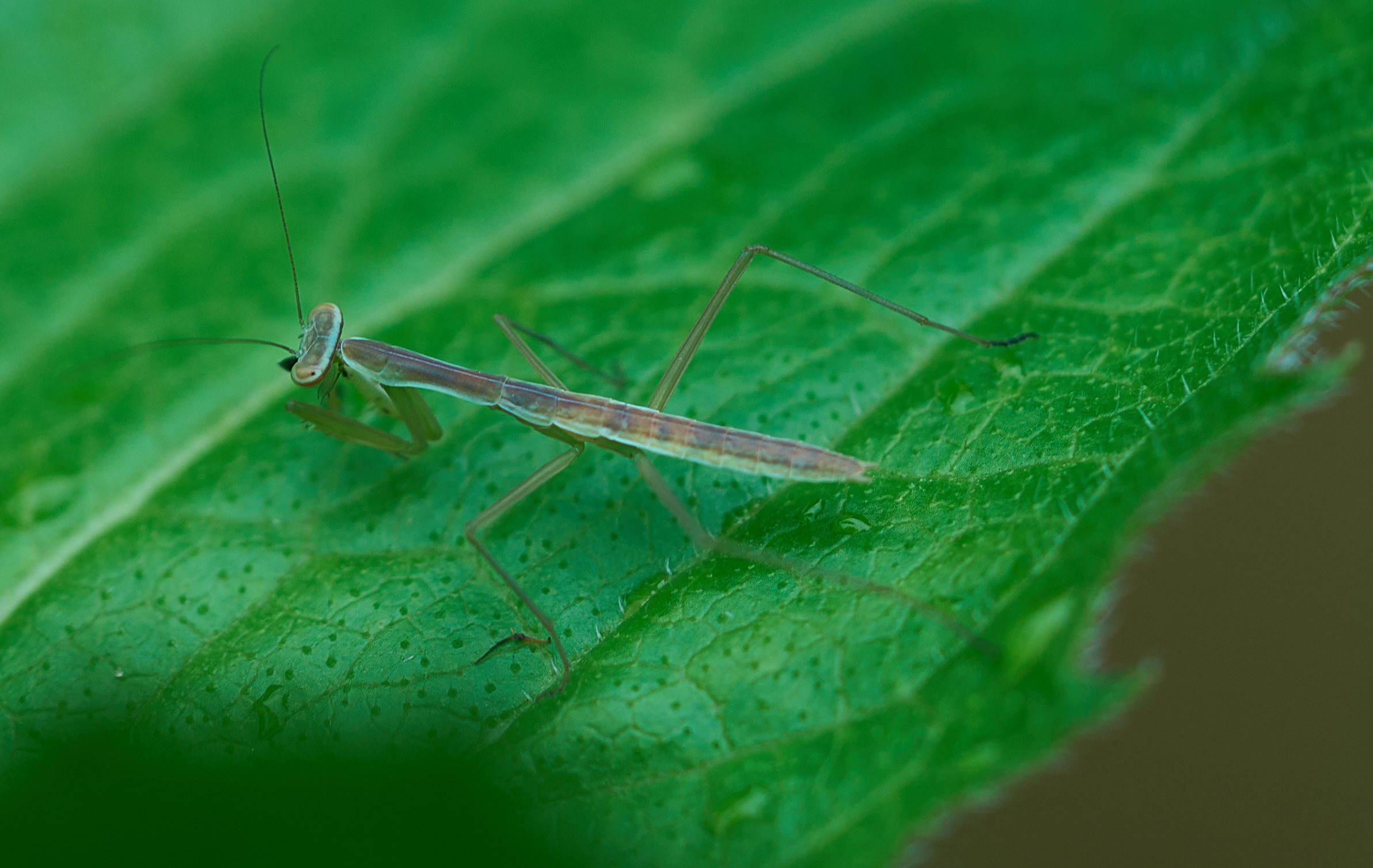
Now, these critters are infinitesimally small.  And considering my old eyes, I’m shocked I found then at all.  And as things stand now, I haven’t been able to locate them again on the plants where I originally spotted them.  But this doesn’t discourage me.  After following some of the mantids around the fields last year I know that they get around and move quite a lot to find the diet of tiny bugs they need to fuel their substantial growth potential.

And I don’t mind saying that finding these little monsters cheered me up considerably.  I really do enjoy hunting them around the fields and watching them go about their work of stalking, killing and eating tiny flies and other arthropods.  Their skill is considerable and their appetites remarkable for something so small.

And the other thing keeping me busy is preparation for an upcoming birthday party for one of the grandchildren.  I found out that the propane cylinder I was trying to get refilled was too old.  Apparently after five years it’s considered unsafe and has to be recertified for use.  So, the Tractor Supply folks sold me a new twenty-pound cylinder for eighty bucks and now I have both.  I wonder how much they’ll charge me to “recertify” the old one?  I’m guessing something like eighty bucks.  After all, we’ve got to do whatever we can to discourage the use of evil hydrocarbons!  But it’s fine.  The burgers and dogs will still taste just as good cooked by the new propane.

Well, that’s enough for now.  I’m watching my Amazon account today.  I sold 613 pages of “The Sniper” on Kindle Unlimited today.  That’s almost three books worth and that is pretty good for my sales output so I want to see if it increases before I go to bed.

Life over Art

Thomas Mann was a famous German author whose heyday was the first half of the twentieth century.  He had a Nobel Prize in literature for one of his novels and a reputation for writing psychological stories that were full of melancholy and longing for lost happiness.

In addition to his novels which were too long for my liking he wrote a handful of novellas that were collected in an English translation under the title “Death in Venice and Seven Other Stories.”  One of these stories is named “Tristan” and is the story of a sanitarium up in the Alps that especially treated people suffering from tuberculosis which is never actually named in the story but only hinted at when a patient would cough and then check a handkerchief for blood.  But in addition to the actual patients at this sanitarium called Einfried there was one resident who stayed there for the atmosphere; a “novelist” named Detlev Spinell.  And novelist would be an exaggeration.  No one has ever read his book and even letter-writing is an enormously slow and painful exercise when performed by him.  In the story, this writer is the cause of the death of a woman who is attempting to recover from a mild case of tuberculosis which is several times emphatically stated to be only affecting “the trachea, and not the lungs, thank God.”  He is a malevolent force that insinuates into the young woman’s mind that she is the victim of a crass, plebian existence that sacrificed her health and artistic spirit at the altar of mundane human activities, specifically; marriage and childbirth which was the event that sapped her strength and weakened her body sufficiently to allow the wasting disease to get the upper hand with her.

And this unhealthy influence by Spinell eventually causes her health to completely break down.  And so, the doctors call for her husband to return to the sanitarium before her incipient death.  And while this catastrophe is occurring Spinell takes it upon himself to write a letter to this husband who at this point is occupying a room in the same building.  He painstakingly writes the letter, mails it, smiles at the husband in the hallways when they meet and gives no thought to what will happen when the letter returns from the post office to the building that they both reside in.  The letter is an insulting and disparaging polemic attacking the husband for his “plebian” tastes and lack of artistic feeling.  And he announces that he has awakened the wife to her true spiritual stature and thereby causes her to renounce her allegiance to ordinary life (and by that choice, life itself).

Now all of this is quite bizarre but Mann paints the personalities of husband, wife and Spinell very skillfully.  And this allows the personalities and their relationships to each other to make sense.  The husband is a very plain and “normal” individual.  A businessman who embraces the life of a husband and father along with his hard charging life as a capitalist.  He loves his wife and child but he isn’t above pinching a maid in a hallway when the opportunity arises.  The wife loves her husband and child but she has the artistic side to her personality and she can be influenced into believing that the prosaic life of a housewife and mother is a demeaning occupation for someone as sensitive and with such an elevated soul as herself.  And then there is Spinell.  He is an abnormal spirit of the “artistic” type who sees life through a prism that only values the spiritual and pure emotions and sensibilities of the artist.  All ordinary things like the normal male/female relations are fraught with unacceptable amounts of inartistic reality.  Thus, his hatred of the husband in the story and his beatification of the wife.

The climax of the story, to my mind is the collision when the husband reads the letter and confronts Spinell down the hall from him.  He reads parts of the letter to the author and then rains verbal abuse on the head of his frightened and contrite adversary.  But just as his screaming abuse reaches its crescendo, from out in the hall, comes news that his wife’s lungs have collapsed under the ravages of her ailment, causing her to cough up an enormous quantity of blood and that she is on the edge of death.  The husband shifts his focus onto the bearer of bad news:

‘“Is she dead?” yelled Herr Klaterjahn.  As he spoke he clutched the Rätin by the arm and pulled her to and fro on the sill.  “Not quite?  Not dead; she can see me, can’t she?  Brought up a little blood again, from the lung eh?  Yes, I give in, it may be from the lung.  Gabriele!”  he suddenly cried out, and his eyes filled with tears; you could see what a burst of good, warm, honest human feeling came over him.  “Yes, I’m coming.”  He said and dragged the Rätin after him…’

Mann shows us the reality of life and compares it to the shadow of life that Spinell hides in.  He uses art to hide from life.  As for the husband, who really was a crass, plebian individual full of crass plebian faults, he is also a living, breathing human being.  Spinell is a wraith.  His artistic sensibilities and motives are pathetic and infantile.  Now this is coming from Thomas Mann who embraced art as the central motive of his life.  What I find interesting is that he so clearly shows us the primacy of life over art.  I find that powerful.

A photog and His Corner

Old people and literary types will have heard of Thomas Mann.  He was a German author born in 1875.  He won the Nobel Prize in literature in the 1920s and he belonged to the Modernist school.  Back in the 1970s if you had a high school English teacher who was especially perverse he would assign a book of Mann’s called “Death in Venice and Other Stories.”  Now the title story “Death in Venice,” is vile.  It’s the story of an old German writer who has a premonition of death and goes to Venice to feel young again.  He has an infatuation verging on pedophilia for an adolescent boy that mercifully goes unfulfilled and then to the reader’s great relief the protagonist dies.  The only legitimate reason to read this story is for law enforcement profilers to gain a better understanding of pedophile motivation.

One of the other stories in the book is called “A Man and His Dog.”  It is autobiographical and describes Mann’s life in a suburban/rural area of Germany.  He chronicles the walks he takes with his approximately German Shorthaired Pointer dog Bashan.  We hear about the landscape, the flora and fauna and the farmland occupants of his little world.  It is without a doubt, the best thing in the story collection and I’ve always envied his opportunity to share a slice of his world and life in such a congenial narrative.  It really is a pleasure to read.

So, even though I keep German Short Haired Pointers, I can’t do what Mann did.  I don’t have his facility for felicitous phrasing.  But I’m a lot funnier than he was.  So, from time to time, I’ll address things in a post that have very little to do with politics, photography or science fiction.  When that happens, I’ll assign them to the category “photog’s Corner” and that will be a warning sign of irrelevance to the primary foci of this blog.  Caveat emptor.


photog