FE 100mm f2.8 MACRO GM Lens – Damn You Sony!

Just when I think I’m immune to lens lust Sony drags me back in!

Alright, this is not an in-depth review because this lens hasn’t even reached the stores yet.  It come out in early November.  But it has already destabilized my photographic equilibrium with its compelling mixture of desirable features and the stellar reviews the experts are giving it.

So just to put my own spin on it, here are the features I find most exciting.

  1. Fast autofocus.  Okay, probably not blazingly fast because no macro lens can be.  There’s just too much focus racking needed in a macro lens for that.  But its four XD Linear AF motors make it orders of magnitude faster than my current Sony 90mm f2.8 macro.
  2. 1.4X magnification.  That compares with the 90mm and its standard 1.0X magnification.  This is a big deal.  Filling the frame with your subject is what makes for better macro shots.
  3. The reviewers stressed that the Optical Steady Shot (OSS) system actually did seem to work very well on macro shots.  That’s always been a sore point for me with the 90mm lens.  There’s nothing steady about the image unless I’m on at least a monopod.  If this pans out it will be a major upgrade to my macro experience.
  4. The reviewers also stressed that the images when using a 1.4X or 2X teleconverter were still very good which if true means that 2X and 2.8X magnification would be achievable.  I’m most skeptical of this claim.  Whenever I’ve used Sony teleconverters I’ve always noticed a very significant image quality degradation (especially with the 2X unit).  If this turns out to be true it would be a very nice benefit.

Okay enough hyperventilating.  So let’s give some of the bad news.  It’s fifteen hundred bucks!  And I’ve checked the resale value of my 90mm lens ($450).  So I’d be forking over an extra grand or so.  Gack!!!!

Oh, the pain, the pain.  Well, Christmas is coming up.  And I do have some rarely used lenses hanging around maybe I could shrink that grand down to five hundred bucks.

It’s funny just a few months ago I think I was saying how glad I was that I no longer obsessed about camera gear and lenses in particular.  Sure I’m always interested in descriptions of the new odd-ball super-macros that the various Chinese lens manufacturers seem to create constantly.  But I’m never too excited because these lenses tend to be not of the highest quality.

But here Sony has dropped this thing in my lap with basically everything I wanted except a 200mm focal length (and that would be compensated for if it actually does work as well as they claim it does with a 2X teleconverter).  And here I am with my mouth hanging open, desperate to get my hands on this piece of photo kit.  They truly are evil geniuses sitting there in Tokyo (or wherever the hell their corporate headquarters is in Japan) and saying, “Now we’ve got photog right where we want him.”

And they do.  Damn them!!!


Cruel Aesop

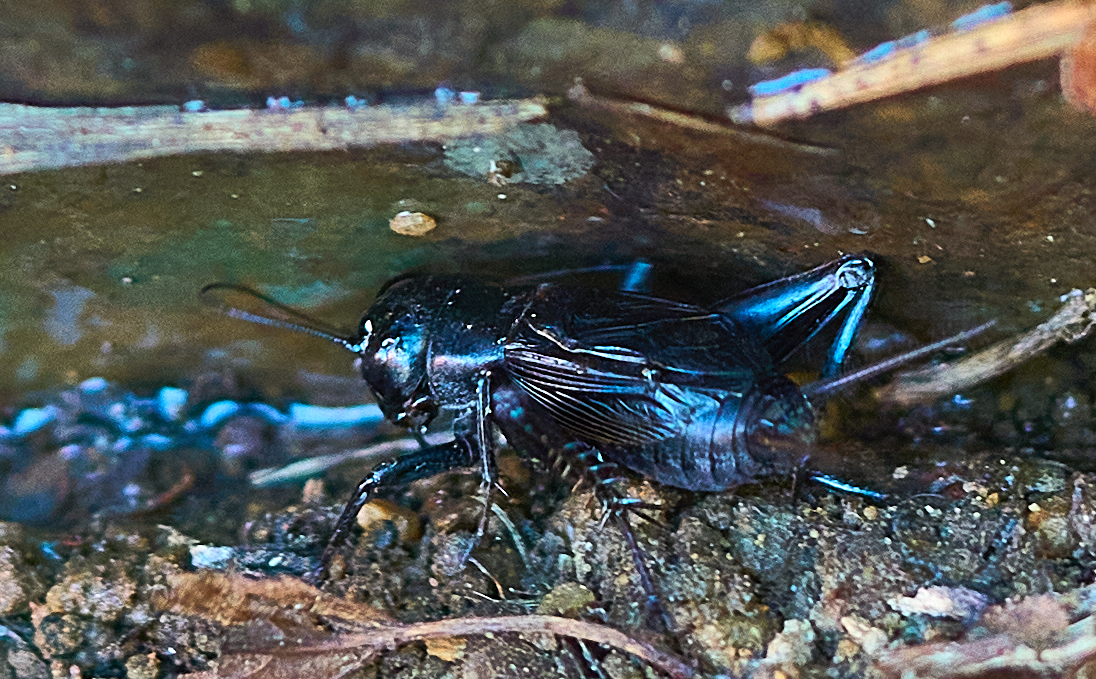
The last two weeks have been unseasonably warm here in Dunwich.  And believe me I’m not complaining.  Summer-like days and mild nights is wonderful.  Not to mention I must be saving money on heating oil.  And it means we can enjoy the summer activities a little longer.  For instance, the raspberry bushes are still producing fruit.  Not as many as last month but enough to enjoy a treat from time to time.  And I can still go out and take some macro shots of insects and the few flowers that haven’t completely died.  In fact, the wolfbane is about to bloom in the next week or so.  And every night when I bring the dogs out for their final walk, I can hear the crickets chirping away.

And there is an enormous number of them because the sound is everywhere and it is fairly loud.  But at the same time, it has a different sound in the fall.  This is based on the air temperature.  The lower temperature means the sound will be lower pitched and slower.  It’s almost like a power hum that has fallen an octave.

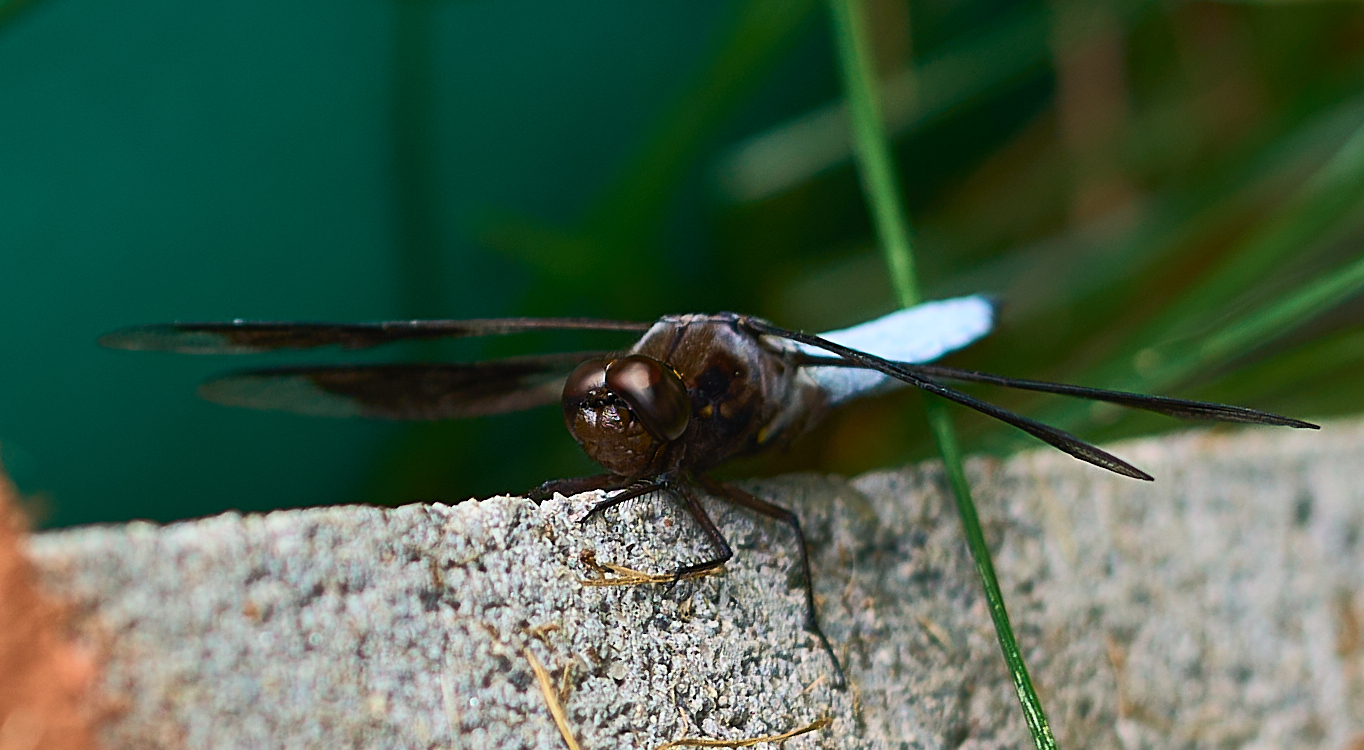
And to my subjective ears it sounds sad and confused.  It’s as if the crickets don’t understand that they are preparing to die.  Unlike Rutger Hauer’s character in “Bladerunner;” Roy Batty, they don’t realize “it’s time to die.”  And that’s exactly the vibe I get when I see the last of the dragonflies moving around the fields.  They’re confused and slowing down and it’s as if their programming is failing.  It doesn’t cover the case where the weather stays warm after they’re supposed to have died from freezing.

It’s also the case of the preying mantises.  They’re still walking around the gardens trying to find food or mates but they’re running out of steam.  Their eyes are already dark and they’re going through the motions but they’re already the walking dead.  Even if I handed them food, I doubt they could eat it.

The only insects that haven’t succumbed to seasonal despair are the honey bees.  They still go around visiting the last living flowers gathering pollen and nectar to bring back to the hive.  And that’s because they have a future and a plan.  They’re filling up the remaining cells in their combs with food to keep the hive going right through winter and into spring.  Their program hasn’t run out.

Now, I am aware that this is just my emotional response to the realities of insect life and its relationship to seasonal variation.  Evolution has crafted the life cycle of most insects in the non-tropical regions to include the death of adults in late fall.  This is the result of millions of years of evolution and it’s a fact of life.  But humans are affected by these facts and have speculated about them going all the way back to Aesop in ancient Greece.  He talked about the ant and the grasshopper that brings up the same exact dichotomy that I see between the honey bee and the cricket.

And humans anthropomorphize these creatures making the ant a hard-working and thrifty fellow and the grasshopper a lazy, hedonistic good-for-nothing.  Well, Aesop was preaching.  While I find the cricket and even the dragonfly sad figures.  After all, don’t we all eventually find our lives winding down?  And even if it is the circle of life, it has a certain tragic aspect.  Well, just a bittersweet reflection on the beautiful Indian Summer that we’ve been gifted with this year.

Can It Happen Here?

Do you ever get the sense that human civilization is a juggernaut that basically has no one steering?  Our activities have become this unstoppable force that tramples anything that gets in its way but basically has no idea where it’s headed.  Now there are lots of people and their leaders who try to direct things but most of them seem to be idiots or so completely selfish that they only recognize their own priorities or even if they seem to exhibit some altruism, they’re completely mistaken in their beliefs about what are the important problems or at least what are the right things to do about them.

And now that humanity has increased to more than eight billion souls and with our capabilities to destroy enormous numbers of people with weapons of mass destruction, we seem to be constantly on the brink of blowing the whole furiously spinning human enterprise to smithereens.

I am aware that this is hardly anything new.  Going back to 1945 and Hiroshima we have been living in the shadow of Armageddon now for eighty years.  And going back to 1914 we have for well over a century been living in the seeming collapse of European Renaissance civilization.  But it does seem to have reached a breaking point.  With the current trends we have seen concerning population decline and apparent rampant psychiatric collapse of a sizable percentage of young people we must be reaching the point where either someone or some group rallies a core of people to step back from the brink of collapse or this whole civilization will break down into a dark age; something like what happened during the so-called late bronze age collapse.

In general, it looks like there needs to be a sanity check on what we value.  The current social media environment is so dysfunctional that if someone proposed destroying the internet he might become the next prophet; whether you want to compare him to Mohammed or Martin Luther.  But whatever the solutions that are selected there is no doubt at all that our present trajectory is disastrous.  And I have named religious reformers because it is obvious that the primary problem is not economic or technological.  It is spiritual, or if you prefer, psychological.  We have allowed nihilistic concepts and other harmful ideas to percolate into young minds through teachers who shouldn’t be allowed to interact with children.  And it’s having dire effects.  For this reason, it will require a reset of what we teach children.  I’ve begun to hear that some states and localities are purging the trans-gender subject matter and teachers from their schools.  But it’s going to take a much more systematic approach to get a handle on this poisonous influence on children.  And I fear that places like California it’s already too late to fix.  People will have to flee to save their kids.

The real question in my mind is, “Is it too late?”  At a certain point if a society can no longer provide the basic services and protections for its people, they will flee in search of a refuge.  It happened in the bronze age Eastern Mediterranean.  Can it happen here?  I think so.