Edge of Tomorrow (2014) – A Science Fiction Movie Review

This is a time loop movie.  It’s Groundhog Day crossed with Starship Troopers.

(Spoiler Alert – Skip down to last paragraph to avoid spoilers and read recommendation)

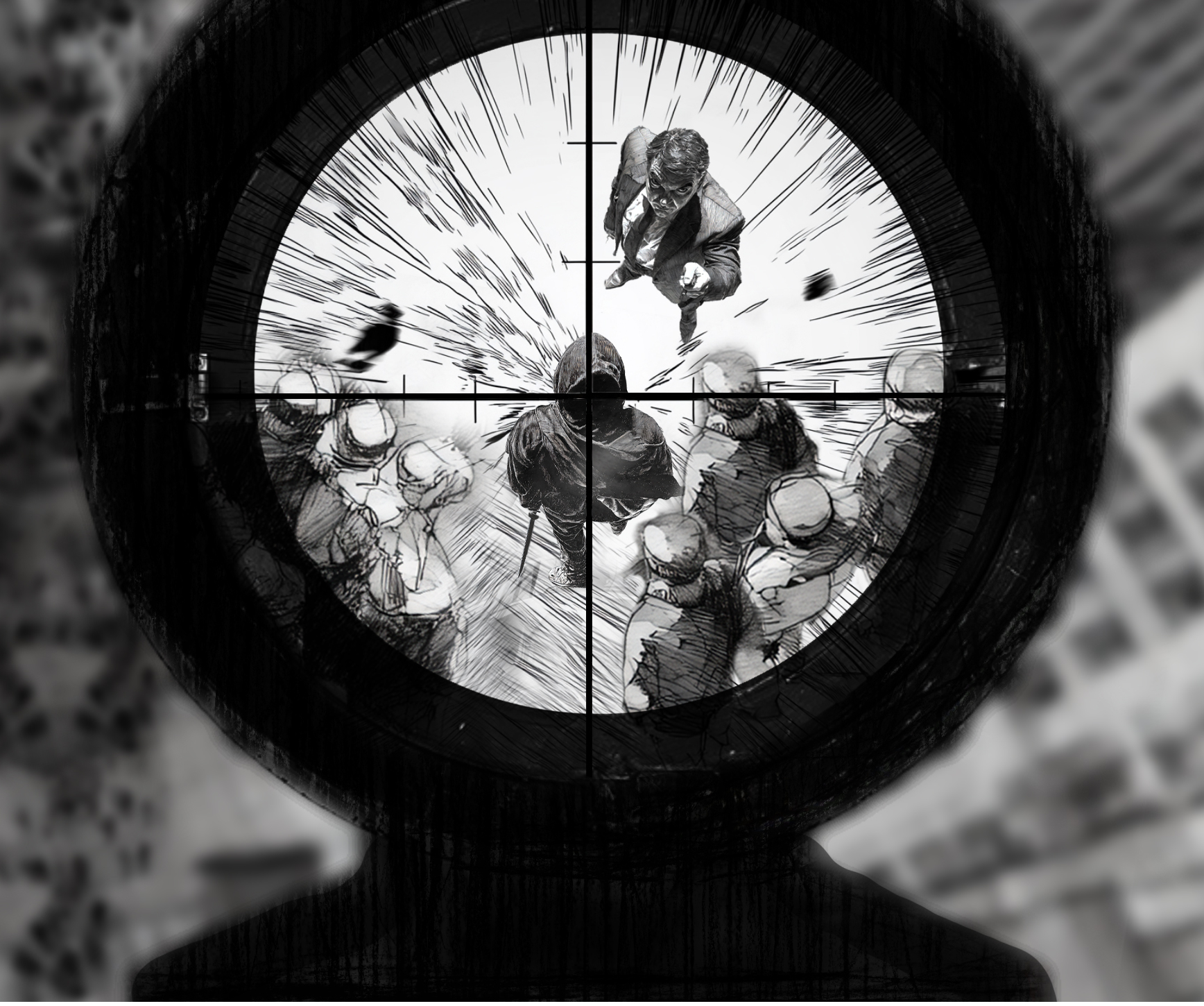
Tom Cruise is Major William Cage.  He’s the US Army’s public relations man during a war against aliens called the mimics who have conquered mainland Europe and are about to be counter-attacked by humanity’s attempt at D-Day from a London staging area.  But instead of staying behind in an office to edit commercials his superiors have loaned him out to the Brits as a warrior.  He tries to desert but is handcuffed and handed over to Master Sargeant Farell (played by Bill Paxton) and put into powered body armor and dropped into battle in France.  And of course, since he’s not a real soldier, he’s killed in the first few minutes of the horrific battle.  But right before he dies, he manages to kill a special mimic called an “alpha.”  And because some of the alpha’s blood gets on him, he ends up in a time loop that always brings him back to the same day of the battle.  And as long as he’s always killed he’ll come back again.

And from starting out as a hopelessly incompetent soldier, by virtue of getting to endlessly re-live and re-die on that day, he becomes adept at fighting mimics.  During one of these replays, he meets Sergeant Rita Vrataski (played by Emily Blunt) and just before she dies, she tells him to find her the next time he wakes up.  In other words, she has had the same time loop ability.  Through endless additional replays, Cage and Vrataski figure out that the mimics are aware of all the humans’ plans and fighting them is futile.  But if Cage is exposed to a device that was made to read the mind of alphas he will discover where the head mimic (the omega) is hiding.  But in the effort Cage loses his ability to reset time and come back to life.

And so, there is a kamikaze mission with Cage, Vrataski and some comrades to storm the Louvre where the monster hides.  As it works out everyone but Cage is killed and he is mortally wounded just as he blows up the omega.  But somehow killing the omega (I think) resets his looping ability and he wakes up with all of them alive but the omega destroyed and the mimics basically defeated.

Alright, so what about all this.  This is a pretty good sci-fi war movie.  The special effects are good.  The acting is good and the plot is pretty well worked out.  And even Emily Blunt’s Rita Vrataski character isn’t a complete girl-boss super hero.  She is annoying from time to time but not hopelessly.  Cruise carries the movie with a decent amount of character acting from his “comrades” and with even a little humor thrown in to lighten the mood.  The endless live/die repetition is handled very well for most of the movie with only a couple of spots where they seemed to over do it.  I will say that in the final assault the image on the screen is sort of too dark and hard to really understand.  It’s at night in an underground vault and under water so maybe that’s realistic but it feels confusing and unhelpful to the viewer.  All in all, I recommend this movie to fans of sci-fi action movies.  It’s pretty good.

Refocusing Science Fiction – Part 2

What if you wanted to write a science fiction story about genetic engineering?  Now a good example of that is Michael Crichton’s “Jurassic Park.”  Here we have geneticists mining dinosaur DNA from mosquitos trapped in amber from the Cretaceous period.  And presto-change-o we’ve got tyrannosaurs and ceratopsians running around after Jeff Goldblum while he’s running around after Laura Dern.  Isn’t that marvelous.  And sure, it is if you’re selling books or movie tickets.  But there are a few hitches.

As far as I know there has never been any DNA that has lasted tens of millions of years.  Ever.  So, no Jurassic Park.  But suppose you wanted to write a story about genetic engineering.  And suppose you wanted to write it about genetic manipulation of humans.  Now you’re talking about science that’s completely possible.

With the advent of techniques like CRISPR (acronym for clustered regularly interspaced short palindromic repeats) it has become relatively easy to delete and replace DNA sequences in living cells including germ cells (sperm or egg cells or in the zygote following fertilization).  This is reality not science fiction.  But what could happen if this technology became widely used is still science fiction, so far.  A Chinese scientist named He Jiankui in November 2018 announced that he had created the first human germline genetically edited babies.  I think he was sent to prison for the act.

But the point is this is not Jurassic Park.  This is technology that exists.  And therefore, science fiction can be written about the kinds of worlds that would result if we used this technology.  It could be utopian or dystopian or it could be very complicated and involve people’s lives being changed in ways that are neither of the extremes.  What if these edited babies live much longer than normal humans?  That would create certain problems.  Or what if they’re all super geniuses and can’t relate to normal people and their normal hopes and dreams?  Either of these scenarios can have consequences that would make interesting stories.  Because fundamentally, the interesting thing about science fiction stories isn’t the science but rather its effect on human beings.  If scientists bring back dinosaurs but they don’t run amok trying to eat Jeff Goldblum (which really would be fun to watch) no one would care.  If the sun explodes but humanity has been extinct for a billion years then no one reading the story would care.  The stories are about us and that’s the thing that the writer has to make you understand.

So, I’d really like to read some stories about things that could really happen and maybe even will happen.  Maybe a good story would be about someone trying to figure out how to use artificial intelligence to eliminate violent crime or find a way to make democracy work to most people’s satisfaction.  There are an endless supply of technological problems and scenarios that already are possible and just need someone to expend a little brain power to make entertaining.  And I’m guessing in the not-too-distant future a writer with a bit of skill and a little imagination will write at least one good one.

Refocusing Science Fiction – Part 1

I guess strictly speaking, science fiction starts with Jules Verne and evolved into H G Wells and then expanded into a plethora of subgenres that include every imaginable kind of story that involves “science” in some aspect of the story.  And the types are endless and the mixing of the types with each other make the number of different subtypes equal to the cardinality of the continuum (a very big number they say).  You have space travel, time travel, dimensional travel, multi-verse reality.  There’s solar system colonization (with and without terraforming), interstellar exploration with and without colonization), there’s first contact with different alien species, there’s interplanetary war, interstellar war, there’s the human galactic empire, there are galactic civilizations made up of many species.  There are stories about the origins of the human race that involve older races either creating it or influencing it (with or without monoliths and xenomorphs).  We have futures that include artificial intelligence as our servant or as our master or locked in a mortal combat with us.  There are stories about our future that involve evolution either natural or induced that change us in any number of ways; physically, mentally or supernaturally where we develop abilities that give us almost godlike powers.  There are comic stories, love stories, war stories, literary stories that concentrate on the psychological effects of technology and stories that try to extrapolate what the future of technology and science will do to humans in the future.  There are even stories about our extinction.

But almost all of these stories have been terribly far from reality.  Even the “hard” science fiction writers who have tried to base their stories on science fact have for the sake of making an interesting story, diverged very far from what the future will really look like.  For instance, interplanetary space travel.  What has been imagined about exploration of the solar system for the last hundred years or so has been mostly wrong in several aspects of the science.  The only exception has been manned travel to the Moon.  Looking at Heinlein’s Moon landing in the movie “Destination: Moon” it really wasn’t that terribly different from the reality of the Apollo missions.  Now granted he used a single vehicle and not the orbiter plus lander arrangement, but the overall effect was pretty close.  Three or four Americans rocketed to the Moon and came back just as quickly as they could to avoid the difficulties of carrying enough rocket fuel for the return trip and air to breath for a few days.  But every other space flight in science fiction history has ignored things like micro-gravity health hazards and cosmic and solar radiation damage to the human body.

And as for interstellar flight they’ve hand waved themselves past the realities of just how insanely far away even the closest stars are in terms of travel time.  I won’t even begin to talk about anything like time travel.  There just isn’t any scientific evidence that it can even possibly exist.  As for Skynet deciding to kill off humanity using a cadre of cyborgs that look like Arnold Schwarzenegger, well I won’t say it can’t happen but I think maybe liberties have been taken with the likelihood.

So, what should science fiction be about?  Let’s talk about that in Part 2.