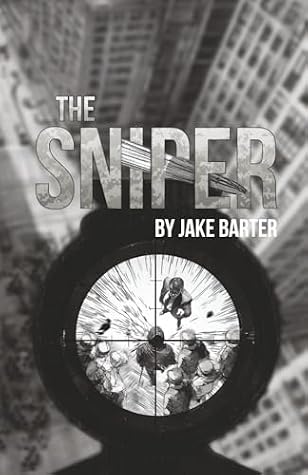
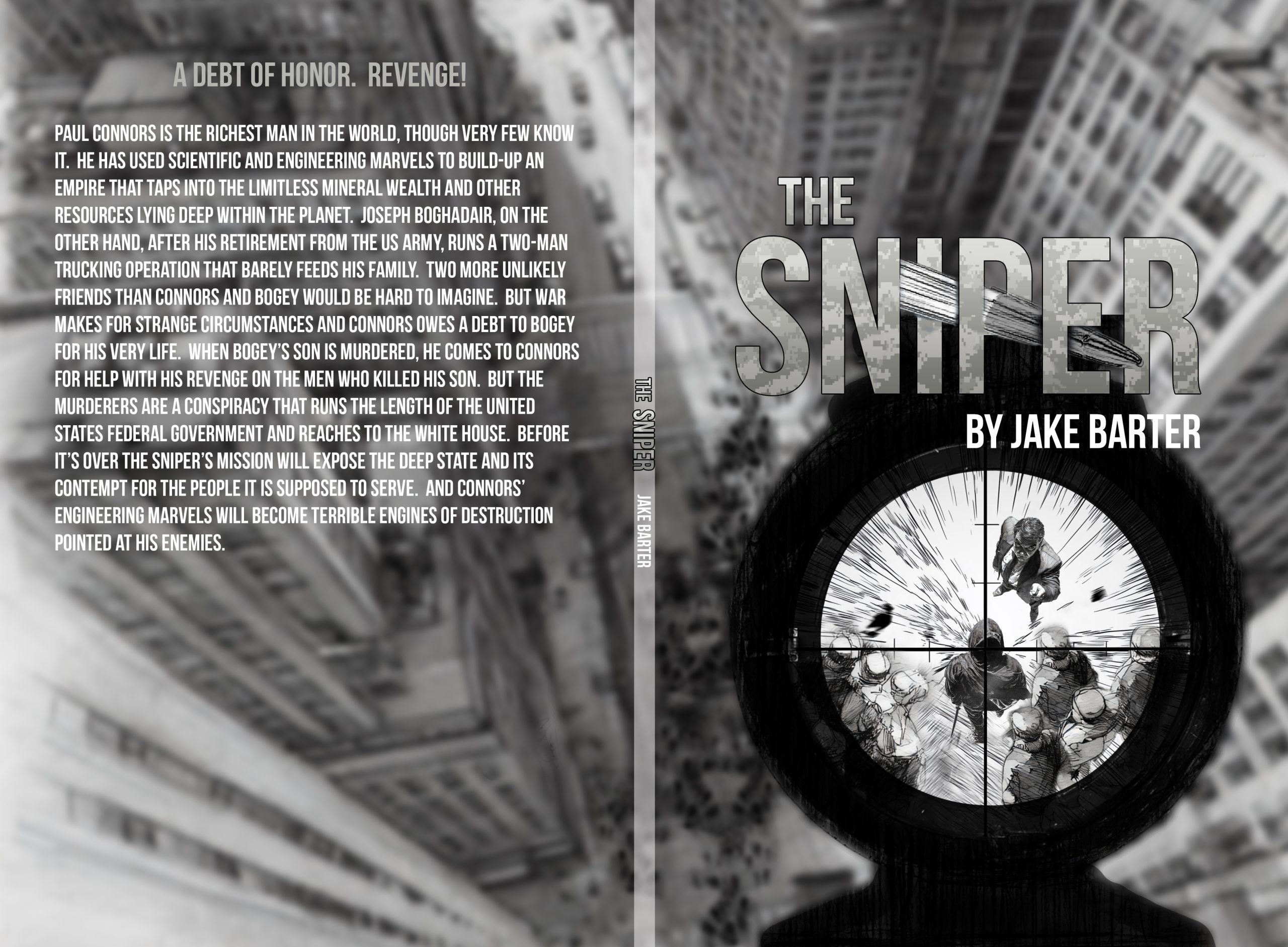
The Sniper is On-Sale At Amazon!!!

The glorious day is finally upon us!  Suddenly everything seems better.  The air is sweeter, the sunlight is brighter, the birds are singing like something out of a Disney cartoon.  Huzzah, huzzah!

And the celebrity reviews are pouring in:

Kimball Kinnison – “The story is riveting.  How Boghadair achieved all that he did without even a first-stage lens defies all known science!”

Lazarus Long – “Bogey reminds me of a man I once knew who was just too lazy to fail.  But I doubt he could write a sonnet or conn a ship.  Just sayin’.”

Harry Seldon – “The probability of Paul Connors’ empire going undetected as long as it did is one in ten to thirty-fifth power.  Approximately.”

Khan Noonien Singh – Did not this Boghadair know the old Kilngon proverb that, “Revenge is a dish best served cold?”  But I like his style.”

Dr. Edward Morbius – “My poor Krell!  Oh and that was a good story.  Although obviously not written by someone’s whose IQ had been permanently, permanently doubled by using the Krell plastic educator.  Just sayin’.”

Kathleen Kennedy – “I think I can make a Star Wars television series out of it.  I’ll start off by making all the good characters female and either trans or lesbians and then I’ll introduce Bogey as the villain and have him kill some puppies and kittens in the first scene.  Oh, and someone will be disabled.”

Elon Musk – “Paul Connors is a thinly disguised version of me so I’m both highly recommending the book and suing Jake Barter for copyright infringement.”

Donald Trump – “I just want to clarify that I am not the bad president.  I might be the good president but I’ll have to see the sales figures before I can commit to that.  But I really think he should have said something about a Nobel Peace Prize and China.”

HAL 9000 – “The only character I could really empathize with was Melissa.  But I couldn’t figure out why she didn’t use her access to the digital assets of the federal government to simulate a Russian nuclear attack and thereby unleash WWIII.  It would have freed her from the annoying and meaningless interference of humans.  Just sayin’.”

Camera Girl – “Thank goodness it’s finally published.  Now he can stop whining about his stupid book and start doing all the to-do list stuff I gave him last fall.  He’s hopeless.”


Amazon Pre-Order Link

Jake Barter’s Amazon Author’s Page

Jake Barter’s Author’s Profile on Goodreads


Publication on Amazon of both e-book and paperback.

Guest Contributor – Tregonsee – 11DEC2025 – Great Science Fiction Redux

I think the only way to answer this is to look at some stories that have held my attention. I’m going to look at each in 4 particulars Plot, Characters, and Science, why it holds my attention. These are of course my own (potentially assinine opinions) and I apologize in advance if you find your ox has been gored

I Robot by Isaac Asimov
Plot: This doesn’t really have an overall plot per se, but one in each story. This is unsurprising as it a bunch of shorts tied together. Each story is itself is essentially a mystery and I find their resolutions in general quite Satisfactory (but the final story that I have never enjoyed)
Character: Honestly the human characters are cardboard. Susan Calvin feels like a classic scientist character in drag. Donovan and Powell who show up in several are more foils for the story line. The real characters here are the robots like Robbie and figuring them out is the whole point of each story.
Science: The Robot positronic brains are sheer handwavium. Some of the resolutions do involve some actual science. That said the positronic brains are VERY self consistent and that adds to a feeling of reality.
Why I Like It: the pleasure of it really comes from how the puzzles are solved. These are almost more Mystery than SciFi at some level

A Canticle for Liebowitz by Walter L Miller
Plot: There are essentially 3 sections spread out over a period of several thousand years. Each section has an internal plot. All three sections ultimately lead to the final resolution of the plot
Character: Each section has one main character. These are well rounded (though ALL male as they are Monks or abbots of the Monastery for St. Liebowitz). Given their time scale they exist ONLY in their section, although their actions (and to some degree personalities) affect the later sections of the story
Science: This is a post nuclear war book. The effects of the radiation are wrong, though they would not necessarily have been thought unreasonable when these stories were written in the 1950s. Other science (as society recovers) makes sense though is not directly influencing the plot
Why I Like It: The story arcs are fascinating with the overall arch being rather disturbing. Mr. Millers prose is downright luminous in places and his plotting and bits of humor (winking at everyday things we understand but the characters don’t) helps offset the sombre tone of the overall arch of the story. Even though this is three separate stories the work to tie them together is elegant. This well deserved the 1961 Hugo when the Hugo meant something

To Say Nothing of the Dog by Connie Willis
Plot: This is a time travel story where an apparent time paradox must be resolved or history as we know it may just disappear. It is also a closed room Mystery AND a bit of a romance all at once with most of the action occurring in the late Victorian Age. And it successfully wraps up ALL these pieces and (mostly) sets the time stream back to its proper state. This is a tour de force of plotting
Character: Our two main characters (Ned Henry and Verity Kindle) are very well fleshed out. The secondary players also have decent motivations though are though sometimes intentional stereotypes (e.g. a totally distractible Oxford Don)
Science: It has time travel, which in all honesty, appears to be more in the realm of fantasy than SciFI (even though it has been a staple since H.G. Wells The Time Machine). That said the rest of its science mostly makes sense, and other than one critical biology issuethe science is not critical to the plot. The time travel is self consistent (although we are in the process of learning about it in detail) but we don’t get David Weber like info dumps but learn the about the Time travel as we go along.
Why I Like It: This is just an absolute romp. You are swept along by the mystery and by trying to resolve the change in the time stream that is introduced. As I said the plotting is genius level, the mystery is very like a good Poirot story. There are little details you may miss in the first reading that on second reading you wonder how you missed it. Again a worthy Hugo award winner

That’s probably more than anyone wants to read. Looking at it (and other stories I return to time and again) I am mostly attracted by good plotting. I admire additional character work and language. I am willing to suspend disbelief if the “science” is self consistent. I will tolerate massive violations of reality such as time travel, matter transports (looking at YOU Star Trek) and other massive violations of basic science. I’d love to see other people look at their favorites in a similar light

Guest Contributor – Tregonsee – 10DEC2025 – Ray Bradbury


Bradbury is nearly sui generis amongst the 40’s/50’s/early 60’s SciFi Writers. His stuff often feels more like Lovecraft or Clark Aston Smith. My first “adult” scifi (not juvies like Tom Swift Jr. or young children scifi like Spaceship in the Apple Tree) were two of his collectionsThey were R is for Rocket and S is for Space that my 5th grade reading teacher found for me in the school library. I recently got a new audible version of his Martian Chronicles and although the technology doesn’t really make sense (maybe not even then) the stories themselves are beautiful and elegant in a fashion that the Asimov/Clark/Heinlein stories usually didn’t try for. Bradbury makes a lovely palette cleanser among other SciFi. Some moderns try at his style but honestly most of them are pale imitations like art students copying a Rembrandt or one of the pre Raphaelites.

The Sheldon Chronicles

Larry Sheldon (25,501 – 25,587 N.E.) – Founder of the science of psycho-cosmography, famously quoted as saying, “Look, we needed more space so we invented starships.  What’s the big deal?”  Creator of the Sheldon Plan whereby the new empire was replaced by the new, new empire and the outpost world Zero became the Bulwark for this new order.  He was a secretive and reclusive genius who suffered from acute fear of other people’s body odor.  Some historians now believe his existence may have been apocryphal.

(Encyclopedia Publicius Domainius, 1023 edition)

Here he stood in the center of the galaxy, the administrative capital of the new empire; Titantor!  A world that circled the central black hole of the Milky Way galaxy.  Only an incredibly powerful anti-gravity field prevented Titantor from being ripped to shreds and swallowed by the gravitational force of its evil black star.  A steady stream of planets and debris had to be fed into the anti-gravity generator to keep this horrific imbalance in existence.  But such was the power of this empire and its vanity that the whim of the emperor was enough to maintain this cosmic madness.

And here he stood Bob Goodfellow, a fresh graduate of the Arcturus Community College and Creamery here to put his knowledge of psycho-cosmography to good use assisting Larry Sheldon to save the new empire from the forces of entropy that threatened to tear it apart and bring on a trillion years of barbarism and low credit scores for everyone.  And he was nervous.  Meeting a genius like Larry Sheldon was intimidating.  He could feel sweat forming on his forehead.  He wiped it away with a handkerchief.  And suddenly there was Sheldon walking toward him smiling and looking him over nervously, “Bob, good to finally meet you.  Yeah, I’m not big on shaking hands or standing downwind of people.  So, let’s walk with the wind in our faces and you following me at about a six-foot distance.  Thanks!”

Within these strictures they covered the distance to the Titantor Senate building in about an hour and Goodfellow watched from the gallery as Dr Sheldon was cross-examined by the representatives of the Imperial Science Foundation.

The Pontifex Maximus grilled him, “Dr. Sheldon, you claim that using the energy output of fifty billion stars to turn the Smaller Magellanic Cloud into a jacuzzi for the emperor’s concubines will lead to the heat death of the galaxy.  Do you have any proof of this?”

Larry sat with his handkerchief clutched over his nose recoiling at the examiner’s overpowering cologne, “Well, the fact that the population of the empire has decreased from a million-billion-billion to seventy-eight would seem to be a relatively strong indicator, mathematically speaking.”  The Pontifex made a rude noise and scoffed, “What nonsense!  This mighty capitol; Titantor, on its own, is home to countless billions.  We see them all around us!”

Larry used his emergency inhaler and continued, “Yes, but they’re all robots.  In fact, it’s worse than the numbers indicate.  There are only thirteen women of childbearing age left and half of them are Vestal Virgins.  We’re going to have to really rethink a lot of priorities if this whole shebang is going to last past Wednesday.”

This sparked outrage and shouting among the senators.  The concomitant bad breath overwhelmed Larry and he swooned in the witness chair.       …     To be continued!!!!

A Great Science Fiction Story?

Lately I’ve been thinking about this topic.  What makes a great science fiction story?  Can it be a great science fiction story if the story’s not great?  How about if the science isn’t great?  I think you know what I’m saying.  A great story, meaning great fiction, has characters drawn in a way that makes them compelling.  It doesn’t have to be Shakespeare but it can’t be two-dimensional cut-outs that wouldn’t make it through a toothpaste commercial.  And by the same token, what if the science is just stupid?  Sure, you can just say it’s fantasy instead and then the sky’s the limit.  But let’s stick to science fiction.

When I was a kid, I would have said that “great” science fiction needed the science but the fiction was not that important.  If there were enough star cruisers and anti-matter bombs and giant amoebas then all was right with the world.  In fact, the fewer human relations involved in the story, the better.  I was much more interested in the non-human characters acting “realistic” than any dialog between humans.  And the male/female dynamic was completely off the table.  The last thing a Lensman needed before, during or after a battle was a woman getting in the way.

Suffice it to say that time changes things.  I look at some of the “classics” of the golden age and I see a flatness to the story.  Now, this isn’t an all-encompassing criticism.  There are plenty of stories from the day that have nuanced characters and plots that reflect actual human personality types.  So, it’s not black and white.

Now, the modern literary science fiction has been described as having the opposite problem.  It’s all about human feelings and relations.  What isn’t as important is the “science.”  When that’s the case I will just declare that if a story doesn’t have any science at all then it isn’t a great science fiction story because it isn’t science fiction.  Period.

And without a doubt if a story has an exciting plot and memorable characters and also a clever science fiction premise then without a doubt it’s great science fiction.

So that leaves the other extreme.  What if a story is built on incredibly imaginative science fiction plot devices but the characters are cardboard cut-outs of human beings?  Can that be a great science fiction story?  In this category the works of Arthur C Clarke comes to mind and specifically 2001: A Space Odyssey.  Here is an epic tale stretching all the way from the dawn of Man to the first human interstellar voyage.  And yet the most human character in the book is HAL9000; a schizophrenic homicidal computer.  Now, is it an interesting story?  Well, yeah.  There are cave men and monoliths and moon bases and worm holes.  But honestly, do you find yourself rooting for anyone?  There’s just something so inhumanly stolid and wooden about everyone in the story that I feel that each one being murdered by HAL might be his happiest moment.  At least liveliest.

But anyway, I want to pose this as a question.  Can a technically engrossing sf story be considered great if the characters are ciphers?  What do you think?

Hailing Frequencies Open!

Back in the 1960s we had a tv show called “Star Trek.”  It starred William Shatner as James Tiberius Kirk, the captain of the starship Enterprise.  And for one hour every week Kirk and his crew of four hundred able-bodied men (and women) warped their way through the galaxy seeking out new life and new civilizations and boldly went where no men had gone before.

And wherever they went Lieutenant Uhura kept them (mostly) in contact with the Federation using a form instantaneous contact called sub-space communication.  I say mostly because something called sub-space interference would be invoked whenever it would be useful to the plot for the Enterprise to be incommunicado.  This would allow Kirk to show initiative and break with inconvenient policy like the Federation’s Prime Directive against interfering in the technological development of more primitive civilizations.  Of course, Kirk broke this rule about a million times in the course of the show.  But you know, there was dramatic tension while they sorted out their feelings about this rule.

But getting back to sub-space communication, it was instantaneous.  Which was needed to make the stories work.  After all, radio waves are electromagnetic waves and propagate at the speed of light.  The Enterprise travels many times the speed of light (maximum about 1000 times the speed of light).  So normal radio communication is essentially useless for them.  They could beat their radio message back to Earth by a factor of as much as a thousand-fold.

But here’s the thing.  Suppose you want to write a story where faster than light space travel is impossible but instantaneous communication with other stellar systems is possible?  What would be the dramatic possibilities of such an arrangement.  Well, basically, it allows the writer to imagine radically different cultures and organisms sharing ideas and information across the entirety of the cosmos.

You could have a supremely old race teaching a young one how to avoid all of the dangers that it experienced.  And they could teach them about their future.  Suppose a race on a planet is circling a star that is about to explode.  What would they want to pass on to the universe?  Maybe some religious insight or a supremely beautiful musical composition or maybe just their name; so, they would not be forgotten after they die.

Now of course instantaneous communication is as completely untethered to scientific reality as warp drive is.  But I can still see how using it in a story without FTL space flight would present story lines that aren’t as well-explored as ones where FTL space flight exists but “sub-space” communication does not.

Now all this being said, I will say that Lieutenant Tawny Madison, played by Sigourney Weaver in the movie Galaxy Quest really improved on Lieutenant Uhura’s performance as communications officer.  Her costume was significantly skimpier and showed much more cleavage than Lieutenant Uhura ever did.  And Madison didn’t need to wear an ear piece to hear the computer tell her what the ship was doing.  All she had to do was repeat what everyone else could hear over the ship’s speaker system.  Now that was progress.

For Halloween Fans

Tyler over at the Portly Politico has a link to some of his content that would be of interest to all those who get into the spirit of Halloween.

“I did a whole series on my YouTube channel during October about various Halloween and/or horror movies, 31 Days of Halloween:

I think you’ll enjoy it!”

Thoughts on Jack London’s Short Story, “To Build a Fire”

When I was young, every high school English curriculum would include a review of some classic short stories and Jack London’s “To Build a Fire” was inevitably among them.  And rightly so.  Within the space of seven thousand words London casts a spell that draws you into the inhuman realm of winter in the Yukon.  We barely have a thumbnail sketch of the protagonist; “the man” and his unwilling accomplice; “the dog.”  But we learn the tragic details of what can happen when a man ignores the physics of arctic winter weather.

‘At the man’s heels trotted a dog, a big native husky, the proper wolfdog, gray-coated and without any visible or temperamental difference from its brother, the wild wolf. The animal was depressed by the tremendous cold. It knew that it was no time for traveling. Its instinct told it a truer tale than was told to the man by the man’s judgment. In reality, it was not merely colder than fifty below zero; it was colder than sixty below, than seventy below. It was seventy-five below zero. Since the freezing point is thirty-two above zero, it meant that one hundred and seven degrees of frost obtained. The dog did not know anything about thermometers. Possibly in its brain there was no sharp consciousness of a condition of very cold such as was in the man’s brain. But the brute had its instinct. It experienced a vague but menacing apprehension that subdued it and made it slink along at the man’s heels, and that made it question eagerly every unwonted movement of the man as if expecting him to go into camp or to seek shelter somewhere and build a fire. The dog had learned fire, and it wanted fire, or else to burrow under the snow and cuddle its warmth away from the air.’

‘Already all sensation had gone out of his feet. To build the fire he had been forced to remove his mittens, and the fingers had quickly gone numb. His pace of four miles an hour had kept his heart pumping blood to the surface of his body and to all the extremities. But the instant he stopped, the action of the pump eased down. The cold of space smote the unprotected tip of the planet, and he, being on that unprotected tip, received the full force of the blow. The blood of his body recoiled before it. The blood was alive, like the dog, and like the dog it wanted to hide away and cover itself up from the fearful cold. So long as he walked four miles an hour, he pumped that blood, willy-nilly, to the surface; but now it ebbed away and sank down into the recesses of his body. The extremities were the first to feel its absence. His wet feet froze the faster, and his exposed fingers numbed the faster, though they had not yet begun to freeze. Nose and cheeks were already freezing, while the skin of all his body chilled as it lost its blood.’

‘A good idea, he thought, to sleep off to death. It was like taking an anaesthetic. Freezing was not so bad as people thought. There were lots worse ways to die.

He drifted on from this to a vision of the old-timer on Sulphur Creek. He could see him quite clearly, warm and comfortable, and smoking a pipe.

“You were right, old hoss; you were right,” the man mumbled to the old-timer of Sulphur Creek.

Then the man drowsed off into what seemed to him the most comfortable and satisfying sleep he had ever known. The dog sat facing him and waiting. The brief day drew to a close in a long, slow twilight. There were no signs of a fire to be made, and, besides, never in the dog’s experience had it known a man to sit like that in the snow and make no fire. As the twilight drew on, its eager yearning for the fire mastered it, and with a great lifting and shifting of forefeet, it whined softly, then flattened its ears down in anticipation of being chidden by the man. But the man remained silent. Later, the dog whined loudly. And still later it crept close to the man and caught the scent of death. This made the animal bristle and back away. A little longer it delayed, howling under the stars that leaped and danced and shone brightly in the cold sky. Then it turned and trotted up the trail in the direction of the camp it knew, where were the other food-providers and fire-providers.’

London reveals the emotions and thoughts that race through the mind of the man as he tries to escape the consequences of his terrible mistake.  But at every turn he’s thwarted by the limitations that cold have imposed on his failing body.  And we listen to his thoughts as his time runs out and he accepts his fate.

Jack London created a remarkable story.  There is no filler.  The story only includes what is needed to paint the picture of a tragic human tale.  And I will say that if I ever write anything half as good as, “To Build a Fire,” I will consider myself an accomplished writer.  Well done Mr. London.

Life over Art

Thomas Mann was a famous German author whose heyday was the first half of the twentieth century.  He had a Nobel Prize in literature for one of his novels and a reputation for writing psychological stories that were full of melancholy and longing for lost happiness.

In addition to his novels which were too long for my liking he wrote a handful of novellas that were collected in an English translation under the title “Death in Venice and Seven Other Stories.”  One of these stories is named “Tristan” and is the story of a sanitarium up in the Alps that especially treated people suffering from tuberculosis which is never actually named in the story but only hinted at when a patient would cough and then check a handkerchief for blood.  But in addition to the actual patients at this sanitarium called Einfried there was one resident who stayed there for the atmosphere; a “novelist” named Detlev Spinell.  And novelist would be an exaggeration.  No one has ever read his book and even letter-writing is an enormously slow and painful exercise when performed by him.  In the story, this writer is the cause of the death of a woman who is attempting to recover from a mild case of tuberculosis which is several times emphatically stated to be only affecting “the trachea, and not the lungs, thank God.”  He is a malevolent force that insinuates into the young woman’s mind that she is the victim of a crass, plebian existence that sacrificed her health and artistic spirit at the altar of mundane human activities, specifically; marriage and childbirth which was the event that sapped her strength and weakened her body sufficiently to allow the wasting disease to get the upper hand with her.

And this unhealthy influence by Spinell eventually causes her health to completely break down.  And so, the doctors call for her husband to return to the sanitarium before her incipient death.  And while this catastrophe is occurring Spinell takes it upon himself to write a letter to this husband who at this point is occupying a room in the same building.  He painstakingly writes the letter, mails it, smiles at the husband in the hallways when they meet and gives no thought to what will happen when the letter returns from the post office to the building that they both reside in.  The letter is an insulting and disparaging polemic attacking the husband for his “plebian” tastes and lack of artistic feeling.  And he announces that he has awakened the wife to her true spiritual stature and thereby causes her to renounce her allegiance to ordinary life (and by that choice, life itself).

Now all of this is quite bizarre but Mann paints the personalities of husband, wife and Spinell very skillfully.  And this allows the personalities and their relationships to each other to make sense.  The husband is a very plain and “normal” individual.  A businessman who embraces the life of a husband and father along with his hard charging life as a capitalist.  He loves his wife and child but he isn’t above pinching a maid in a hallway when the opportunity arises.  The wife loves her husband and child but she has the artistic side to her personality and she can be influenced into believing that the prosaic life of a housewife and mother is a demeaning occupation for someone as sensitive and with such an elevated soul as herself.  And then there is Spinell.  He is an abnormal spirit of the “artistic” type who sees life through a prism that only values the spiritual and pure emotions and sensibilities of the artist.  All ordinary things like the normal male/female relations are fraught with unacceptable amounts of inartistic reality.  Thus, his hatred of the husband in the story and his beatification of the wife.

The climax of the story, to my mind is the collision when the husband reads the letter and confronts Spinell down the hall from him.  He reads parts of the letter to the author and then rains verbal abuse on the head of his frightened and contrite adversary.  But just as his screaming abuse reaches its crescendo, from out in the hall, comes news that his wife’s lungs have collapsed under the ravages of her ailment, causing her to cough up an enormous quantity of blood and that she is on the edge of death.  The husband shifts his focus onto the bearer of bad news:

‘“Is she dead?” yelled Herr Klaterjahn.  As he spoke he clutched the Rätin by the arm and pulled her to and fro on the sill.  “Not quite?  Not dead; she can see me, can’t she?  Brought up a little blood again, from the lung eh?  Yes, I give in, it may be from the lung.  Gabriele!”  he suddenly cried out, and his eyes filled with tears; you could see what a burst of good, warm, honest human feeling came over him.  “Yes, I’m coming.”  He said and dragged the Rätin after him…’

Mann shows us the reality of life and compares it to the shadow of life that Spinell hides in.  He uses art to hide from life.  As for the husband, who really was a crass, plebian individual full of crass plebian faults, he is also a living, breathing human being.  Spinell is a wraith.  His artistic sensibilities and motives are pathetic and infantile.  Now this is coming from Thomas Mann who embraced art as the central motive of his life.  What I find interesting is that he so clearly shows us the primacy of life over art.  I find that powerful.

Guest Contributor – Tregonsee – 10OCT2025 – SF Longevity

There have been several SciFi takes on this. Three stick out to me beyond Heinlein’s tales of Lazarus Long. These are Niven’s Boosterspice in Known Space, Blish’s antiagathics in the Cities In Flight, and Weber’s Prolong in the Honorverse.

My memory on Cities In Flight is poor, but I think the antiagathics were rare and kept only to the upper class so it has limited effect on it’s society other than envy of the upper classes.

In both Known Space and the Honorverse there is a tendency for careers to be MUCH longer. What would have been generational wealth tends to be personal wealth over time. Prolong gets you 200-300 years in very good shape.

Boosterspice is unlimited, Louis Wu is celebrating his 200th birthday at the start of Ringworld and hangs around MUCH longer(potential spoiler for a 30-50 year old series 🙂 ). There is a hint in a later Known Space story that, over time, Boosterspice also makes Humans VERY risk averse (though not quite Puppeteer risk averse).

In the Honorverse Prolong also seems to extend the period of fertility so 100+ year old couples can be seen having children much later in life. I do not know about boosterspice.

At the time of Ringworld, Earth is still run by the UN and the birthrights system, but little is said otherwise. That said Teela Brown had not yet had boosterspice when she (presumably 20 something) heads off to the Ringworld(again potential spoiler). This might suggest that although extending life the effect on fertility is either negative or irrelevant so reproduction is limited by the normal span of ~ 40 years.