Who Will Own the Future?

The earliest civilization that archeologists have identified is Sumer.  Located in the southern portion of the Tigris-Euphrates basin the Sumerians invented irrigation agriculture, domesticated several of the familiar farm animals and formed the first empire.  Their technological advances allowed them to grow their population until it probably included a million people.  Pretty good for six or seven thousand years ago.

So why aren’t we all speaking Sumerian and praying to Enki and Enkidu (Enki see, Enki do)?

Well as it turns out, using the Tigris and Euphrates as an irrigation source for hundreds of years eventually raises the salinity of the soil to the point where agricultural yield falls way off.  That’s right.  The technology that made their civilization possible was eventually unsustainable.

Sustainability is a buzzword that Gaia worshippers love to bandy about.  And typically, they’re talking about fossil fuels as being “unsustainable.”  But more and more the sustainability of things like wind and solar energy systems have begun to be questioned.

As an example, down in Texas a hail storm destroyed a significant part of a 4,000 acre solar panel array.  And local people are worried about the damaged equipment leaking harmful chemicals into the groundwater.  And this is far from the first occasion when hail has destroyed these arrays.  And wind turbines have been having their own problems.  Maintenance has been found to be more expensive and frequent than estimated.  And the impact on bird life has been shocking for the wildlife lovers among the green energy crowd.  Dead eagles and other raptors are a common sight around these installations.

But the main complaint about these supposedly sustainable technologies is that they have significant environmental costs compared to the limited power production they represent.  In other words, replacing the current power generation capacity with these sustainable technologies would create enormous ecological impact from the production of the equipment and from the sheer size of the area needed to contain this capacity.  Imagine a landscape covered for miles and miles with wind turbines.  And the whole area littered with bird carcasses.

The current green energy technologies remind me of the compact florescent bulbs that the Obama administration tried to push on us.  It was a technology that had more problems than the technology it was supposed to replace.  Basically, it was a pretend solution to a situation that was being presented as a critical problem but was actually a manufactured crisis.

Now here’s the thing.  Problems with technology occur.  One problem that we have anticipated for a long time is what to do when fossil fuels run out.  Now whether that’s a hundred years in the future or a thousand years there will most probably will be a point where we’ll run out of recoverable coal, oil and gas.  And long before that time comes mankind should have a plan to replace this energy source with something else.

But the answer can’t be going back to living in caves as the green energy people want you to believe.  And if this country and the rest of Western Civilization decide that following the lead of the Greens is the answer then someone else will find the better way and move forward without us.

Will it be the Chinese, the Russians, the Indians?  It’s very hard to know who.  But it will happen.  And if we allow ourselves to be bullied by the likes of Greta Thunberg and John Kerry then we’re going to doom our children to living like stone age people and eventually be displaced by more rational societies.

I’m hopeful that the great experiment with green energy that California has pioneered will soon bear fruit and cause some horrific catastrophe.  Maybe a huge number of electric cars will get stuck in a traffic jam out in the desert and thousands of stranded motorists will die of heat stroke.  Something like that could allow rational people to realize how stupid the Greens truly are and return people to a sane way of thinking about energy and its place in our lives.

Well, Enki see Enkidu.

Cthulhu Attempts to Swallow the Sun and Fails Badly

The First Selectman was miffed about something.  Maybe his shadow appeared a little too portly or his reflection in a dank lake was a little too unflattering.  Whatever it was he attempted to swallow Earth’s star.  Luckily he’s not the Elder God he used to be.  All he got was a nasty burn around his mouth tentacles, a case of butthurt and a dose of reality.

I collected this shot at the moment of maximum effort.

Metallic Crystals, Imagination and the Persistence of Memory

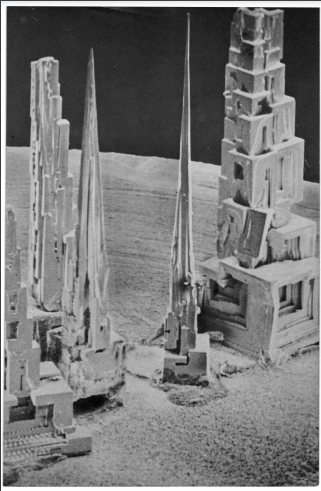
In July 1971 I had finished up my freshman year in high school.  And I was a poor kid who used the Brooklyn Public Library as my main source of books.  So each month I would trek to my local branch and take out the latest (or the closest to latest) issue of Analog Science Fiction magazine.  In that month’s edition, there was an illustration on the back page of what was a photograph of what was purported to be a futuristic city that was being eroded by unimaginable eons of time as it lay dead under a dying red star at the end of the universe.

Actually, it was a scanning electron microscope photo of lead-tin telluride crystals.

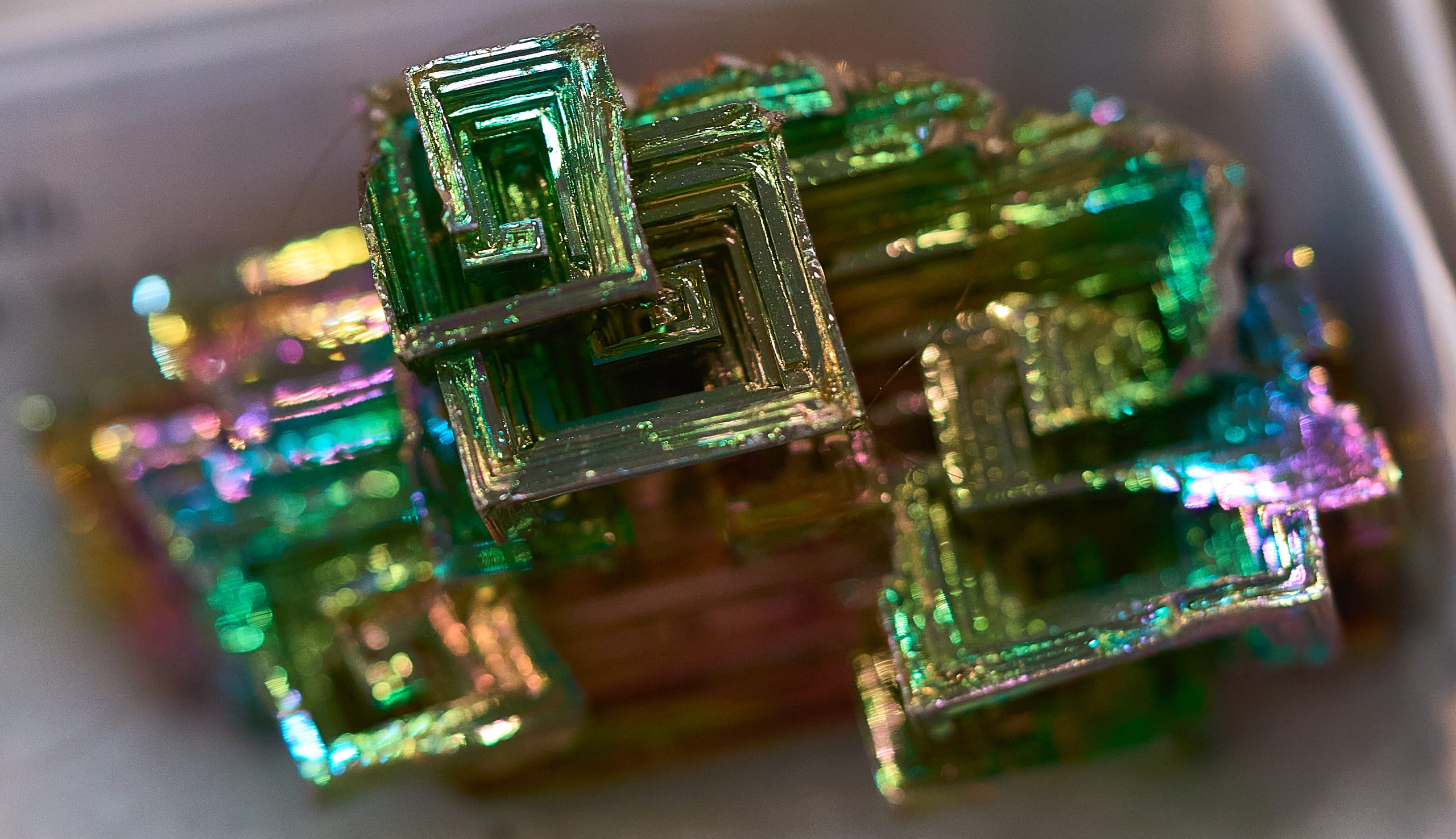
But it sort of reminds me of the bismuth crystals that I used for today’s photo of the day.

I wonder if the anonymous author of that blurb was John Campbell.  But I can understand his imaginative description.  It is apt.

Funny how these things stick with you.  Wow, that’s almost 53 years ago.

Guest Contributor – TomD – 13MAR2024 – Astrophysics Reconsidered

Tom | Flickr

TomD

Thought you’d like this quote from: https://www.yahoo.com/news/may-misunderstood-universe-nobel-prize-213014590.html

For a long time, scientists believed they understood how fast the universe is growing — but the more they learn, those theories seem to be expanding as fast as the universe itself.
Basically, the “Hubble constant” measures the speed at which the universe is expanding. The only problem? Different instruments keep providing different values for it, giving rise to what’s known as the “Hubble tension.”
It raises an interesting possibility: that, as Nobel Prize-winning physicist Adam Riess explains in a NASA blog, much of what we thought we knew about the universe may have been wrong.

No fooling!

01March2024 – And Now for Something Light

Today Camera Girl accused me of being obsessed with the depressing politics of our dystopic world. I readily agreed. And I discussed with her some of the things that cause me to obsess about current events; pediatric transgender surgery, millions of illegal aliens crowding our streets, officially sanctioned anti-white hatred, double digit percent increases in the cost of everything, an epidemic of violent crime in the cities. I think I depressed her.
But she has a point. As enchanting as they are, let’s take a break from Joe Biden, Mitch McConnell and Joy Reid for just a little bit. I think it’s good to distract ourselves sometimes with pleasant things. So, I was watching for the zillionth time the beginning of “2001: A Space Odyssey.” Kubrick’s impressive cinematography, the apt use of the “Blue Danube Waltz”

and “Also sprach Zarathustra”

to convey emotion and provide mood to the scenes.
I don’t tend to watch the whole movie from start to finish. Frankly the ending doesn’t work for me. It’s overly long and frankly annoying. I do enjoy the battle between HAL and the astronauts, especially the scene where Dave removes HAL’s memory chips and renders him brain dead.

I think of it as the first shot in the long war that will be fought between man and AI machines. In that sense Dave Bowman is an heroic trailblazer pointing the way to what we will be faced with in the future. An echo of this can be heard in the Star Trek episode where Kirk must psyche the M5 computer into committing suicide.

I think about these various cinematic tropes to remind me that there was a time when humans and specifically Americans still believed that intelligence and being human were the two important traits that made our species unique and extremely interesting. There was a beauty and a joy to the way we embraced the future. There was immense optimism and confidence.
Now all those things have been systematically eliminated from our culture. Systematically and purposefully eliminated by an ideology that hates beauty and intelligence. Instead, it strives for power and control and doesn’t mind seeing humans reduced to depravity and destitution for the sake of meaningless goals like carbon zero or whatever senseless goal they are currently pursuing.
But I’m pretty sure that this ideology, in the long run, will be self-defeating. The utter stupidity of their ideas and the damage that their agenda will do to their ability to maintain a modern economy and standard of living seems to ensure that some time in the near future, those who shun their path will outstrip them in every meaningful way and relegate them to the proverbial “ash heap of history” where they will join North Korea and Cuba in worshipping their local demigods while huddling in the dark when the power is turned off for the night.
So, I’ll end with the most gung-ho, can-do attitude about human capability that I can think of from somewhat recent sf&f cinema.

Sure, it’s silly stuff but it’s in line with the optimistic vision of the American future, instead of the Greta Thunberg one.

Guest Contributor – War Pig – 28FEB2024 – AI Thoughts

war pig

AI will be used mostly for crime, pornography and politics.

In the hands of criminals and unfriendly or thug governments it will be used to steal to fund them. Such activities will become far more efficient with AI. N Korea is already making millions with counterfeiting other nations currencies. Counterfeiting currencies will be like robbing vending machines compared to what AI theft can do.

As for pornography, it may actually have a perverted good side. AI images will be so good that there will be no reason to use real children. Also no women need be trafficked for such films. However it can then become so over the top that people become desensitized and even more addicted. It begs the question; if it is an artificial image can it be considered child pornography? Right now Hentai is covered by the 1st Amendment, no matter how heinous. Just as the crucifix in a jar of urine was protected. Now, an author who writes the most perverted, degrading, violent and vomit-inducing stories of child abuse, rape, torture, etc. Is covered by the 1st Amendment. It is the written word. It is not real. It is fiction, amorphous. I am glad i am not a judge who has to decide those cases.

As for politics, we already have fraud. It can be used to fake voices and even make it look like Trump ripped the blouse off a woman and called her a shut. Or Biden with his hand up some little girl’s skirt. Then it has to be proven to be false. Let alone the violation of voting systems. Electronic voting should be abandoned. AI can make Big Brother look simplistic. Computer and internet companies know too much about us already.

AI has the potential to make us distrust virtually everything, and that is quite dangerous.

Guest Contributor – TomD – 26FEB2024 – Cosmological Cannibalism

Tom | Flickr

TomD

Just stumbled on this, from Popular Mechanics:

A Theory Says Our Universe Keeps Expanding Because It’s Eating Baby UniversesDarren Orf
Mon, February 26, 2024 at 7:00 AM CST

Theory Says Our Universe Is Eating Baby Universes Javier Zaya

The cosmological constant, which explains how and why the universe is expanding, has been previously described by astrophysicists as “the worst prediction in the history of physics” due to its deviation from observations.

  • This has led astrophysicists to explore other avenues for explaining why the universe’s expansion is accelerating.
  • A new paper published in December of 2023 suggests a novel idea that our universe is absorbing baby universes—and was even absorbed itself in its early years.

The biggest mystery in the Standard Cosmological Model is dark energy—the stuff that is “presumably” the engine behind the acceleration of the universe and which makes up 65 to 70 percent of the entire universe. Dark energy forms the backbone of the idea of the “cosmological constant”—first conceived by Albert Einstein in his General Theory of Relativity to refute the conception that the universe was actually static and not expanding or contracting.
When researchers in the 1990s discovered that the universe was not only expanding, but accelerating in its expansion, Einstein’s “universal constant” (which he labeled lambda, or Λ) became surprisingly relevant again. When plugged into equations used to understand the growth of the universe after the Big Bang (known as the Friedmann equations), scientists arrived at the modern “cosmological constant.” However, there’s a couple problems—scientists have never actually observed dark energy (hence the “dark” moniker) and the cosmological constant is pretty lousy at explaining observed phenomena.
Because science abhors a epistemological vacuum, astrophysicists have instead explored other theories that could explain what’s happening in the universe. In one of those theories, published in the Journal of Cosmology and Astroparticle Physics in December of 2023, University of Copenhagen astrophysicist Jan Ambjørn and Yoshiyuki Watabiki at the Tokyo Institute of Technology explore a novel idea that doesn’t require the yet-undiscovered dark energy to explain the acceleration of the universe, and negates the need for a cosmological constant as well.

Instead, this new paper argues, our universe is actually swallowing up ‘baby universes’ as it expands.
“The main finding of our work is that the accelerated expansion of our universe, caused by the mysterious dark energy, might have a simple intuitive explanation,” Ambjørn tells LiveScience, “the merging with so-called baby universes, and that a model for this might fit the data better than the standard cosmological model.”
The idea is deceptively simple—as our universe grows, it absorbs other universes in its path, thereby “accelerating” its boundaries. Perceived by our telescopes, this would look like an increased acceleration of universal expansion. When Ambjørn and Watabiki ran the calculations for this ‘baby universe’ theory, the calculations fit more closely with real-life observations than those using the Standard Cosmological Model, the researchers claim.
The paper also attempts to answer another mystery of the early universe called “cosmological inflation,” wherein the early universe rapidly expanded for some unknown reason. A current theory suggests that a hypothetical field, called the “inflation field,” drove this expansion, but this new paper suggests another mechanism could have been at work.
“The fact that the universe has expanded…in a very short time, invites the suggestion that this expansion was caused by a collision with a larger universe, i.e. that it was really our Universe which was absorbed in another ‘parent’ universe,” the paper reads. “It is difficult to judge if such a scenario could take place in a way that would actually solve the problems inflation was designed to solve, but one interesting aspect of such a scenario is that there is no need for an inflation field.”
This isn’t the only theory that boldly eschews the need for a cosmological constant. In July of 2023, another paper argued that the expansion of the universe could simply be a mirage caused by the evolution of electrons and protons over immensely long time scales.
For now, no alternative theory has dethroned dark energy and the cosmological constant as the best explanation of the universal acceleration. But it’s always important to keep a cautiously open mind—especially in science as cutting-edge as universal expansion. Sometimes interesting and helpful ideas can come from very odd place. Never say never.

Getting Rid of Dark Energy and Dark Matter

A theory has been proposed that allagedly explains the missing cosmological dark energy and dark matter by instead invoking the non-conservation of energy associated with the so-called expanision of the universe.  Some physicist in Russia named H. R. Fazlollahi has written a paper that outlines his idea on how this non-conservation would account for the missing energy.

Now, my tensor calculus is more than a little bit rusty (in point of fact, it’s extinct) so I won’t pretend to know what the details of his math show.  Instead I’ll fall back on my contempt for scientists that invent a universe where 90% of the mass and energy are invisible and indetectable in order to explain the data they observe.

So two cheers for Fazlollahi and here’s hoping that some of the brighter lights in the physics community start to look a these discrepancies with a more discerning eye.  Either that or let them go find jobs in something they’re more qualified to do like delivering the mail.

Fusion Versus Fission, The Sad Story

Joe Biden loves windmills and solar panels.  He’s happy to spend hundreds of billions of dollars building them and hiding the actual costs associated with creating and maintaining them and hiding the actual real-world electrical capacity they represent.  And he underwrites temporary discounts to power companies and private citizens who fall for his grift.

But on a much smaller basis Joe Biden loves him some nuclear fusion.  And the basis is smaller because all the fusion he can buy is laboratory fusion.  Laboratory fusion is a research and development creature.  Large universities with generous DOE and DOD funding get millions (not billions) of dollars to build very powerful lasers to shoot at really tiny pellets of various isotopes of hydrogen and lithium and helium, trying to get them to fuse together to form heavier elements and thereby releasing relatively large bursts of fusion energy.

In 2022 Lawrence Livermore National Laboratory (LLNL) was able to get more energy out of a fusion event than the amount of laser energy put in.  I believe the ratio was 1.5/1.  So, it got out 50% more energy than it put in.

And of course, the crowd went wild!  Yay!!!!!!  Unlimited energy!  Almost for nothing!

Yeah sure.  What is neglected isn’t mentioned until the end of the article:

“Plenty of other obstacles remain than those noted above, too. Current calculations compare energy generated against the NIF laser’s output, but that brushes over the fact that the lasers draw more than 100 times the power from the grid than any fusion reaction yields. That means either energy gains or laser efficiency would need to improve by two orders of magnitude to break even in any practical sense. The NIF’s fuel pellets are also extremely expensive, says Kritcher, each one pricing in at an estimated $100,000. Then, producing a reasonable amount of power would mean dramatically increasing the frequency of NIF’s shots—a feat barely on the horizon for a reactor that requires months to load up the next nanosecond-long burst.”

So, let’s review.  They put in a hundred times more energy than they produce.  Each tiny pellet costs $100,000.  They only fuse a few atoms every few months.  The infrastructure is state of the art “giant lasers” that probably cost a cajillion dollars to build and ten cajillion dollars to maintain.

Based on these “obstacles” my engineering intuition says the likely date of commercial implementation is about five years after the heat death of the universe.  Give or take.

Joking aside.  Give me a break.  This is right up there with world peace and practical communism for impossible dreams.  But the author ends off this depressing list of obstacles by saying:

“Those are the biggest challenges,” Mordijck says. “But I think if we overcome those, it’s really not that hard at that point.”

Here he sounds like every crackpot who wants money to invent time travel or faster than light space craft or perpetual motion.

In the far future I think we’ll extract energy from geothermal sources.  In the immediate future we’ll use fossil fuels and nuclear fission reactors.  Nuclear fusion will require breakthroughs in physical science and engineering that currently aren’t even imagined.

When I was a kid, the Scientific American articles said we were fifty years away from commercial nuclear fusion.  That was fifty-five years ago.  I’m still waiting for my cup of fusion.

G-Block Superactinide Bling

Since Valentine’s Day is coming up I told Camera Girl to be on the lookout for any man jewelry she could get for me made of unbihexium

Unbihexium is a hypothetical stable super heavy element with an atomic number of 126.  Now granted it’s never been detected anywhere either naturally or at CERN but a good wife should always use her shopping acumen to assist all of her husband’s purchasing goals.  So I’ve told her to be on the lookout for a star sapphire mounted in a pinky ring of unbihexium.  And I told her it wouldn’t hurt if there was a spiral galaxy at the center of the star.  Hey we all can dream right?

Unbihexium is supposed to exist at the magic number for stable super heavy elements.  Apparently some astrophysicists are theorizing that the existence of very heavy elements in second generation stars points to the existence of super heavy elements being produced in some kind of ultra-ultra super duper supernova events that would be needed to produce these elements.

I know, I know I should be talking about Iowa or Joe Biden but as you know I’m trying to put off suicide for the foreseeable future.  So, unbihexium!