Tomorrow the Stars – A Science Fiction Book Review – Part 1 – Poor Superman

A while ago I spoke of buying a book I owned fifty-some-odd years ago.  So, here’s a story from that book to talk about.  The author Fritz Leiber was pretty popular back in the day.  So, I don’t intend to rewind the plot here because it’s a short story (twenty-eight pages) and anyone can find it out there in the public domain, I’m sure.

But I just want to give some impressions of the best aspects of the story.  This is explicitly a post-apocalyptic world.  New York City and Washington DC are craters.  And because of the disaster the US government has been supplanted by a regime called the Thinkers.  They are frauds who have convinced the populace that they have supercomputers and atomic rockets that go to Mars to commune with the all-wise Martians and something called the “Mind Bomb,” etc., etc., etc.  The real scientists have been cowed into keeping quiet and the nominal leader is a guy named Jorj Helmuth who was a publics relations specialist in the before time but now believes his own hype and thinks he’s a master of sleep learning and hypnotism and whatever else he’s made up.

The story is basically the maneuvering of Jorj, his cronies, the scientists and a few other actors on stage.  Leiber lays out the story and the characters in broad strokes but very skillfully and it’s fun to recognize the Soviet (and American) propaganda playbook being run to fascinating effect.  It’s a cautionary tale about idealism and chicanery and power politics and the danger of believing in your own lies.  And even thought this story was written in 1951 it reads the same as if it was written today or tomorrow.

And it has a great villain who just exudes realpolitik and a feme fatale and even a twist ending to make sure you don’t forget that it’s from the golden age of science fiction.  And even the title of the story is the punchline.

All these same people inhabit our present world.  The lies and make believe from then is no different from the BLM or Antifa grifts that we see all around us.  Probably the closest thing would be the climate change scam that has bankrupted Europe and exacerbated the monetary problems we’re experiencing.

So, that was fun.  There are a few more stories in the book that I’ll highlight in later episodes of this book review.  But I’ll say that “Poor Superman” is the crème de la crème of the entire collection.  And since it’s the last story in the book you finish it off with a smile on your face.  See, that Bob Heinlein really knew the trick to editing an anthology.  Make sure the last story leaves them wanting more.

So, who remembers this story or at least remembers the name Fritz Leiber?  Surely, I’m not the only old science fiction fan here and I’d love to get some other opinions.  After all, I’m just one man.  And I’m not even superman.

Guest Contributor – Chemist – 24SEP2024 – Death of SF Magazines

I have always enjoyed the shot story format. For a while, in the 60s & 70s, some of the big name authors were competing with each other to write a complete story on the back of a picture postcard. Some of these were amazingly good!
As for Analog, I gave up on it a long time ago (30 years?). Their Science Fact articles were all doom and gloom:
“We are all going to die and thee is nothing you can do about it!”
Or:
“Here is why FTL travel, Nuclear fusion, laser defenses, etc. won’t work and cannot work.”

And, to me, the Fiction was woke before woke was a thing. So I stopped buying after I realized I had a years worth of issues that I had not read and could not motivate myself to read.
I suspect that Analog (and maybe the others) got infected by the same liberal women who took over the NY publishing houses.

Another datapoint: I recall talking to a successful SciFi author in the 80s who switched from writing short stories to novels. When asked why, he said: “Its just as hard to sell a short story as a novel, but novels pay a hell of a lot better.”

BTW, Photog, another non-woke publishing house is Chris Kennedy Publishing.
You might consider sending him a copy of your novel.
https://chriskennedypublishing.com/

Just Something that Came to Mind

Lately there have been a lot more options if I wanted to talk about what’s in the news.  There’s all kinds of Jimmy Kimmel talk.  He’s off the air, he’s back on, he’s gonna apologize, his show won’t be carried in a quarter of the country, blah, blah, blah.  And Donald Trump just got through trashing Joe Biden and the UN in front of the General Assembly.  There are psychopaths shooting up innocent victims everywhere you look and Democrats are desperately kowtowing to Mamdani hoping he can provide the magic bullet needed to bring back the millions of voters who are jumping ship.  Yep, there’s all kinds of madness everywhere you look.

But I can use a break from it from time to time.  I just get fed up with the awfulness of the world and the awful people doing awful things.

So, let’s talk about something less depressing and maybe more interesting.  A while ago I mentioned I bought a copy of a book I owned back in the stone age.  It’s an anthology of science fiction stories published in the 1950s, edited by Robert Heinlein, called, “Tomorrow, The Stars.”  There are fourteen short stories in the book’s two hundred and forty-nine pages.  They’re all between ten and twenty pages long and were written by authors “famous and less well known” at the time.  Interestingly, one of the less well-known authors was a certain, “Kurt Vonnegut Jr.”

So, I’ve been rereading these stories, some for the first time in over fifty years.  I won’t pretend that they’re all equally good or that any of them are timeless prose.  They’re not.  They’re pulp fiction or maybe slightly better than pulp fiction.  But they’re also entertaining.  They amuse.  They keep the reader’s interest.  They tell a story.  All that good stuff.  But what’s my point?  I’ve read lately that science fiction short stories are an unsellable product.  All the magazines and the anthologies are going bankrupt.  No one will buy them.

Back in the dark ages magazines like Analog and The Magazine of Fantasy & Science Fiction made plenty of money selling monthly editions filled with mostly just short stories.  Sure, they would also serialize some novels but mostly we were reading short stories by authors, “famous and less well known.”  Now I am well aware we are living in a new age.  Theft of intellectual property has been the downfall of all the formerly lucrative entertainment forms.  CDs, DVDs and books have been pirated out of existence.  Young people have been conditioned not to pay for anything.  Everything is a streaming service.  Amazon sells books by the penny/a page method.

Yes, yes.  I get all that.  But these are just the technical details of our age.  Piracy has always been around.  What it takes to sell a product in the face of these kinds of obstacles is the same thing that is needed in any other place and time; creativity and psychology.  And in fact, a short story would seem to me to be the easier sell.  You can read (or hear) a short story in a car ride or a subway commute or a high school class that you don’t want to listen to.

Sometimes you don’t want a four-hundred-page epic fantasy.  Sometimes you don’t even want a novella.  Sometimes you want a ten-to-twenty-page story to take you out of your life for a half hour.

Just something that came to mind.

Hear Ye, Hear Ye

Update:

To verify my ownership of “The Sniper” for the Royal Road folks, I am adding this note to show I also control Orion’s Cold Fire.


We interrupt the daily progression of actual civil war to bring you a message about a fictional civil war story.  I’ve finished the manuscript for my book, “The Sniper.”  Now I’m looking for beta readers.  I’m looking for folks to read the book and give me their honest feedback.  Also I’d like to disseminate the book to friends and family who you judge would be a good fit for the book based on your estimation and if they agree to read it I’d like to get their opinions too.

I’m looking to get this book out to the largest group of people possible to see whether it is something that people will want to read.  So after reading it if you think it’s appropriate for people you know let me hear that too.  And remember, I’m not a fragile author.  If you think it sucks, say so, but also tell me why you think it.

If you’re interested leave a comment to that effect and I’ll e-mail you a copy of the story.  Now this is just a pdf.  No nice cover, no actual paper.  Just electrons.  But I will guarantee that this sniper is nothing like the actual sniper we’ve had to hear about for the last week.

And just to remind you here’s the beginning of the book.


Chapter 1 – An Object Lesson

Joseph Boghadair was set up at a loophole in a small prefabricated metal building at the top of the mountain that contained the Icarus Mine.  His .50 caliber sniper rifle was trained on the narrow road that led up to the mine.  He could see a line of black SUVs about a mile and a half down the road and he was getting ready to start firing on the convoy.  His first shots took out the engine of the lead vehicle thereby halting the convoy.  His second volley took out the engine of the last car in line thus trapping the rest of the vehicles between.  Then at a more leisurely pace he took care of the other eight vehicles.  By this point the passengers were crouching behind their disabled cars and randomly firing handguns and automatic weapons in Joseph’s general direction with almost no discernible results.

After about half an hour a few of the men in black body armor attempted to reach a stand of trees about 300 yards away to their left.  Joseph put a few well aimed rounds in front of their path and they quickly retreated back to the supposed safety of their not-so-mobile-autos.  Joseph snorted wryly at their shyness.

An hour after that a helicopter approached the mountain from the opposite direction to Joseph’s loophole.  Walking over to a window on the other wall he could see a distant Blackhawk approaching at relatively high altitude.  Joseph then began his preparations for their reception.

Between crew and troops, the Blackhawk had a dozen men on board.  And more importantly it had a couple of Hellfire missiles.  From a very safe distance away it targeted Joseph’s position and fired.  The missile struck precisely on target and obliterated the steel structure almost completely.  All that remained was the foundation of the structure around the mine shaft, now clogged with debris.

The Blackhawk landed about three quarters of a mile from the mine entrance.  At this point the agents, hunkered down behind their vehicles, began to stream toward the helicopter.  By the time they reached the aircraft the troops had exited and were waiting for their rescued brethren to arrive.

FBI Special Agent in Charge, George Chastain assembled both teams and briefed them on the updated mission plan.  “We will proceed to the mine head and look for any human remains.  We will collect whatever we can retrieve for lab analysis and attempt to seal the mine head until qualified personnel can be assembled for recovery operations.  It is presumed that the target, Joseph Boghadair was killed by the missile strike but we will take no chances.  He was an extremely dangerous individual and should not be approached by anyone without backup and prior approval from leadership.  In addition to his war record it is believed that Boghadair is responsible for the shooting deaths of forty-six people in the last six months with thirteen of those people being FBI personnel.  No one enters the mine until remote sensing equipment is brought in.  Alright, proceed.”

The agents formed two groups.  Apparently, SUV agents and helicopter agents must not bond very well.  But before they were more than a hundred feet from the helicopter the ground began to quake so powerfully beneath them that they were irresistibly knocked off their feet.  And while they were clawing at the ground for dear life, they could see that the high ground where the mine head was located had collapsed into the earth.  The roar of that collapse was more frightening than the initial earthquake and some of the agents hid their heads under their arms in abject terror.  When the mountain stopped shaking the men started to collect themselves and stand up.  When they looked around them, they were astonished.  A circular pit had opened up centered on the mine head.  It was a thousand yards in diameter and so deep that only blackness could be seen at its center.  Several cracks had formed outside the circular pit.  One of these had nearly swallowed the Blackhawk.  It was on its side and half buried in the crevice.  Its rotors were fractured and it wouldn’t be flying away from this landing.

Chastain went over to the edge of the crater and just stared down into the blackness below.  Then he went back to his team and started giving orders to begin a retreat from the stricken mountain.  He was trying to think of what he was going to tell his boss.  Nothing reasonable came to mind.
Grammata-Euphoria

All this Charlie Kirk media madness and the manhunt have depressed the hell out of me.  We live in a madhouse surrounded by awful, depraved people.  So I needed a break.  So I’m writing about something lighthearted instead.  My apologies.  I’m sure on Friday more horrible things will occur to drag me back into the madhouse.

Publishing a book.

Step two complete!  I sent off my manuscript to the one traditional publisher that I’m confident isn’t ideologically opposed to the political position of my protagonist.  Now I’ve got to write a “query letter” and send it out to a bunch of agents to see if any want to represent me.  And I have to make a list of publishers that will take submissions without agents.  Once I’ve done all that, if no one bites then I have to self-publish it and then I have to market it (advertise, announce it on social media, run a Kickstarter, hire a skywriter to put my message over Manhattan, and get a Superbowl commercial).

Well anyway, that will keep me busy for a while.  Based on all the advice for new writers that I’ve read, I intend to disseminate my story for free to all of my friends and try to get as much good word of mouth and favorable reviews as I can when it’s ready to launch.  After all, I don’t want hundreds or thousand of readers and dollars.  I need millions and billions!  Like the holy texts, my book should be in every home in the first and second world.  And dammit why not the third world too?  Surely, I can squeeze the little bit of hard currency that they would normally buy food with and divert it into my coffers.  Yes, yes.  That sounds right.

Well anyway Larry Correia started a monthlong Kickstarter for his new book on Ark Press and within about 24 hours he had $150,000 collected.  And what has he got that I haven’t got (beside thousands of devoted fans)?  Unfortunately, that is exactly what he has that I don’t.  Ah, the trials and tribulations of the unknown author.  There should be a “Tomb of the Unknown Author.”  It could be right past the colonnade of heroic sculptures of Homer, Moses and whoever wrote George Burns’ jokes.  It should have an eternal flame that’s a large hibachi using charcoal brickettes as fuel.  Some residue and aroma from a nice porterhouse steak would be fine and possibly a meat thermometer somewhere nearby.

You know I did learn that writing a story really is just for yourself.  I found parts of the work where I said, “Now that’s exactly how it should be.  Dammit, the writer nailed this perfectly.”  And of course, I know I’m talking to myself but it’s immensely satisfying when the words evoke exactly the emotion you’re reaching for.

Of course, the tricky part is knowing (or hoping) that the scene will elicit that same response from someone or better still, many someone-s who will let the world know just what a genius the author is.  I guess the definition of a great writer is when the whole world (mostly) is moved by what you write in the way you wanted them to feel.

Alright, that’s enough grammata-euphoria.  I’ll only report back when something interesting (publication or a book deal) is imminent.  Until then we can concentrate on the latest hideous atrocities on the streets of our cities and Trump’s latest poke in the eye to the Left and its minions.

Writing’s Easy.  Selling is Hard.

As I mentioned a day or two ago, I’ve finally finished my story about the sniper.  Of course, it still needs a spell check and another read through for errors and any “infelicities” of style that I may find.  But for the most part I’ve brought it to a close.

But now comes the really hard part.  Self-publishing versus traditional publishing.  And for me it’s especially difficult because the story is unacceptably “right wing” from the point of view of anyone in the traditional publishing industry except for one or two houses like Baen Books who cater to stories from our side of the great political divide.

I have just begun doing my research on some kind of order of operations to maximize my chances to publish the book so that the largest number of people will hear about it.  And my level of knowledge of the whole publishing process is pretty darn close to absolute zero.  I’ve only reached out to one guy I know of who writes in the same general universe with me but I think I’ll have to feel my way around by reading and watching content that is meant to educate the public about trad publishing vs. self-publishing and then get a better handle on what writers on the right generally do.

So far all I’ve read makes the whole process seem incredibly slow and painful and chock full of interactions with gatekeepers and unsympathetic literary agents who will never return any of my correspondence but will dismiss me as a talentless hack.

But maybe I’m completely mistaken and instead I’ll be embraced by the publishing world as the next Cormac McCarthy and be showered with accolades and surrounded by business agents fighting one another to get me to sign book and movie deals.  Within months I’ll be quoted by millions of readers who will flood my website with messages of delight about my brilliant writing and demands that I “take their crowdfunding money” for my next writing effort.  The millions of dollars will pile up in Camera Girl’s sewing closet (she likes cash) and I will become a recluse and start wearing outlandish clothes to reflect my new status as a global phenomenon.  I can hear it now.  The crowds chanting at DragonCon, “photog, photog, photog!”

Okay good.  Now I’ve got that out of my system.  I’ll go back to finding out whether the “hybrid” publishers I’ve read about that cater to right and libertarian authors are legit or really the infamous “vanity press” scam artists that take all your money and ship a few boxes of print-on-demand paperbacks and tell you to, “Go market the damn things yourself!”

Well, I wanted to try writing a book.  Now I’ve done it and I better find out how to get other people to know it exists without spending a million dollars doing it.  And that’s another thing.  Now that AI can draw covers maybe I can save some money by using it.  Of course, I understand that I’ll anger all of the artistic community that does book covers for a living.  Hmmm.  Maybe I should find out what it costs.  There are already so many people mad at me in the world, adding to that number sounds like a bad idea.  Well, we’ll see.

Guest Contributor – Ed Brault – 12JUL2025 – For We Were Young and Sure to Have Our Way

FSFAug1960
FSFAug1960

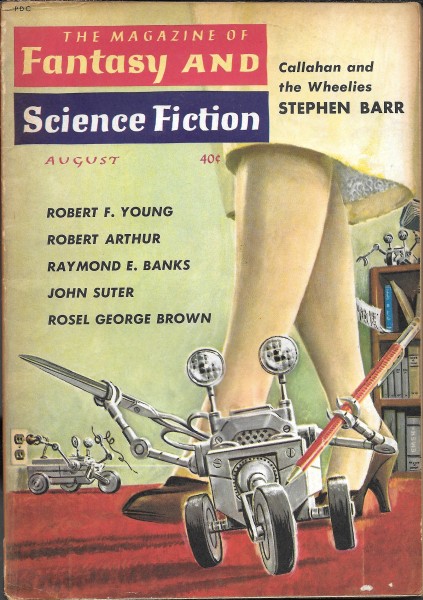
I started reading science fiction almost as soon as I learned to read. My folks belonged to the SF Book Club, and also subscribed to Analog and the magazine of fantasy and Science fiction. One of the first stories I remember was called “Callahan and the Wheelies. That got me started and I never stopped. I still read Analog, but in the online version. Been reading it since the early sixties.

Tom’s World – 12JUL2025 – The Joy of Reading

Tom | Flickr

TomD

The gift of the ability to enjoy fiction, or nonfiction for that matter, has a requirement: an attention span exceeding a minute or two. And that seems to be becoming increasingly rare. Both my parents were readers, likewise myself and two siblings.

I don’t remember exactly when I started reading Sci-Fi but it was as a teenager somewhere along the line. But I suspect that I’m one of the few people on earth who, while in grammar school, read every single volume of Encyclopedia Britannica cover to cover.

I really wish that Nook and Kindle were available back then. I started with Nook probably around 2010 and now use both. Point being that every book I’ve read in the last 15 or so years is still available to me. When, in 2009, I moved from my last residence in metro Atlanta where I had lived for 20 years, I “donated” a long bed and a half pickup truck loads filled to the brim with mostly paperbacks. What a loss! And that wasn’t the only donation made from that house.

I could have that entire mass of books on around several gigs on a thumb drive with lots of room left.

But at least I have the last 15 years and I find myself rereading. +The device keeps perfect order, organizing by order of purchase, title or author.

When I Was Your Age Television Was Called Books

When I was a kid, I was a science fiction fanatic.  I went to the local branch of the Brooklyn Public Library and pored over the shelves.  I read everything they had and then I went to the next closest library and found what they had that was different.  And so on and so forth.  Until I reached the main branch; “Grand Army Plaza.”  And then there was no more.  So, all that was left until a new book made its way to the shelves was the monthly edition of Analog; the science fiction magazine where new stuff was to be found.  Sometimes there was a novel serialization by some well-known author like Heinlein or Frederik Pohl or Joe Haldeman or Gordon Dickson.  But more often there were short stories by anyone and everyone.  Not all of them were great or even good but they were still fun to read.  I had my own subscription for a number of years.  Then I found Camera Girl and I had too much to do with work and school to read anything but textbooks.  But I still saw the Analog covers at the local magazine rack down by the local El stop of the NYC subway.

But once I left New York, I confess I completely lost track of Analog.  I guess I just assumed that it (and its competitors; Asimov’s and The Magazine of Fantasy & Science Fiction) were still out there chugging along even without me.

Turns out I was wrong.  Apparently, they’re all dead or dying.  The market for short science fiction has completely dried up.  Even the anthologies that used to collect these stories and sell them as books have stopped making money.

I guess none of this is surprising to folks who understand how the mass marketing of entertainment has changed.  I guess it only makes sense that the same generations that refuse to buy music and refuse to buy movies would also refuse to buy books and magazines.

Apparently, what they will buy are video games.  Now that reminds me of an old joke from an old movie.  There’s a scene at the beginning of the movie “The Princess Bride” where the grandfather played by Peter Falk is trying to read a story to his grandson who is playing a video game and objecting that instead of a book he wants to watch television so Falk says, “When I was your age television was called books!”

So, I’m at least two generations too late to imagine Americans reading short stories.  Now isn’t that amazing.  Or is it just paying for books that’s obsolete?  I think it must be the latter.  I understand there are free websites where authors provide their stories to consumers and they support these writers somewhat indirectly through Patreon or other means.  I guess this could be the new economy.  It seems as improbable as the world of the “Matrix” where human beings acting as bio-batteries power the cyber world they dream through.

Maybe I’d better find one of these sites and see if I can get these penniless zoomers to read my stuff.  I think I might see if I can play this three-penny opera thing that’s growing up in this brave new world.

Lost Histories

Lots of fantasy and science fiction authors have used the rediscovered history theme.  I think maybe Robert Howard used it for Conan and maybe some of his other sword and sorcery stuff.  Tolkien sort of used it for the Lord of the Rings.  The Red Book of Westmarch is supposed to be the source from which he wrote his books.

So, the conceit is usually a scholar is searching through old manuscripts and suddenly finds stories that somehow no one has ever read before.  I guess maybe a case could be made that an existing manuscript might have a palimpsest layer that couldn’t previously be seen or read and now because of advances in sensing techniques it can.

But usually, this kind of text underneath text is limited to at most a few pages of written language.  But as anyone who has been a religious reader of this site knows, the Roman papyri from the ruins of Herculaneum are slowly and painfully being deciphered using a form of x-ray tomography.  These charred and unopenable papyrus scrolls are being read right through the other layers of charred plant material by an artificial intelligence that can scan the three-dimensional surface of the scroll in its rolled up and damaged condition.

Currently the progress is glacially slow.  And this is even though a million-dollar prize has been announced for the tech genius who can take the scans and turn it into text.  Currently the part of the library being examined contains the works of an obscure stoic philosopher which has extremely limited popular appeal.  But there have been claims made that the total library was an extensive collection of Graeco-Roman literature and history.

If this turns out to be true and the scanning technology becomes robust, there may be many lost masterpieces of ancient writing to be found.  Lost plays by Sophocles and histories of ancient peoples like the Etruscans.  Every classical scholar has a wish list of what would be wonderful to recover.

But what comes to my mind is what a perfect place to find some lost history with fantasy or science fiction elements.  Now exactly what they would be is something that will require careful thought.  As I said there have been a lot of stories somewhat in this vein.  The trick would be to allow this history to tie into the present day in some way.  There could be detailed information of something that’s been buried and could be retrieved.  Or maybe it’s something that’s hidden in plain sight and possibly still operating in the present day.

So, this is the vaguest of outlines and needs lots of thought but while I was out watering the vegetable patch and photographing half-grown preying mantids it occurred to me.  And since I never have an undocumented thought, lo and behold; here it is.  It occurs to me I’ve never written a horror story.  Mostly I just make fun of H.P. Lovecraft but a two-thousand-year-old Etruscan demon might be something I could get interested in.  And since we know next to nothing about the Etruscans, I could make up anything I wanted and no one could definitively call me out on any of it.  What could be lazier?