Lately I’ve been thinking about this topic. What makes a great science fiction story? Can it be a great science fiction story if the story’s not great? How about if the science isn’t great? I think you know what I’m saying. A great story, meaning great fiction, has characters drawn in a way that makes them compelling. It doesn’t have to be Shakespeare but it can’t be two-dimensional cut-outs that wouldn’t make it through a toothpaste commercial. And by the same token, what if the science is just stupid? Sure, you can just say it’s fantasy instead and then the sky’s the limit. But let’s stick to science fiction.
When I was a kid, I would have said that “great” science fiction needed the science but the fiction was not that important. If there were enough star cruisers and anti-matter bombs and giant amoebas then all was right with the world. In fact, the fewer human relations involved in the story, the better. I was much more interested in the non-human characters acting “realistic” than any dialog between humans. And the male/female dynamic was completely off the table. The last thing a Lensman needed before, during or after a battle was a woman getting in the way.
Suffice it to say that time changes things. I look at some of the “classics” of the golden age and I see a flatness to the story. Now, this isn’t an all-encompassing criticism. There are plenty of stories from the day that have nuanced characters and plots that reflect actual human personality types. So, it’s not black and white.
Now, the modern literary science fiction has been described as having the opposite problem. It’s all about human feelings and relations. What isn’t as important is the “science.” When that’s the case I will just declare that if a story doesn’t have any science at all then it isn’t a great science fiction story because it isn’t science fiction. Period.
And without a doubt if a story has an exciting plot and memorable characters and also a clever science fiction premise then without a doubt it’s great science fiction.
So that leaves the other extreme. What if a story is built on incredibly imaginative science fiction plot devices but the characters are cardboard cut-outs of human beings? Can that be a great science fiction story? In this category the works of Arthur C Clarke comes to mind and specifically 2001: A Space Odyssey. Here is an epic tale stretching all the way from the dawn of Man to the first human interstellar voyage. And yet the most human character in the book is HAL9000; a schizophrenic homicidal computer. Now, is it an interesting story? Well, yeah. There are cave men and monoliths and moon bases and worm holes. But honestly, do you find yourself rooting for anyone? There’s just something so inhumanly stolid and wooden about everyone in the story that I feel that each one being murdered by HAL might be his happiest moment. At least liveliest.
But anyway, I want to pose this as a question. Can a technically engrossing sf story be considered great if the characters are ciphers? What do you think?
I have an old beat up collection of Ray Bradbury’s short fiction. It’s called “The Stories of Ray Bradbury.” It was published in 1980 and contains about a hundred of his stories. These stories appeared earlier in a number of short story collections that came out over the years that Bradbury was writing. And he also wrote after this collection came out so there’s nothing original or definitive about this collection but it contains most of the short stories that his reputation was based on. And because it is such a large selection (almost nine hundred pages in a 9.5 X 6.5 hardcover volume), there are great stories and poor ones. There is fantasy, horror, something like science fiction and even nondescript fiction. And because it was written over the course of about forty years it changes. The emphasis, the stylistic touches, the topics all change. But the voice is always recognizably Bradbury. For the most part he is interested in the people. The science is not the story. In fact, most of the time it’s just the excuse for poking and prodding the people and watching them react. It’s a pleasure to walk through this old volume and relive old stories and find out how I’ve changed over the years. Have my preferences changed? Yes. But my likes and dislikes have mostly remained the same. Possibly I’m a little bit more sensitive to the quality of the prose rather than the surprise in the ending.
It’s interesting to consider that science fiction short stories have been declared a dead field. No one buys the stories either in book collections or in magazines (paper or electronic). And that strikes me as a sad situation. So many of these short stories contain wonderful ideas and characters and images that stir the imagination. But somehow, they no longer have any value in the present world. Can that be the permanent state of literature? I guess it could be. Capitalism is ruled by the law of supply and demand. So, there’s no demand for short stories.
Well, that’s too bad. Maybe the future will include a manner for artists to exhibit their works for people similar to how musicians currently perform concerts. A live presentation where the audience listens to the story or watches a video presentation of it in a format that can’t be pirated and therefore has value as a single use experience. All that’s left is the memory of the story. Of course, that’s what movies were but now they’ve also lost their value. So maybe not. But I find a book of short stories to be a treasure trove. A hundred stories and maybe fifty are very good and ten are wonderful. That’s a pretty impressive collection. I think any prolific author would be satisfied with that track record.
One thing that Bradbury liked to do was string together some of his short stories into a larger framework. He did this with turning his Green Town stories into “Dandelion Wine” and his dark carnival stories into “Something Wicked This Way Comes.” And what that shows me is these short stories can be the seeds for longer fiction. But if no one reads them and rates them how will these seeds ever sprout. Oh well.
Now that I’ve assumed the persona of Jake Barter, my whole life has changed. Jake Barter is no ordinary man. At the very least he has the training of a double nought secret agent and the social connections of Bruce Wayne. His resume is a combination of special forces operator and philosopher king. And because of this I told Camera Girl that she needed to treat me with much greater respect and an almost religious awe.
I don’t think she “gets it” yet. You know what they say about a prophet in his own country. Well, that goes double for a pseudonymous author. I think I may now begin to write the memoirs of Jake Barter in my spare time. I think he will be a picaresque character who gets involved in serious situations like wars, revolutions and social movements and ends up causing things to go south in horribly predictable ways based on his sloth, greed and phenomenal incompetence. His only redeeming qualities are monumental overconfidence, enormous likeability and unbelievable luck. I’m thinking I’ll start him off as a special advisor to Trump on constitutional law and then take it from there.
But seriously, I am thinking about new characters for future stories and I think the next thing I do will have a strong humorous streak in it. And this is because I do enjoy making fun of things I don’t like and combining that with a writing project should make it a lot of fun for me. But what I must do is decide if it will be in the same “universe” as “The Sniper.” So far there isn’t a lot of humor there and maybe it would be better to separate a new project from a place with so much trauma lurking around every turn. And that’s fine. Making up multiple fictional worlds allows the author to escape from any traps he’s gotten himself into in the old ones. You can get tired of a scenario or you just need a break from figuring out how to keep your characters from either getting killed or solving all their problems. After all, either of those paths ends the story. So, you have to be constantly threading the needle to maintain the overall “problem” but still carve out a piece of plotline to make the present installment interesting.
I think I might want to do an extraterrestrial story. I’ve played around with some short story / novella length things in the past but they just petered out. I think this time I’ll try to storyboard a whole bunch of stuff first so I have a direction and enough plot lines and an overarching direction for the thing before I get really started. And what is currently completely stymying me is deciding what kind of Earth this will be. Will it be like the actual current day disaster we are living through or will it be some kind of “day after tomorrow” where we’ve gotten our act together and learned how to live like human beings. Well, I’ll let Jake Barter work on that for a while.
Back in the 1960s we had a tv show called “Star Trek.” It starred William Shatner as James Tiberius Kirk, the captain of the starship Enterprise. And for one hour every week Kirk and his crew of four hundred able-bodied men (and women) warped their way through the galaxy seeking out new life and new civilizations and boldly went where no men had gone before.
And wherever they went Lieutenant Uhura kept them (mostly) in contact with the Federation using a form instantaneous contact called sub-space communication. I say mostly because something called sub-space interference would be invoked whenever it would be useful to the plot for the Enterprise to be incommunicado. This would allow Kirk to show initiative and break with inconvenient policy like the Federation’s Prime Directive against interfering in the technological development of more primitive civilizations. Of course, Kirk broke this rule about a million times in the course of the show. But you know, there was dramatic tension while they sorted out their feelings about this rule.
But getting back to sub-space communication, it was instantaneous. Which was needed to make the stories work. After all, radio waves are electromagnetic waves and propagate at the speed of light. The Enterprise travels many times the speed of light (maximum about 1000 times the speed of light). So normal radio communication is essentially useless for them. They could beat their radio message back to Earth by a factor of as much as a thousand-fold.
But here’s the thing. Suppose you want to write a story where faster than light space travel is impossible but instantaneous communication with other stellar systems is possible? What would be the dramatic possibilities of such an arrangement. Well, basically, it allows the writer to imagine radically different cultures and organisms sharing ideas and information across the entirety of the cosmos.
You could have a supremely old race teaching a young one how to avoid all of the dangers that it experienced. And they could teach them about their future. Suppose a race on a planet is circling a star that is about to explode. What would they want to pass on to the universe? Maybe some religious insight or a supremely beautiful musical composition or maybe just their name; so, they would not be forgotten after they die.
Now of course instantaneous communication is as completely untethered to scientific reality as warp drive is. But I can still see how using it in a story without FTL space flight would present story lines that aren’t as well-explored as ones where FTL space flight exists but “sub-space” communication does not.
Now all this being said, I will say that Lieutenant Tawny Madison, played by Sigourney Weaver in the movie Galaxy Quest really improved on Lieutenant Uhura’s performance as communications officer. Her costume was significantly skimpier and showed much more cleavage than Lieutenant Uhura ever did. And Madison didn’t need to wear an ear piece to hear the computer tell her what the ship was doing. All she had to do was repeat what everyone else could hear over the ship’s speaker system. Now that was progress.
Tuesday morning, I have a telecom with a book editor. My marketer provided me with the name and I’m going into this with absolutely no expectations and only slightly more understanding of the services.
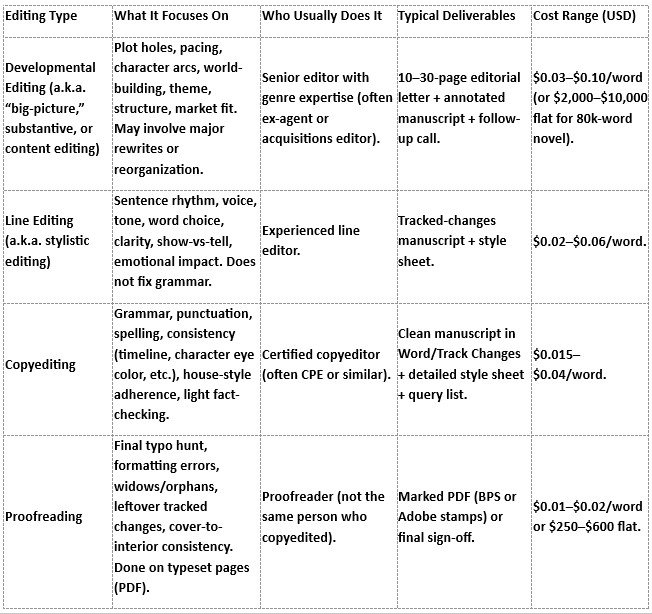
As is now my habit I went to Grok and asked it. “What are the various types of editing that a fiction author might contract for his book.”
And the LLM responded in part:
“Below is a breakdown of the main types of professional editing that fiction authors typically contract for, listed in the usual order they occur during the publishing process. Each level assumes the previous one(s) have been completed.
Now, this is a lot of stuff. And if you add it all up for even a short 65,000-word novel (like mine), it’s at least, several thousand dollars.”
That’s a lotta dough.
So, my intent is to listen and take notes and see just how much in the way of editing I want and/or can afford. I intend to be open about my lack of a trust fund and my unwavering faith in my literary muse. So that should eliminate the developmental editing and line editing functions from the discussion. And honestly, even if I had endless cash to spend, I think I want the words and ideas to be my own and in the voices that I’ve invented.
As far as copyediting and proofreading, I guess I’ll decide whether the benefits justify the costs. After all, I can spell pretty well and for the most part spellcheck does tell me what bothers it. And I did do a pass through the manuscript myself already so I think it would have to be a reasonable fee to win me over.
But regardless of all my reservations I find it stimulating to go through these processes in publishing a book. After all, I’ve been reading professionally published books all my life and I’ve never seriously considered what value was added by the editor. I mean, if the author had terrible spelling and didn’t pay attention to normal grammar and orthography maybe that would have bothered me as a reader. But I’m guessing that the golden age sf writers were all pretty reasonably literate and capable of providing a clean manuscript.
But now I’ll speak to someone who does this for a living and maybe I’ll get a perspective I didn’t consider. Well, we’ll see. Maybe I’ll decide to buy some editing.
And I’m still waiting for the cover artist to get back to me to discuss that piece of the puzzle. Well, one thing at a time.
It is entirely possible that this is the first science fiction movie I ever saw. I seem to remember seeing this on tv as a pretty young kid (maybe seven or eight years old). For that reason, it had a huge effect on my perspective on entertainment. Of course, watching this movie after all these years is a shock from seeing just how ridiculous the whole production is. But at the same time there is a fondness based on the nostalgia it inspires in me, even after all this time.
(Spoiler Alert – Skip down to last paragraph to avoid spoilers and read recommendation)
David MacLean is a young grade school boy whose father is an engineer at a local factory doing top-secret government work. He’s also friends with the local astronomer Dr. Stuart Kelston. David has a small telescope in his bedroom. One night he is awakened about four thirty in the morning by what looks and sounds like a thunder storm but as he watches out his window, he sees a flying saucer land in a sand pit located adjacent to his family’s property.
David runs into his parents’ room and tells them the story. Out of a desire to find out what had scared his son George MacLean goes outside to the sand pit to investigate. And the aliens open up a hole in the sand pit and capture George. When George does not reappear by daylight Mary MacLean calls the police and reports her husband missing. Two patrolmen in a squad car show up and while searching the sand pit area they are also captured by the aliens.
A little later George returns to his house and we immediately see that he is no longer the same man. Whereas previous to his disappearance he was a friendly husband and father, now he is a surly abusive man who backhands his young son for insisting that he saw the space ship land. Also, David discovers that George has a small X shaped wound on the back of his neck near his shirt collar. After a few minutes the two patrolmen appear at the house and they obviously behave just as George is.
And this pattern repeats as through his telescope David sees a little neighborhood girl Kathy Wilson being captured. Later George pushes his wife Mary into the sand pit. And off camera, the town’s Chief of Police also ends up captured too. With all these people now controlled by the saucer-men, their diabolical plan begins to unfold. They are trying to sabotage the nearby factory that is building an atomic powered rocket along with the other plants that are supplying components. Kathy Wilson’s father; Dr. William Wilson is a physicist who is designing the atomic rocket (although how a physicist becomes a design engineer is beyond me). So, she attempts to kill her family by burning down their house. George works in the factory creating the rocket engine so he and his wife attempt to assassinate Dr. Wilson with a high-powered rifle. And the two police officers successfully burn down the engine plant.
At first no one believes David when tells his story and the Police Chief has him imprisoned in a jail cell awaiting his parents’ appearance and probably his subsequent death. But the desk sergeant is disturbed by his obvious fear and calls a medical doctor to look at him. Dr. Patricia Blake listens sympathetically to David’s crazy story and when she finds out that they both know the astronomer Stuart Kelson, she calls him up and is told that David is a very honest and serious child. And when his parents arrive to get David, she notices that they really are behaving abnormally and so she makes up a story about David having symptoms of polio to prevent them from dragging him away.
Now Dr. Blake takes him to Stuart Kelston and we get a crash course on the latest theories on Martian biology. And somehow Kelston intuits that Martians have gotten wind of the atomic rocket project and they are here in their flying saucer to sabotage the project. And Kelston trains his enormous observatory telescope on the sand pit across town just as George MacLean pushes General Mayberry, who is in charge of security for the whole rocket project, into the sand pit.
Kelston springs into action. He calls the Pentagon and a Col. Fielding orders a mechanized brigade of tanks and other weaponry to descend on this little town. Orders are given to arrest the MacLeans, the Police Chief, the two patrolmen and General Mayberry. Only David’s parents are captured alive and are sent to a hospital to attempt to remove the control devices in the back of their necks. The army surrounds the sand pit and eventually finds the saucer and use explosives to open up a tunnel leading to the ship. Fielding and his men descend down and attack the “mu-tants” that serve the super-intelligent Martian. The servants are about seven feet tall covered with green skin and have bug-eyes. They shamble around so slowly it’s amazing they get anything actually done. The master is this little homunculus in what looks like a glass bell jar that the mu-tants carry around. He’s got a humanoid face on top of a body that’s an immobile lump with a few tentacles sticking out here and there. He seems to have been spray-painted with bronze colored paint. He controls his servants by telepathy which we observe as him furrowing his brow. At some point, David and Dr Blake are captured when a hole randomly opens in the ground below their feet. And they have to be rescued by the army and Dr. Kelston (he seems to be in love with Patricia Blake).
The last scenes are of the whole human team running away from the sand pit as the space ship begins to depart with a bomb that the army planted in it about to explode. In the last scene David wakes up and runs into his parents’ room to discover that the whole thing was a nightmare. He goes back to his room and falls asleep. But at four-thirty he’s awakened by noise and sees exactly the same sight of the saucer landing in the sand pit. The End.
My thoughts on this movie. Where to begin? Okay, so the whole movie drips with 1950’s cold-war paranoia. Every character portrayal is over the top and the dialog is pretty hokey. The astronomer’s explanation why the Martians are aware of this atomic rocket project makes no sense at all. And the idea that a local astronomer can summon an army by calling the Pentagon is pretty hilarious. As for the aliens, the costumes and the scenery in the tunnels are laughably bad and the space ship looks like a 1950’s set designer’s idea of a 2000’s manufacturing space. The special effects, mainly, an infra-red “ray gun” is pathetic. On the other hand, the personality of the boy; David is sympathetic and Dr. Blake comes off as a compassionate woman which is always attractive. And the whole action of the army in their “war” against the aliens is ridiculous. The colonel leads his troops into the tunnels and he’s firing machine guns at mutants instead of his gunners doing that. But it’s a great bit of nostalgia. The terrible special effects and the vintage military clips from WWII training footage is wonderful. And all the B-movie and television actors like Leif Erickson, Hillary Brooke (The Abbot and Costello Show), Barbara Billingsley (Leave it to Beaver), Robert Shayne (Inspector Henderson on the Superman Show) and Richard Deacon (Mel Cooley on the Dick Van Dyke Show) are so familiar and comforting. I highly recommend this movie for anyone who loves schlocky old sci-fi.
For a truly lazy man nothing is worse than hyperactivity. And so, my current frenetic schedule has rendered me borderline despondent. But the mail must get through! No, wait. The show must go on. So, let’s do this thing.
Let’s start with the government shutdown. I think the Democrats are crumbling in real time, before our eyes. Most of the people impacted by programs that are about to run out of money, (e.g., Snap) vote for Democrats. So, they’re going to be hurting really soon and that is going to be bad for Democrats running for office. I read an article that said Schumer is already dealing with a bunch of Democrat Senators who are frightened that they’re going to be blamed for poor people going hungry. My guess is things will come to a head in about a week. Well, good. Anything that makes Chuck Schumer look bad is by definition a wonderful thing. So, yay!
Next, the Mamdani ascension to Gracie Mansion looks poised to happen in two weeks. And both Democrat and Republican establishment figures are petrified that this guy is going to reduce New York City to a Mid-Atlantic version of Mexico City. Basically, a bankrupt madhouse run by gangs and beyond the control of the police. And I think they’re right. I read that a large number of the NYPD are going to retire if he wins. I don’t think you need anything more than that to tell you where the city will be next summer. Bedlam.
On a personal note, I received a detailed proposal for the marketing of my book, “The Sniper.” Currently I haven’t had a chance to even look at it yet. I’m bogged down in Dunwich civic life to such an extent that I lose track of the day of the week. But as soon as I can I intend to study it intensively and make up my mind on whether I think I should pursue a commercial plan to market it. By the way, if any more of you folks have finished reading it, please pass along your criticisms to help me weigh the value of going forward with a structured commercial release of the book. Well, to be continued.
I’ve been following Trump’s press releases and moves on the Ukraine War. He was talking as if he would provide Ukraine with Tomahawk missiles. But when Zelensky showed up in Washington to receive them it didn’t happen. Some outlets are saying he told Zelensky he no longer believes Ukraine can win and they should negotiate seriously with Russia to find a ceasefire and a peace plan. I have to confess I’m not sure whether Trump has a plan or is just trying to keep both countries at arms’ length. Russia has made some significant (albeit glacially slow) gains on the battle field. The cities of Pokrovsk and Kupiansk are teetering on the edge of complete capture and several others (Kostyantynivka, Myrnohrad and Lyman) are not far behind. Pretty soon the Russians will accomplish through arms what they are telling Ukraine they demand for a peace settlement. What happens then is anybody’s guess. The NATO countries are stating they are getting ready to send their troops into Ukraine. But I have a hard time believing that England, Germany and France will get their people to agree to this. Well, maybe Trump can broker a deal that’s not too disastrous for Ukraine. We’ll see.
May I offer up this the 1985 SciFi Enemy Mine (https://en.wikipedia.org/wiki/Enemy_Mine_(film) )? It is an excellent adaptation of Barry B. Longyear’s novella of the same name, Directed by Wolfgang Petersen (of Das Boot fame). It had a low budget (40 Million) and its special effects are well, dated even for 1985. Excellent acting by Dennis Quaid and Louis Gosset as the principals. Bombed at the box office as it was Neither Star Wars, Dune, nor Wrath of Khan.
I would also like to add in the war film department the 1969 film Battle Of Britain . To say the storyline is weak is an understatement (although it is briefly redeemed by Susannah York prancing about in her knickers). The killer here is the aerial fight scenes. These involve LARGE numbers of actual Spitfires, Me109 and Heinkel 111 aircraft (Me109 and Heinkels being part of the Spanish Air Force). They are well scripted and had input from Douglass Baeder and Air Marshall Dowding. It has a G rating but some scenes are almost too realistic and freaked out the 8-year-old me, who dunned my dad into taking me to the movie.
I always thought this was a great short story. What a perfect subject for an easily made mini-movie. No super complicated special effects. Some old clothes and props. I like it.
There have been several SciFi takes on this. Three stick out to me beyond Heinlein’s tales of Lazarus Long. These are Niven’s Boosterspice in Known Space, Blish’s antiagathics in the Cities In Flight, and Weber’s Prolong in the Honorverse.
My memory on Cities In Flight is poor, but I think the antiagathics were rare and kept only to the upper class so it has limited effect on it’s society other than envy of the upper classes.
In both Known Space and the Honorverse there is a tendency for careers to be MUCH longer. What would have been generational wealth tends to be personal wealth over time. Prolong gets you 200-300 years in very good shape.
Boosterspice is unlimited, Louis Wu is celebrating his 200th birthday at the start of Ringworld and hangs around MUCH longer(potential spoiler for a 30-50 year old series 🙂 ). There is a hint in a later Known Space story that, over time, Boosterspice also makes Humans VERY risk averse (though not quite Puppeteer risk averse).
In the Honorverse Prolong also seems to extend the period of fertility so 100+ year old couples can be seen having children much later in life. I do not know about boosterspice.
At the time of Ringworld, Earth is still run by the UN and the birthrights system, but little is said otherwise. That said Teela Brown had not yet had boosterspice when she (presumably 20 something) heads off to the Ringworld(again potential spoiler). This might suggest that although extending life the effect on fertility is either negative or irrelevant so reproduction is limited by the normal span of ~ 40 years.