The most important single ingredient in the formula of success is knowing how to get along with people.
Theodore Roosevelt
All the Secrets of the Universe and Some Really Important Stuff Too!
The most important single ingredient in the formula of success is knowing how to get along with people.
Theodore Roosevelt

So now I have to start writing book two of my series. And boy, that’s a wide-open operation. You see I wrote the book based on the idea of a father’s revenge. And all the stuff that grew out of that was seat of the pants writing that came to me as things that would make the story more fun. I invented Connors to give Bogey a powerful friend who owed him. I invented Cutter to facilitate the impossible task of Bogey being invisible to the surveillance state. I invented Chastain to have a conflicted antagonist to provide resistance to the protagonist but also acknowledge the justice of his cause. All of these major characters and the plot elements they involve just grew out of the desire to tell Bogey’s story in an interesting and dramatic way. But Bogey’s crusade is over. He won. He steps out of the center stage. Now what?
It’s not an easy question to answer because I need a direction to go. Certain things are now baked in. The United States government nuked some of its own citizens. A shadowy tech giant took down Washington DC with a technology nobody (including me!) truly understands. This weakened United States is struggling to hold onto the allegiance of many states that have seen its unjust criminal actions exposed and want to free themselves from its tyrannical control. That’s a lot of stuff going on. It’s like the cue ball hitting the racked balls on the nose and scattering them across the table. All the king’s horses and all the king’s men couldn’t put things back together again. So, we have to dodge around the flying wreckage and wait for the ricochets to subside before planning the next move. Of course, I could cheat and place the next story five, ten or even twenty years into the future and announce some faits accomplis as ancient history. And I know that is the lazy way out but, after all, I am an extremely lazy man.
But all of that is still only the window dressing of the story. Hanging together a future history is relatively easy. What I really need is another character with as compelling a problem as Bogey had with his son. But really the two elements are linked. Bogey’s problem grew out of the injustice of the society he lived in and his war against this injustice gives the story its trigger but the larger effect also has to be an interesting story too. So, I need another personal story wrapped up in the tumult I have set loose on my imaginary world. So, what I’m looking for is a personal story that is tied up in the larger actions that I’ve unleashed and that takes the world in a direction I think will be interesting and lead to further stories and actions beyond. The only problem is where to start. Hmmm.
“I fear I have nothing to suggest at the moment, sir.”
“Come, come, Jeeves!”
“I fear not, sir. Possibly after I have seen the lady—-“
“You mean, you want to study the psychology of the individual and what
not?”
“Precisely, sir.”
The old parties are husks, with no real soul within either, divided on artificial lines, boss-ridden and privilege-controlled, each a jumble of incongruous elements, and neither daring to speak out wisely and fearlessly on what should be said on the vital issues of the day.
Theodore Roosevelt

Well, Easter has arrived and Camera Girl is killing the fatted calf (well, she’s serving beef anyway). She’s going all out and in addition to the roast beast there will be lamb and a pasta course with the requisite meatballs and sausage, and various other paschal delicacies like stuffed mushrooms, rice balls and so forth. So that means we’ll be stuffed to the gills by the time dessert is served. She’s serving four different homemade cakes and various ice cream flavors along with Klondike Bars which are an especial favorite of several individuals (including me!).
All of this food will incapacitate some of the attendees (including me!). Probably the girls will avoid the worst ravages as they are more moderate in their grazing and sluicing habits. Whereas all three generations of men will be fighting over possession of the recliners in the living room to better accommodate their bulging stomachs and comatose brains. I don’t assume there will be any great demand for movies from this tranquilized crowd but just in case I’m trying to decide what classic cinema I should have queued up for their viewing pleasure. I think when I was a kid the choices were “The Ten Commandments,” “Ben Hur” or “The Wizard of Oz.” Now “Ben Hur” is easily lined up with Easter. “The Ten Commandments” also is linked since the Last Supper occurred on Passover and the movie chronicles the occasion of the first Passover.
But exactly what is the link between Easter and “The Wizard of Oz?” I guess back in the 1960s the television networks must have had to pay top dollar to air that children’s favorite and they must have thought it would seem even more special if it happened when families gathered for a holiday. I guess I can continue the tradition this year. Well, unless the kids stage an insurrection and demand some vapid modern show.
Of course I could go another direction altogether. A double feature of mid-century science fiction (let’s say “Them!” and “The Thing from Another World”) or W. C. Fields’ “It’s a Gift” and “The Man on the Flying Trapeze.” Both of these options would provide entertainment that greatly exceeds what would typically be found on the cable channels today.
But maybe what we should do instead is even more revolutionary. Maybe we should sit around and talk. After all, how often does the family all get together in one place and find out how we’re all doing? There’s a lot going on in the family. Businesses are being started, students are entering the work force. There’s even a romance that will be represented at the table I believe. That’s a lot to discuss. Maybe that’s what we should do. After all, pretty soon those finishing school will start dispersing far and wide and since I’m getting up there who knows how many more times, we’ll meet face to face. So, I should take the opportunity to spend some time talking to them while I can. I think that’s what I’ll do. Let’s see how that works out.

With a great moral issue involved, neutrality does not serve righteousness; for to be neutral between right and wrong is to serve wrong.
Theodore Roosevelt

The picture I posted is of an old late 70’s era lens for a film camera. It looks a little grungy but I haven’t touched it in well over 20 years.
This lens has a feature that all lenses had at the time but not any more and I don’t know why. It is called “depth of field preview”. This is set up at f4. See the 2nd ring out from the body? It has the straight vertical orange line with the little 4, 8, 11, 16 on each side of the vertical. Notice that the lens is now focused between 10 and infinity (meters). Now look down at the 4’s on each side of the orange vertical. They show that the camera will be focused from around 10 meters to infinity. That explains your shot above.
The DOF preview also tells you that if you were shooting f16, you would be focused from roughly 4 meters to infinity.
To this day I miss this feature. But I guess that it requires too much thinking (read any) for today’s public.
UPDATE:
I should mention that this camera is a Canon AE 1 from sometime in the late 70’s. It was an auto exposure (AE) but you still got to set ISO and shutter speed, and not to mention focus vis a split image distance finder.
(Quick historical aside: split image was the principle optical range finding method for most naval gunnery prior to radar. If you’ve ever seen the zagged warship camouflage paint schemes from WWI and up to mid-war WWII, the purpose was to defeat or eliminate the effectiveness of split image range finding. It gives you no clear planes to match up.)
I had a main camera before the AE1, a Nikon F1, a pure manual camera though it did include a “match needle” for setting shutter and f stop. Before match needles, we had to carry a light meter on a cord around our necks. Things were definitely manual but that meant that you had to have an understanding of all of the elements involved and how they related.
I learned to shoot with my Dad’s single shot 1934 depression era .22 bolt action. No magazine. In order to shoot, you had to, open the bolt, take a single .22 round, insert it in the chamber. close the bolt, pull back the firing pin, aim and fire. Just like having to set all the elements of a photograph, this little production meant that the shooter had no instant backup and had to think about about what he was doing, and understand.
I remember trying to teach my stepson how to shoot with a Ruger 10-22, an autoloader. The 1 lesson was a disaster. With all the easy backup rounds, he had no motivation to absorb the elements that go into a successful shot and just start spraying to little effect. All further lessons until he was a fundamental shooter were with Dad’s old Winchester single shot. Or as I was later pounded into us in the Marine Corp, “sight alignment, trigger squeeze”. I already knew but I did qualify Expert using a M14.
Successful photography is a balancing lesson between a number of variables. Until you learn those variables, one by one and how they interrelate——–
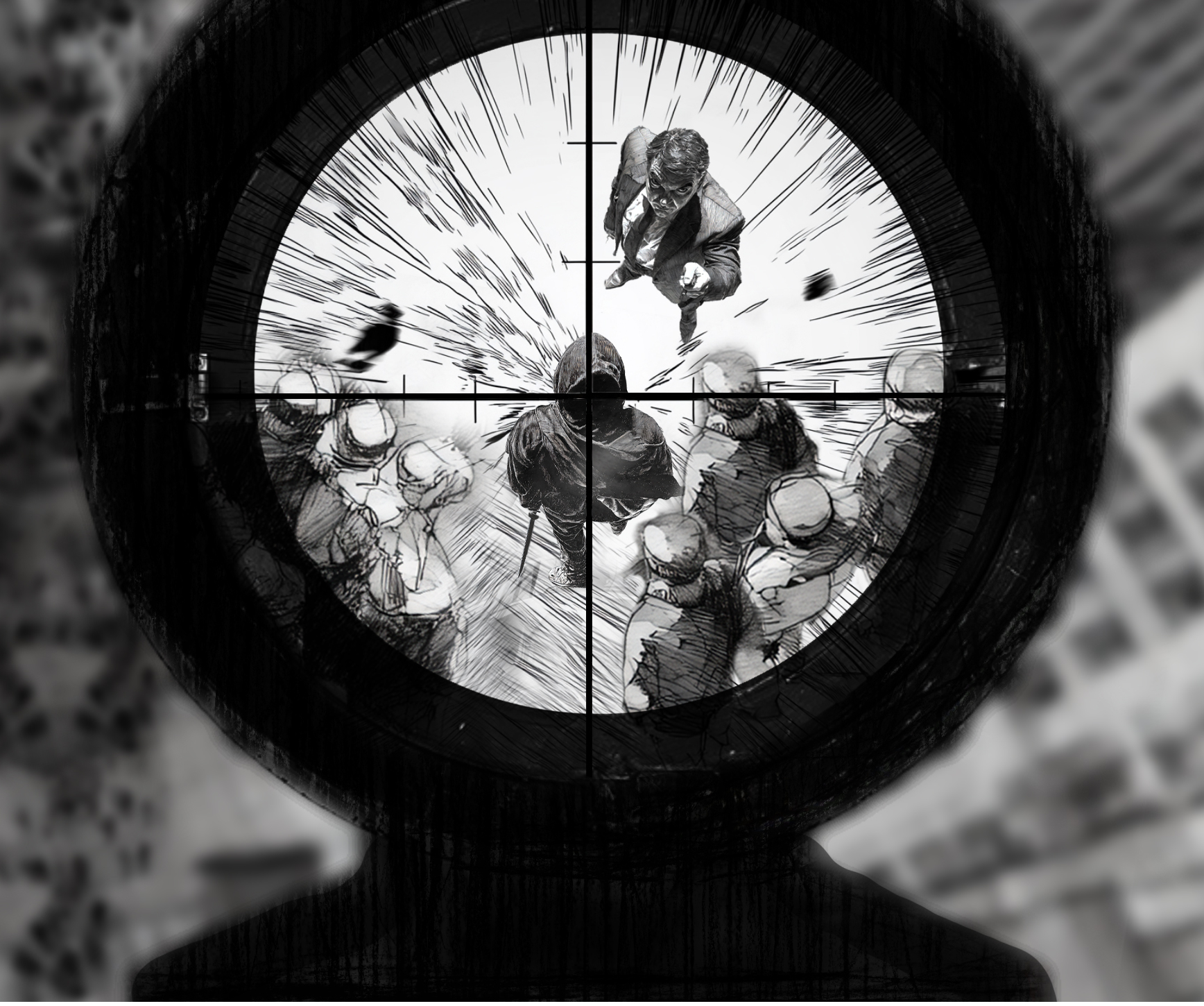
In the last few days, I’ve been getting a few more reviews on Amazon for the “The Sniper.” And today I got my first somewhat negative comments. Take a look.
4.0 out of 5 stars Uneven political thriller good for a slow day
Reviewed in the United States on April 3, 2026
Format: Kindle
The Sniper is a good, but uneven political thriller.
It’s not particularly deep, but entertaining. I liked the plot. I liked most of the characters.
The lack of a star was in the author’s (and maybe the editor’s) lack of basic writing. While the beginning of the novel is a great premise, the lack of detail is astonishing. It’s like someone describing a video game, but just the broad strokes. I read for the details.
The other nitpicky thing is that the basics of prose dialogue is ignored entirely. An exchange between two characters is all one paragraph. And then there’s the commas (or lack thereof). It’s the classic of “Is it Thanksgiving or cannibalism?”
It’s a casual read. If you can read past the details, the general plot is pretty good.
Very interesting.
The Good:
The Bad:
The Ugly:
Yes, very interesting. First of all, this is honest criticism. This fellow doesn’t know me from Adam and he doesn’t owe me anything. That’s valuable to someone who wants to know whether his writing is any good. So, look at the things he likes; “entertaining. I liked the plot. I liked most of the characters.” Those are the most important basics of a story. That’s pretty good.
Look at the criticism; “uneven, not particularly deep, lack of details are astonishing.” He wants more! Okay, that’s a problem. This reader probably wants lots more technical description. So, in terms of the mining equipment and the technology for collapsing the earth under a city he wants the details. Fair enough. Well, there will be sequels and we can get that stuff fleshed out to satisfy the technical type. But since this book was about Bogey and he wasn’t a technical guy, I left that stuff aside. When Connors and Cutter get their stories, I’ll geek out on the details. So that’s okay.
Now for the ugly, I’m guessing that the reviewer was an author or an editor himself. I decided not to use a professional proofreader/editor for the book. I felt comfortable with the level of standard English I could provide. The reviewer is obviously very sensitive to the conventions of professional editing. And that’s legitimate but I’m guessing a lot of my readers won’t be as sensitive to that level of editorial finish.
So, I’m pretty happy with that review. I got an honest review and four out of five stars is pretty damn good news. So, I’m hoping to get a bunch more reviews and who knows I might even get an honest 3 stars from someone. I can take it.