Tempus Fugit – Part 4

“McKenzie’s face paled and his eyes were wide.  He said, “Something must have happened at the end of the program.  It got us back to Earth alright but then some kind of power surge must have caused a tachyon overload and shot us back along the time axis.  I need to review the instrument data.  I can figure out a way to send a tachyon pulse in the opposite phase and throw us forward but I need to do some calculations to calibrate the size of the pulse.  This is an enormous time change.  It may take a few oscillations forwards and backwards to calibrate it perfectly to our present day.  So, it may take us a few days to get home.”  I calmed down considerably after hearing this and told McKenzie to take his time and not to get upset.  And he did seem calmer after I said this.

The seven wise men got to work and were buzzing away at the data from the drive instruments for several hours.  And over the course of those hours, I suddenly began to see this accident as an opportunity.  I asked the photographic expert to see what he could do to capture as much data on Earth at 55 million BC.  And when I said this, it was like a switch was snapped on him and he got incredibly excited realizing what a scientific opportunity was in front of him.  And McKenzie lost one of his assistants as this fellow worked feverishly to record everything he could before we left the distant past.

And within a day they had their program worked out.  They even found out what had gone wrong.  Apparently, the drive needed a slower de-ramping at the end of the cycle to completely rule out the overload we had experienced.  McKenzie even cavalierly said it had been a lucky break because now we could add time travel to the capabilities of his drive.  And I laughed seeing him so full of bravado.

We set the time voyage for the next “morning,” whatever that meant, and when the time was upon us, we put on a brave face but I could tell everyone was keyed up.  We strapped in and the drive snapped on.  All the familiar feeling happened and then after what felt like a slightly longer period it shut down.  We cranked back the cover off the viewing port and there was Earth.  And it was awful.  The oceans were gone.  The planet was a blasted airless rock like the Moon.

We were all hit hard.  I said to McKenzie, “What is this?”  He looked even more upset than before but stammered out, “I must have overshot by a billion years.  This must be Earth after the sun runs out of hydrogen and becomes unstable.  But it doesn’t seem possible I could have been off so badly.”  He said he would use the position of the stars to get a read on how far in the future we were.  I said, “Sure, go ahead.”  And I tried to sound casual but I was scared, plenty scared.

The boys got busy figuring out the date from star locations.  After a few hours McKenzie came back to me and said he had the date.  I asked him how far in the future we were and in a flat intonation he croaked out, “A thousand years.””

Tempus Fugit – Part 3

“When we returned from Pluto we began the planning for the first interstellar trip.  We had about fifty stellar systems that had earthlike planets in what we measured to be the Goldilocks Zones around their stars.  We selected a red dwarf about fifty light years from earth; LHS 1140 whose second planet was believed to be a super-earth well within the habitable zone of its star.  We intended to take a lot of measurements of the planet and its neighborhood and then head straight home.

The crew would be me, McKenzie and a six-man science team that would take the measurements of the exoplanet and the surrounding system.  I also insisted that Bertram train one of his colleagues on his star drive in case any accident incapacitated him before the return.  He started laughing when I told him this, “Afraid I’ll jump ship and go native?”  I told him this was a dangerous mission and we had to have some redundancy for something as important as the astrogation.  He laughed again but he put together a manual for running his equipment and trained one of his “bosses” for the upcoming flight.

McKenzie set up the program for LHS1140 and the ship was equipped for a one-month voyage; oxygen, water, food, medicine.  I even brought some firearms, only because I realized where we were going there was no law in effect other than force.  I kept the locker those were in under lock with me the only one with a key or even knowledge of their existence.  I guess that was a little paranoid but you never know.

Came the morning of the trip everything had been inspected three times and the dashboard was all green lights.  We launched into the upper atmosphere and McKenzie set the program and a display counted down from sixty seconds.  When it reached zero, we felt the strange sensations of the drive for a few moments and then we felt normal again.  When we uncovered the viewing port there was a strange world far below us and the light of a red star was illuminating it.  The whole crew burst into spontaneous cheers.  You never saw seven nerds happier than these boys.  I thought they would never stop slapping each other on the back and jabbering about who had been most right about the planet’s appearance.  I have to admit I was pretty excited too.  That world was a mostly ocean planet with white clouds and what looked like island chains sprinkled across the equator.  There were even what looked like ice caps at the poles.  It was an amazing sight.

The boys spent the next week photographing and taking spectrograms of everything they could see.  I made a decision that for this first trip we would not enter the atmosphere of the planet.  Probably out of an exaggerated sense of caution I wanted to make sure that no microbes from this alien world found their way back to Earth.  The boys were bitterly disappointed but shrugged their shoulders and took it in stride.  After all, even a week flew by shockingly fast because of how busy all the observations and tests kept them.

Finally, I set the return hour for the morning of the eighth day.  McKenzie recalibrated his instruments by stellar observation and as the final minutes ticked off, we took our places and strapped in for the ritual.  Once again, the skin numbness and mental unease hit me but a few moments later it ceased and we cleared the viewing port to see Earth below us.  The rotation of the Earth had us facing the Eastern Hemisphere and so we could see Africa and Asia.  But something was screwed up.  India was floating off shore.  There was ocean between it and the Asian continent.  And when you looked at the whole world all of the land masses were “off.”

One of the scientists explained it to me, “That’s what Earth looked like 55 million years in the past.”  I looked at McKenzie and said, “I hope you brought your tools because we’re a long way from home.””

Tempus Fugit – Part 2

“Devon, what was your genius’s name?” I asked.  “Bertram McKenzie.  He was originally from rural Maine and all the rest of his family were working class people who labored in the fishing and lumber industries.  But he had always had a mind that looked at things differently.  When he looked at a landscape of hills and trees his mind saw curves intersecting in geometric figures.  Everything was a jigsaw puzzle waiting for him to find the missing pieces.” said Devon.

I could see he had lost focus and was stewing over whatever loss he had suffered.  I said, “Had he made any progress on your FTL drive?”  Devon startled, then nodded, “Yes, yes, he had figured out a way to produce tachyons and use them to freeze time while a vessel moving at normal speed was translated across any distance in almost no time at all.  It had to do with a particular juxtaposition of different atomic environments adjacent to an electron flow.  Very thin layers of complementary metallic elements produced a surface against which time slipped by without aging what was enclosed in the field within the surface.

He had performed thousands of tests to perfect the environment needed.  He’d been sending out orders to a firm that did atom thickness vacuum metal vapor deposition work.  He’d built small test units with a number of crazy metallurgies.  Various platinum metals with layers of gold, tantalum, niobium and several other exotic elements sandwiched between in various geometric shapes.  Finally, he identified the perfect metallurgy.  There were even hollow spaces designed to allow cryogenic liquid hydrogen and helium to be pumped in.  With these as walls he built his miniature ship, about three feet long.  Inside he installed various generators to produce electric current and a control system to run the programs that his machines needed to perform.  It was fascinating.  The test program was to place the ship on a platform at the top of a cell tower and then when it disappeared, to immediately inspect a spot fifty miles away that lay in line with the rotation of the Earth from that spot.  The first fifty-three times the experiment was run absolutely nothing happened.  The ship stayed completely still.  But Bertram doggedly retrieved his test vessel and changed some of the parameters of the equipment or the program.  On the fifty fourth run the vessel disappeared.  It did not show up at the site it was meant to reach.  A careful inspection of the ground in between found it embedded in a tree about half a mile south of the expected line of motion.  The tree had been knocked down and the vessel was a flattened hunk of junk.  But it worked.  The concept had been proven.

Bertram’s budget was expanded asymptotically.  No expense was spared.  We got to work on a prototype that would be a craft one hundred feet long and capable of flight inside and outside of planetary atmosphere.  The work was done under the highest level of secrecy.  But somehow the secret leaked out.  Intelligence agencies around the world were buzzing with news that we had a star drive.  Washington was livid.  But what could they do?

Once the vessel was built and its first few trials to the Moon had been successfully run it was decided that the first exploratory mission would be to Pluto.  After all that was a good tune-up for a stellar mission.  I insisted on being aboard and since Bertram was game, I made sure he would be there too.  And after all, he might be needed for repairs.  The takeoff was a traditional aircraft ascent into the upper atmosphere, no gee force, no rapid climb.  When we reached a cruising height the field was built up and the program was activated.  It was the strangest feeling when the ship energized.  I could no longer hear the rush of the air against the outer skin of the vessel.  All I could hear was the hum of the drive.  But I also felt some strange sensory effects.  It was as if my skin became numb and I had a feeling of depression settle on my mind.  But when the drive shut off all the effects ceased.

When we uncovered the viewing window there was the strange heart-shaped vista of Tombaugh Regio visible on the surface of Pluto!  An unforgettable sight.  I sat there and stared for half an hour before I could believe it was true.  We had a star drive.  I congratulated Bertram and realized he hadn’t heard me.  He was doing some calibration measurements for the journey home and was singing lowly what sounded like the “Ride of the Valkyrie.”  When I floated closer to where he was sitting, I could make out the words, “Death to the Wabbit, Death to the Wabbit, Death to the Wabbit.”  He really was a strange man.  But he was also the greatest genius of all time.”

Tempus Fugit – Part 1

He was the richest man in the world by quite a lot but he looked like he had seen a ghost.  I had interviewed him several times and had always gotten along better with him than the rest of the journalists around.  Maybe because I had treated him the same whether he was schmoozing the Democrats or the Republicans.  And that was because I found him interesting.  And that was because he actually did stuff that was interesting.  He made personal helicopters and robot servants and had invented a cure for baldness.  He was a Thomas Alva Edison for the 21st century and he was always surrounded by a bevvy of super models.  What wasn’t to like?

But when I showed up at his office for our appointment the man looked stricken.  His face was completely colorless and his eyes were blank.  I had been let into his office and he was sitting at his desk but he was looking past me at the wall behind me.  After an uncomfortable minute I said, “Devon, should I come back another time?”

His eyes slowly shifted to my face and he shook his head, “No, you’re here.  Let’s talk.  What do you want to talk about?”  I said, “Well, I guess I’d like to know what happened to you?  Was there a tragedy in your family or with your friends?”

He thought about that for a bit and said, “Yes, in a way there was.  A very sad story.  But I’ll have to tell you the whole thing for it to make sense.  Why don’t you sit down.”  He opened up a drawer and took out a pack of cigarettes and lit one up and said, “For the last ten years one of my government contracts has been a research project into a faster than light (FTL) space drive.  For five years we looked at all kinds of reasonable and crazy ideas and we found exactly nothing that was even remotely possible.  I hired every physicist that graduated from MIT or Cal-Tech and every single one of them came up with nothing.

But eventually I heard about a brilliant theoretician who was wasn’t working on space travel but instead had been investigating the fundamental basis of time.  He was attempting to find the tachyon, the basic particle underlying the phenomenon we call time.”

I said, “But Devon what would this research into time have to do with faster than light travel?”  His face showed a glimmer of life for the first time, “Because in the general theory of relativity it is assumed that time is just another dimension along with the three spatial dimensions.  If you can control time, you can control the speed at which the other dimensions are traversed.”

I nodded my head with a somewhat confused look on my face and he continued, “This time researcher was a very strange man.  He was in a sense, self-taught.  He had attended a state college as an undergraduate and done exceptional work in physics but he didn’t have the money to continue on as a graduate student so he dropped out and somehow found himself at work in my company as a laboratory technician.  I discovered that one of my labs was using an inordinate amount of electrical power and I traced it back to this fellow.  He was running his own experiments off-hours.  When I told his boss to fire him, he confessed that they’d be lost without him.  He had an astounding collection of skills with the advanced electronic and high energy equipment that was needed for this faster than light research so replacing him would take months and require hiring five or six separate technicians.  I relented but ordered that the pirate report to my office for “orientation.”  I wanted to meet this strange man.

And strange he was.  He was about thirty years old.  He was about six feet tall, brown curly hair and very thick glasses.  He had an intense expression as if he wanted to ask a question but didn’t know how to say it.  This sort of intrigued me so I tried to put him at his ease so that I could delve into his peculiar circumstances.  It turned out he was incredibly well versed in almost every aspect of general relativity and particle physics.  He had a theory about the speed of light and how it related to the “viscosity of time.”  He said that photons were laminar flow phenomena and what he was investigating was turbulent temporal flow.  I at first assumed he was completely crazy.  I later discovered I was wrong.”

Vitality and Right-Wing Literature

I was listening to a podcast by NY Times token “conservative” Russ Douthat talking to conservative publisher Jonathan Keeperman.

Keeperman is a publisher for a press called Passage Publishing.  He has a lot of avant-garde friends like Curtis Yarvin and possibly some of the Silicon Valley folks like Peter Thiel.  He and Douthat talked (a lot) about how the Right is becoming a sort of counter-culture in the way that the Left did back in the 1960s and beyond.

It’s kind of interesting to hear them discuss this shift in the culture in general but one of the more interesting things that Douthat said was that up until now the Right hasn’t produced any real literature on its side of the cultural divide.  Then Keeperman made some offbeat suggestions saying things like Cormac McCarthy’s

“No Country for Old Men” is from the right.  I think specifically he said that the Coen Brother’s movie based on it is from the Right.  Now never in any imagining have I ever equated the Coen Brothers or their movies with anything right-wing.  So, I find this very strange.  And honestly, all the people associated with Curtis Yarvin have always struck me as hipsters.  And I have always ranked hipsters as the most left-leaning of all the various weirdos to be found in New York City.  So, none of this makes a lot of sense.

But I guess if someone interested in literature who wasn’t a Leftist wanted to talk to the New York Times about literature, he would talk to Russ Douthat and try to find some middle ground where they could both make believe that Douthat wasn’t a total leftist.

I was interested to read that Keeperman has published illustrated editions of H P Lovecraft and Robert E Howard and that leads me to think that maybe he’s not a leftist.  The Left despises both of those old authors and would never publish their works under any circumstance.  So, I need to find out a lot more about Keeperman and his press.  It could be interesting.

But he said one interesting thing about the current state of right-wing literature.  He said that the problem with most of it is that it’s mostly just grievance based.  It exists to rail against and blame the leftist society we currently live in and therefore loses the chance to be “vital.”  Essentially, it’s existence is only as a protest against the status quo and therefore only has a negative presence.

And that interested me.  Because my book is in a real way, exactly that.  It is a war being fought against the status quo.  And so, I have to look at what I wrote and see if his criticism of this kind of story is a legitimate case against the value of the story I have written.  In order to do that I will have to look at what gives “vitality” and entertainment value to a story.

Of course, all things are relative and being objective, especially about something I myself wrote is fraught with peril.  Probably the only way to know for sure is to attempt to get it published and see what results.  But it has given me pause and I will think long and hard to see if I think there are any aspects of the story that lack “vitality.”  Whatever that is.  Boy when it rains it pours.

She-Hulk X

I was watching the 1930s King Kong movie yesterday and thought, “That was a damn good idea for a motion picture.”  It had a love story, a damsel in distress, prehistoric monsters, an ocean voyage to a tropical island, a battle scene involving the latest weapons technology of the time, a strange culture, a scantily clad pretty woman and the capitol city of the world as a backdrop.  It was a fantastic story and considering the special effects technology of the time it must have been a truly exciting movie to watch.

Now I compare this to what passes for adventure movies today and what have we got?  Most of what is out there are superhero movies.  One or more characters dressed up in spandex running or flying around battling each other to cause or prevent mayhem to the human population around them.  And after two hours of this, usually nothing much has happened.  Some space jewel or other has been found or lost and some bad guys have been captured or chased off.  But to all intents and purposes nothing substantive has been achieved or lost.  For the most part no one even dies.  It seems rather pointless.

I think something has been lost from the art of storytelling.  Now this isn’t completely the case.  There are still movies with a beginning, middle and end.  I guess a decent example would be Christopher Nolan’s Dark Knight trilogy.  Batman Begins, The Dark Knight and The Dark Knight Rises; beginning, middle and end.  We see why Bruce Wayne became Batman.  We see him defeat his greatest adversary and we see him walk away when he can do no more.  It’s not Shakespeare but it is decent story-telling and effective spectacle.

Now compare this to the Marvel “Avengers” series.  There have been dozens of these movies if you count all of the sequels, spin-offs and television productions.  Each “hero” has a sequence of movies and then there are the ensemble films and basically nothing meaningful happens.  And now they’ve gotten to the point where they want to swap out the older white male heroes with black and female successor heroes.  The most laughable one I’d say is “She-Hulk: Attorney at Law.”  I have to assume that if she loses a case she hulks out and rampages through the court building until her client can escape the pulverized masonry.  Basically, these people have no conception of story-telling and are just building boring envelopes that they can fill with CGI effects.

Even something as absurd as the John Wick movies is better than this.  At least it started with an original movie that had a character and a plot.  Granted the character is a cartoon and the plot is as simple minded as any imaginable but there is an arc to the story and things definitely happen; mostly flying bullets and dead Russian mobsters but within the confines of the story it keeps your interest mostly.  Now it is almost unbelievable that they’ve been able to turn this into a series.  The body count in the first movie was in the high two figures.  In the second movie, which was the last one I watched, the action was so frenetic I couldn’t even tell how many people he killed.  The automatic weapons fire was almost continuous for ten minutes at a time.  I don’t even know how we’re supposed to believe that the guns don’t start to melt from the heat.  But even this absurdity is preferable to the boring Marvel movies.

I understand that Hollywood is solely driven by return on investment and pumping out sequels to existing intellectual property like the comic book characters is one of the only allowed pathways to getting a film made.  The exception is someone like Christopher Nolan whose reputation for success will allow him to make a movie like Oppenheimer.  But you can count those trusted movie-makers on the fingers of one hand.  And they’re getting old.  What happens when they’re gone?  She-Hulk II or III or X?

Now, Wouldn’t That Be Something

When I was a kid interstellar exploration was something that people talked about as if it were only a matter of time before we figured it out.  Fifty years later and I think we’re all a lot older and wiser.  Even completely automated space craft reaching the nearest stars has begun to look like an improbability anytime within the next millennium.  The scope of the resources needed to get something from here to even Proxima Centauri is staggering.  Of course, I’m talking about a total project time that only totals into decades of time.  If we’re interested in a 40,000-year round-trip, we could start working on it right now.  But something like that is so laughably useless that I’d be embarrassed to even admit considering it as one of the options.  To make the trip in a time frame that makes it useful the ship would have to accelerate to and decelerate from some considerable fraction of the speed of light.  Let’s postulate 30% as the fraction.  With that capability the trip would take something like twenty-five years round-trip.  Sure, that’s a long time but our civilization should have a long enough attention span to follow up on the project and mine the results when the probe returns (if it returns).  But the scope of such a project is too titanic for our current technological stage.  It’s too grand.

Let’s look at more manageable projects.  What’s doable?

I don’t have much enthusiasm for Elon Musk’s manned trip to Mars.  Four or five years in space is a lot of radiation for astronauts to absorb.  I don’t see the sense in it.  I prefer the robot exploration thing we’ve been doing with the Voyager and later probes.  The recent flyby of Pluto was very impressive.  But I think much more ambitious unmanned exploration of the solar system is warranted.

I think the best bang for the buck is finding out if Europa has life in its ocean.  I can imagine a series of visits.  The first should be an orbiter that sends down a probe to take reading.  Once the presence of water oceans has been confirmed a lander can be sent to try and find life.

I realize this is a large order to fill.  I don’t know exactly how thick the ice crust is over the ocean.  It may be many miles.  If that is the case a very creative solution may be needed.  Possibly a nuclear powered “drill” might be an option.  Of course, if all else fails we could set off a nuke.  Then again if there really are “Europans” we might start an interplanetary war.  So maybe some thought will have to be expended thinking about the best way to search for life there.  But I see a series of missions to attempt to answer this question as one of the most meaningful and exciting challenges that currently exist for mankind.

Of course, I’ve been talking of the cuff.  Doing a quick AI search I see that the exact thickness of the ice is estimated to be between 5 and 20 miles thick.  NASA’s Europa Clipper mission, launching in October 2024 and arriving at Jupiter around 2030, will use radar to penetrate the ice and measure its depth more precisely.  So, chances are I’ll be old and broken down before much of anything is known about this ocean.

But I still find the prospect exciting.  Imagine if some kind of multicellular life exists in that ocean.  I hesitate to even imagine intelligent life there but it’s not impossible.  We might find that wherever there’s liquid water and organic molecules life tends to develop from spores that float around in outer space.  Now wouldn’t that be something?

To Serve Man.  We Need a New Cookbook

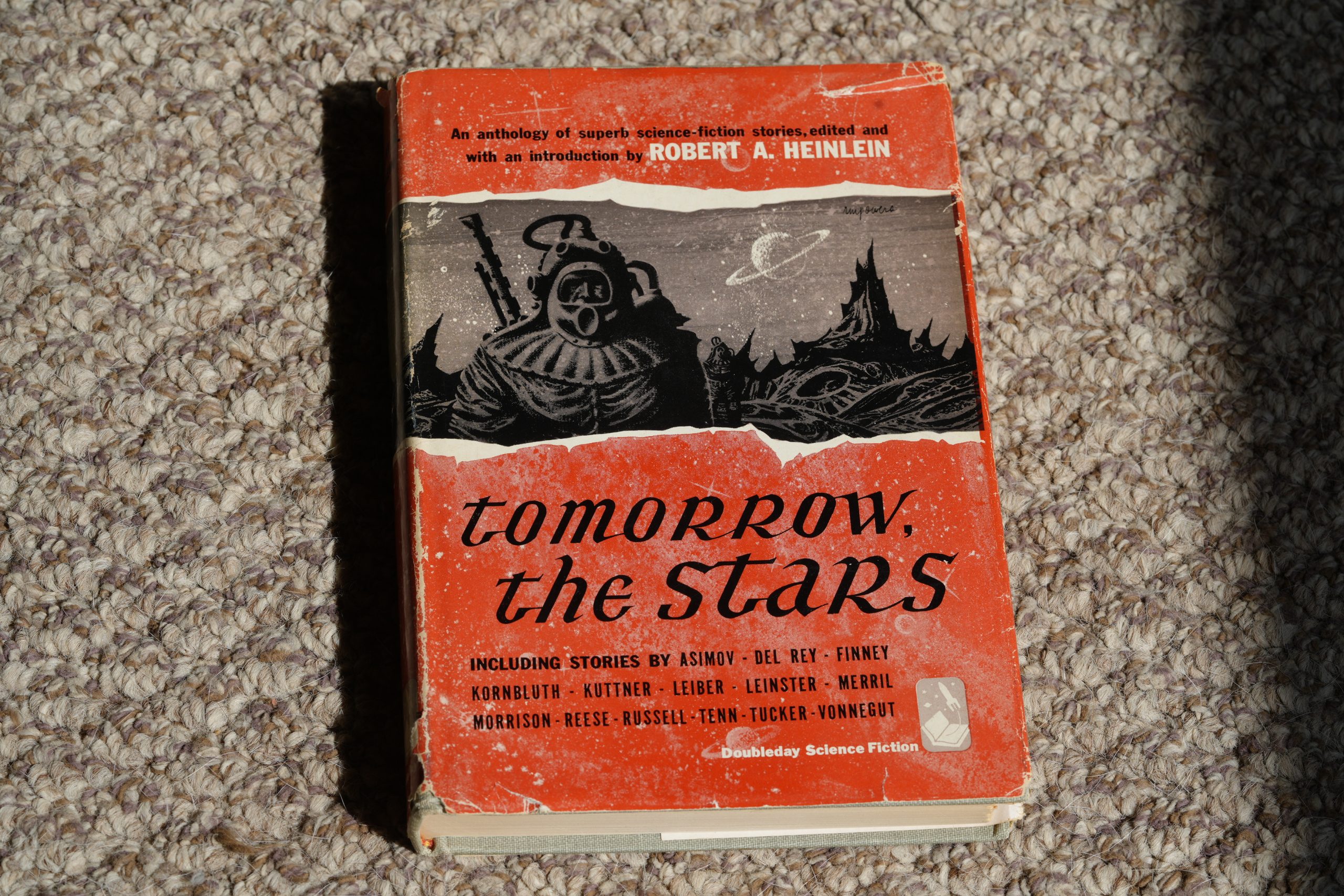
All this Heinlein stuff has me thinking about science fiction.  And that’s fine by me.  The current political theater between the Trump administration and the various judges trying to block his orders isn’t something I want to provide a blow-by-blow description of.  Either Trump figures out a way around these obstacles or he fails.  Either way I’ll wait till I can see the outcome.

But science fiction is interesting to me.  From my way of looking at it, science fiction is the dominant form of storytelling in American society and has been for well over a century.  Now this isn’t what literary types believe.  But genre fiction is the dominant form of fiction in this country and science fiction is what fueled the imaginations of young people for most of the twentieth century and still does even in these times of moral rot in the arts.

So, this gives me a chance to talk about my ideas about where science fiction should and will go.  And I think the current direction of technological progress will provide the impetus for where the stories will go.  Currently I don’t think space travel and advances in biology are the topics that garner our attention.  Not to say those things won’t continue to interest people.  But currently the real impact of technology on our lives is artificial intelligence.  But more than just how far AI will go in replacing humans in various aspects of commerce is what this will do to our society.  And more specifically how will humans push back on the people running industry who don’t see this as a problem or at least don’t see it as a problem for them.

Because let’s be clear.  Automation of all kinds has been changing our world for hundreds of years.  An iron foundry displaces ten thousand village blacksmiths.  An automobile factory and a gas station in every village eliminates the need for train stations across the country and all the people who worked on them.  Every innovation in technology displaces the human beings who supported the previous version of “how things are done.”  But this latest innovation wants to replace the most important attribute of a human being; his ability to think.  His ability to create intellectual property.

And that’s a revolution.  And I think, that’s what science fiction will want to talk about.  Of course it’s been talking about that for decades.  On the hackiest level, that’s what the Terminator movies are all about.  The machines are going to get rid of us.  So are the Matrix movies.

But I think more nuanced portrayals of how AI will affect humanity and how humanity can affect the roll out of AI are what is needed and what will be interesting to people.  Now far be it from me to denigrate the fine work that Arnold Schwarzenegger and Keanu Reeves have done to enlighten the human population to their imminent danger at the hands of sentient machines.  I know that I’m always on the lookout for Austrian bodybuilders sporting gatling guns or déjà vu black cats crossing my path.

But what seems to me to be needed is a way to make AI healthy.  Currently, everything about our on-line existence is harmful to us.  It’s some combination of anti-social, irritating and stultifying.  It’s making our lives worse.  And that doesn’t seem to be accidental.  It seems to be a feature of the algorithm.  It almost seems like an anesthetic meant to keep us groggy and confused.

I think science fiction should be focused on rethinking how this ultimate technology has to be forced to work for the benefit of humans instead of as a rat poison to finish us off.  So that’s what I think.

Guest Contributor – Tregonsee – 24MAR2025 – Heinlein Juveniles

Hmm reording in my preference

Have Space Suit—Will Travel (1958)
Citizen of the Galaxy (1957)
Starman Jones (1953)
Time for the Stars (1956)
Farmer in the Sky (1950)
Tunnel in the Sky (1955)
The Rolling Stones (1952)
The Star Beast (1954)
Space Cadet (1948)
Rocket Ship Galileo (1947)
Between Planets (1951)
Red Planet (1949)

And yes Space Nazis is silly NOW but it was written in 1947 and so is a reasonable period thing. That said it still is a bit of a loser as a story:-) . Have Space Suit is clearly the best of the best. I read both Between Planets and Red Planet, but other than the Venusian Isaac Newton I remember little. For a Heinlein piece of writing that tells me it was unremarkable (although likely superior to many “Hugo” award winners since the early 2000’s)

As to Starship Troopers that is a special case and I need to recuse myself from that judgement. You see it was the first Heinlein I read when I purchased it for 75 cents at a book fair in 6th grade. So I did read it in the time period for a Juvenile. It certainly has many of the Heinlein juvenile tropes with a just out of teenage protagonist (The literary types if they deigned to read Heinlien might call it a Bildungsroman). There is NO sex and perhaps a little romantic/sexual tension.

One might argue that Starship Troopers being an intentional polemic to duty is of a larger import than the Juveniles, and yet Have Space Suit deals with the complexities of who rules and how they rule with Three Galaxies, Citizen of the Galaxy takes on slavery and the fact of people ignoring it for their own profit, Starman Jones deals with the issues of having cheated to break out of an unfair system and the consequences (admittedlythey DO get Deus ex Machinaed out of the way), I can’t say I wouldn’t give Starship Troopers to a young person (Having myself benifitted from it although the powered armor was more of interest than the politics to a 6th grader). And it sits closer to the Juveniles in style and feel than either Stranger in a Strange land or The Moon is a Harsh Mistress. If I must put it in the Juveniles it goes before Have Space Suit. But as I noted I am biased and one never forgets their first love.

As a separate issue should Podkayne of Mars be in this list. It is an oddball (and not published for the same publisher) but yet other than a female protagonist it certainly fits the mold as well as Starship Troopers.

The Juvenile Novels of Robert A Heinlein – A Short Discussion

I had so much fun with the Heinlein short stories that I’m rolling into the Heinlein juveniles.  I think many people understandably feel that the juvenile novels may be Heinlein’s best work.  I confess I’m of two minds about that.  They have different properties and leave room for adult novels to show their quality in a different way.

But let’s see where we can go with these stories.  I think I’ll rank them best to worst according to my incredibly sensitive literary faculty.


Have Space Suit—Will Travel (1958)

The Rolling Stones (1952)

Farmer in the Sky (1950)

Starman Jones (1953)

Citizen of the Galaxy (1957)

Tunnel in the Sky (1955)

Red Planet (1949)

The Star Beast (1954)

Space Cadet (1948)

Time for the Stars (1956)

Between Planets (1951)

Rocket Ship Galileo (1947)


I’ve left out Starship Troopers (1959) because although Heinlein included it in his juvenile series.  I think it’s actually one of his adult stories.

Now my order is obviously idiosyncratic and to be perfectly honest most of the stories are fairly equally good so it’s a very rough sorting.  I did put Rocket Ship Galileo last because now, space nazis do seem a bit silly to me.  But at the time the story seemed just fine to adolescent me.  Maybe depending on the day “Tunnel in the Sky” and “Citizen of the Galaxy” could switch places on the list.  And maybe a few other ones too.  But let’s go with this.

The only story that I think I can objectively hold up as accurately ranked is my first choice, “Have Space Suit—Will Travel.”  I think Heinlein did excel his usual juvenile story here.  The protagonist, characters and plot devices are especially enjoyable and I can say even now, a sequel or two in this universe might be a fun read.  Who knows, maybe one day I’ll contact the Heinlein estate to find out if they have any provisions for making that part of his intellectual property available to “respectful” collaborators.

I gave copies of all these books to my grandsons as soon as they were old enough to read.  I consider them excellent company for growing boys.  Just looking at that list of names makes me think of picking up “Starman Jones” or “The Rolling Stones” just to relive the feeling of reading them for the first time.  They are each a touchstone to a very happy time in my life when the local library had a whole shelf of these Heinlein stories just waiting for me to read them and move onto the next one.

One other word on these books.  Of all the books, I think “Between Planets” was the only one I never reread.  I remember it took place on a Venus that was tropical in climate.  There was a Venusian named Sir Isaac Newton, I believe, but I don’t remember very much else about the plot other than some kind of interplanetary political intrigue.

So, what is your order of excellence?  And what is your rationale?  And where exactly do you stand on the “Starship Troopers” question?  And what is your opinion on space nazis.  Leave your comments in the comments section below.