Some might wonder what took me so long to get “The Sniper” onto the Based Book Sale roster. Well, as with every deficiency in my biography it comes down to laziness and poor planning. But at long last the stars have aligned and it’s full speed ahead.
The Based Book Sale starts Wednesday, September 9, 2026, 12:00 AM PDT and runs through Wednesday, September 16, 2026, 12:00 AM PDT. “The Sniper” will be a linked free promotion on Amazon from September 9th to September 13th. Afterwards it will be available as a $0.99 e-book purchase there until the end of the Based Book Sale. After that it will revert to the $4.99 e-book price. The paperback will maintain its current $9.99 price throughout.
Even for folks who already have “The Sniper” there will be lots of other quality non-woke stories to get free or at a really good price.
Bureaucrats are one of the things that make American life purgatorial. But small-town bureaucrats are a special case that is worth discussing because of their emergent characteristics. When I was young and living in New York City, one of the most horrific ordeals that the city could dish out was a trip to the Department of Motor Vehicles. The DMV was located in a large old building and there would be many, many lines of New Yorkers waiting to get their business attended to. Maybe your license was about to expire and you had to pay the fee or get your picture taken or take the eye test or, God forbid, you needed to correct a mistake on the document. You would wait in one of these lines and hope against hope for quick service. Eventually, this hope would cruelly die in that first line. The glacial pace of the line would sooner or later crush your spirit and you took on the same weary, miserable expression of everyone else around you. And even before you reached the front of the line you would have already sized up the essential traits of the clerk waiting on your line. She (it was always a woman) had a face that could stop a clock and her IQ probably hovered around 75 and she worked and talked so slowly that you weren’t sure from moment to moment whether she had lapsed into a coma. But regardless of her demeanor and obvious imbecility the only thing you knew going in was that she would declare your problem didn’t fit her services ands she would redirect you to the back of some other line. And this same process might be repeated several times until finally you might just flee the building rather than risk arrest for assaulting a public servant.
But small towns do not possess this kind of apparatus. Even at tax time they do not possess the vast numbers of citizens needed to turn lines into killing fields. They just don’t. But what the bureaucracy of a small town does possess in spades is kooks. Once again, they’re all women (well not the road department but they’re not really bureaucrats) and they often have faces that could stop clocks but their scope of influence is limited. There just aren’t enough people in town hall to endlessly stall a tax payer from receiving some government service. So instead of delay they’ve developed the art of obfuscation to a high art form. I was talking to the assistant town clerk of Dunwich and wanted to clear up a problem having to do with the misspelling of a road name. And it was complicated. Both names that were listed in various state databases were incorrect but I wanted to determine who had jurisdiction over what the correct name actually was. She sent me to the Assessor’s Office but the Assessor was out of the office for a while and so I got the assistant to the Assessor. I might as well have been speaking to a parrot. She kept taking the information I gave her and mixing it up in her mind and when I tried to correct her, she just talked over me and tried to solve the wrong problem. And of course, she just kept getting more and more confused and excited until she was just rattling her mantra about how these kinds of problems were usually the taxpayer’s fault. Finally, she told me to call the Post Office because they knew what everyone’s address was supposed to be. But when I mentioned that the Post Office was a federal agency and the state should be the ones with the official records, she told me I had to come back when the Assessor was back because I was upsetting her.
And that’s what I did. The Assessor knew all about the incorrect names in the databases and told me that the state had issued a statement pointing to the documents that contained the correct name. It took all of two minutes to answer the question. The assistant was at her desk with her head buried in her paperwork and studiously ignored my interaction with her boss. So, is the small-town bureaucrat worse than her city relative? Absolutely not. There is none of the moronic sadism that is on display in Gotham. And honestly, I’m sure the assistant assessor isn’t abysmally stupid. She’s just a fuzzy headed old lady who isn’t up to any kind of logical thinking when anything is out of the ordinary. But it does make for an ordeal at Dunwich town Hall. Next!!!
I watched a YouTube video about fiction writing. The premise of the video was that trying to learn how to write by the commonly accepted method of just writing a bunch of stuff and seeing if it’s any good is a hopeless effort. He distinguishes two versions of learning; the “kind environment” and the “wicked environment.” The kind environment is what we would call normal learning. So, if you wanted to learn carpentry or to play the guitar, you would study objective instructions on learning progressively more and more difficult skills in the field while receiving continuous feedback on your mistakes through a teacher or some objective test of your results.
He compares this to learning to write which he says is one of the worst cases of a wicked environment. Basically, you bang out a book on your own without knowing anything about the objective rules of what is good and bad and so your work has a thousand defects that you can’t even recognize. The only feedback happens after you work on a book for months and years. And trying to find objective criticism is extremely difficult. So it’s very difficult to improve.
As an example of the advice given by writers, he mentions Stephen King’s advice that writers should write a thousand words a day. But King also states explicitly that writing is a talent that cannot be learned but is inherent in an individual. You either have it or you don’t.
Now the video maker is someone who sells a program on how to become a writer. So, his point is that what new authors need is to have constant feedback from an objective judge on whether what they are producing is good or bad. He states that before you write a novel you have to first learn how to write a sentence, then a paragraph, then a scene and then a chapter. I guess that does sort of make sense. But I wonder how much it costs to become an author in his school? Well, I see his point about learning to write. It does seem that most of us haven’t gotten an objective teacher to tell us what’s good and not so good in our writing. Oh well.
But this guy has lots of other information on his YouTube channel and actually I found some things that are helpful. He is a big believer in free book promotions as a way to expand audience and advertise its presence to the larger reading audience. So, there are two promo strategies I’m lining up. The Based Book Sale is having a sci-fi sale in September that I hope to participate in and I also plan to set up a promotion on a site called Freebooksy that has hundreds of thousands of readers looking for a free read. Between these two efforts I hope to be able to distribute around a thousand copies of the book and that should be a large enough sample size to figure out whether the book is popular.
Well currently my book has sold a little more than four hundred copies. I guess that’s not so bad but I do hope to see an increase in sales month over month so I want to give it a boost this fall. Now as far as Stephen King’s statement that writing literature is an innate talent that can’t be learned, I guess I’m of two minds. I’m sure there are people who don’t have an inner ear for good writing and probably won’t ever write anything very entertaining. But I also think that training yourself to put together a good scene or an interesting plot line will greatly improve the quality of your books.
Well, we’re going through a cool-down here in Dunwich. It’s been in the low seventies today and rainy. I heard this will be going on for a week or so. That’s okay. With the kids going back to school it’s best if it’s not too hot. Most of the school buildings aren’t air conditioned so summer weather is truly oppressive especially while the kids are still in mourning over summer vacation.
I walked around in the rain and found some interesting bugs. There was a preying mantis and some hungover bumble bees holding onto the cone flowers for dear life. And then I found this really tiny, almost microscopic bight yellow spider. At least I think it’s yellow. Sometimes it turns out that these things are really some very light, bright green that looks yellow to people like me who are blind to green. Well, whatever color it was, it was sliding around on a strand of web and moving from flower petal to flower petal, trying to look like part of the plant. And maybe to someone with color vision, maybe because he’s some kind of green, maybe he does blend in. But to me he sticks out like a sore thumb. So, every time he flies off, I watch him trying to blend into his background. So, then I start trying to get good photos of him. But he’s unbelievably small and every tiny breath of wind shakes the flower stem and throws off my focus. So, I probably took dozens of frames that will be just blurred garbage and those files will add to the terabytes of photos that I should be deleting from my desk top hard drive but don’t.
But it was fun. I found a monarch butterfly chrysalis on a day lily plant. It was at least fifty feet from the nearest milkweed plants, so that’s an interesting bit of information that I can use in the future. I’m trying to decide if I should collect the chrysalis and try to photograph the hatching. I’m trying to decide what would be the optimal container to allow me to get the best photos of the hatching process. I probably will have to hurry because they only spend a week or two in the chrysalis and for all I know it may already be ready to hatch.
There’s talk about another kid’s movie in the near future for me. Princess Sack of Potatoes is back next week for the end of her vacation. The plan is to see the new Minions movie. Camera Girl is also a fan of these annoying yellow creatures so the three of us will experience this event together. Actually, the last Minions movie wasn’t so bad. It took place in the 1960s in New York and London and the music was very nostalgic. I haven’t looked into what the theme for this masterpiece will be but it’s a non-Disney production so that is at least one factor in its favor. Well, here we go into fall!
Tomorrow, I bring some of the grandsons to see the latest Spiderman movie. What is this, the ten millionth Spiderman movie? Well, the oldest grandson is boycotting the film because he’s reached Marvel saturation. And I can’t blame him. I feel that no matter how many multiverse iterations they manage to shoehorn into the plot, I’ve already seen before what will be flashing across the screen. But, regardless, I can’t pass up the chance to hang out with my younger descendants in their own element. I can buy popcorn and their carbonated sugar water of choice and be one of the kids at least one more time. What’s better than that?
And afterward, Camera Girl has promised them their favorite meal; spaghetti and meatballs. We will gather around the dining room table and I’ll see what they have to say about Summer 2026 which ends for them next week. And I’ll tread carefully because mentioning school would be highly insensitive. I remember only too well how critical it is to forego the s-word this close to Labor Day. But I am interested in hearing what they enjoyed most this year. But I also want to just hear what’s on their minds. They’re growing by leaps and bounds and I almost don’t recognize the little kids they were in the teenagers that they’ve become. So, it’s important I keep some continuity in the relations so I don’t feel too disoriented by their rapid metamorphoses.
So, I’ve sold over four hundred copies of my book. Hmmm. Not exactly a national best seller by any stretch of the imagination. And in the last ninety days I sold a little more than ten thousand pages on Kindle Unlimited (KU) which equals about fifty full books. And based on the royalty data that means a book equals about a dollar of royalties to me. Well, all I need is nine hundred, ninety-nine thousand six hundred more sales and I’ll be a millionaire. In your face Elon Musk! Seriously, it apparently takes a lot more than what I did in order to market a book successfully. It’s a little humbling but I still want to pursue finding a larger audience for the book so since the ninety-day window of Kindle Unlimited ends today, I’m going to suspend KU so that I can include “The Sniper” on the next Based Book Sale. Getting the book in front of right-leaning sf fans seems like the right way to grow its audience. We’ll see how that works out. But regardless of my lack of millionaire author status. I think I’ll start the sequel after the summer. I have had some complaints that I need to provide closure on a number of plot and character situations. I think the biggest complaint is that Mel needs to be explored to find out how this AI came about and where she leads to in the story and in Cutter’s life. Personally, I’m more intrigued (and befuddled) about how Connors is going to stabilize his organization after the events of the nuke attack on his underground facilities. I think I’m going to devote considerable thought to how he decides to influence the future shape of social/commercial/political life in the radically altered American landscape.
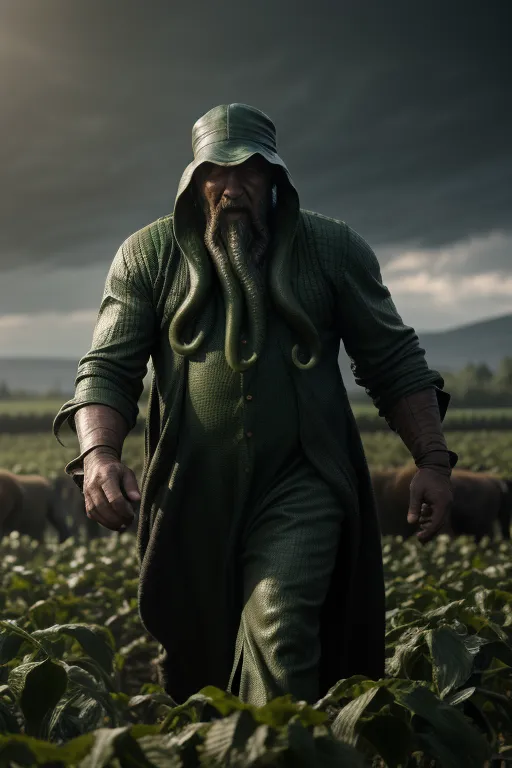
So, this week, in the middle of all the usual crises in Dunwich I got a visit from the First Selectman. I was out in the fields when suddenly the shadow of a five-hundred-foot eldritch horror darkened my path. Now tact is always the key survival trait when dealing with the First Selectman. So, I greeted him respectfully and asked him to what I owed the honor of his attention.
He got right to the point. His kin were having a visit to Dunwich and he wanted to make sure they had a nice stay. Well, when Azathoth, Yog-Sothoth and Nyarlathotep come to town, they’re bound to be hungry from the interdimensional transit and will expect something substantial with which to restore the tissues. So, Cthulhu wanted me to arrange the menu. Since Dunwich is a farming town, I suggested cattle. He gave me a shake of his cephalopodic head and reminded me that all three visitors were obligate anthropophages. Well, that would make this a tricky assignment. Even though I’m regularly fed up with most of my neighbors, I’m not really comfortable with them being eaten alive by monsters from beyond space. And I especially don’t want to be the one feeding them to the hideous entities. But neither did I want to be next on the menu for refusing. So, what to do?
Well, it took a little work but by the creative lowering of our fairground fees I was able to attract and book the Democratic Socialists of America’s New England political rally for that weekend. And wouldn’t you know Graham Plattner was the keynote speaker! Now without a doubt an oysterman would provide just the tang of New England cuisine that the First Selectman’s family would find irresistible. My plan is to let the rally reach a crescendo of communistic agitation and then use a couple of fire houses to marinate the crowd. I gave the First Selectman his choice of sauces; classic Worcestershire cocktail, garlic butter, Bang Bang or a Remoulade. Being old fashioned he went with the garlic butter.
I know, I know. What kind of heartless monster would feed his fellow humans to creatures of cosmic horror. I did think a while about it. But then I remembered that Bernie Sanders and AOC were also supposed to be attending. So that seemed to assuage my conscience.
But today I had new pangs of guilt. I mean Azathoth, Yog-Sothoth and Nyarlathotep have never caused me any harm and here I was feeding them some of the most toxic creatures on the planet. I mean, what if they got really sick. It would be my fault. At the very least maybe I should provide a photo of Plattner to the Great Old Ones and warn them that he probably had at least a sixty-proof rating and anyone with an alcohol problem should probably steer clear of the pugnacious oysterman and stick to something a little less spicy. Well, anyway, the First Selectman seems pleased with the menu. That’s something.
Here we are in the last week of July. Wow. The days fly by when you’re too busy with annoying drudgery. So that’s a strange way of looking at it. While engaged in the drudgery it’s crawling along. But when I finally escape, the day is already wasted away. And what’s left flies down the gravity drain into the past in the blink of an eye. So, I’m just annoyed at the present situation. And it’s only gonna get worse in August and so I’m terribly disgruntled. But until I figure a way out of the trap I’m in, it’s gonna be status quo. Enough. Well, at least I have the weekend off so I’m going to enjoy the next two days as much as is humanly possible. So, stop complaining!
We’re five episodes into the first season of “Landman” and it’s a very odd experience. The main story of Billy Bob Thornton’s character trying to manage a chaotic mix of oil field accidental mayhem, narcotraficante related mayhem and roughneck related mayhem is interesting but the subplot involving his terminally self-absorbed ex-wife is extremely annoying. The other themes associated with his son and daughter are pretty good and his son’s story is expanding into a larger role. Camera Girl and I are enjoying the experience of having a show that we can both watch with at least some degree of interest. There was one scene that I found particularly funny. Tommy Norris’s ex-wife is trying to stage a “family” dinner with herself, Tommy, their two kids and the two oil company guys who are staying at the company “house.” She insists that they all join hands around the table for a prayer and after it’s over the two outsiders are talking about it and one guy says, “Well, that was the first dinner prayer I can remember that was explicitly blasphemous.”
Friday, Saturday and Sunday’s weather is supposed to be beautiful. The kids came over to use the pool today and they said the temperature was perfect. And the butterfly bush is finally in full flower and monarchs and swallowtails (tiger and pipevine) are increasingly present as photographic subjects. And the raspberry canes are starting to produce a bumper crop of berries. So, this is peak mid-summer experience and if I wasn’t committed to an annoying task I would be in seventh heaven. Well, I guess it’s not that bad if I can take the time to complain this much about it.
One of our neighbors put out a bit of video from her bird feeder. It was of a black bear’s nose stuck up against the camera. The bear’s claws were fairly impressive and a good reminder that even a black bear is not a Disney character that you can approach with impunity. We have a bunch of blueberry bushes that are just about ripe so we may be getting a visit from Yogi and company at any time. I have a game camera mounted but I didn’t return the memory stick last time I downloaded the files. I probably should.
Well, that’s enough for now. Just regular stuff going on. Enjoy July.
I’m cheating here. I really don’t have some authoritative answer but I’m interested in opinions. I mean I have my own but I’d like to hear from you readers. I guess I’m trying to separate what people want to see filmed from what they think would film best. For instance, someone might love the book Stranger in a Strange Land but think that it wouldn’t translate to the screen at all. And conversely you might not care for a book but recognize that it would make an amazing visual spectacle. So that’s the challenge. What you pick could be your favorite sf book but only if you think that it would be a terrific movie.
So, to be fair I’ll have to pick a book and tell why the movie version would be phenomenal. Hmmmm.
Alright, so I’ll pick a controversial book; Heinlein’s “Starship Troopers.” And I’ll say why. I’m basing my opinion on the 1997 film directed by Paul Verhoeven. Verhoeven made the movie to be an ironic send-up of what he considered a fascist state. So, he was mocking the military that makes up the whole story. And yet, despite this hostile take on Heinlein’s book, the film is a staggeringly vivid visual spectacle. The vistas of battle on planet and in space are remarkable even though this movie used CGI effects that are several decades out of date. So, I try to imagine what could be done if someone who liked the story and the world it envisions wrote and directed it. I think it could be amazing.
Now let me add that I don’t think this would happen in a million years. Woke Hollywood has no interest in a pro-military sf war movie. Ever since Vietnam they’ve made more than ten anti-war movies for every pro-military one. But since I’m not asking, “what’s the movie most likely to be made,” I feel I can select the story that I favor regardless of its chances of actually appearing on the screen. I think of the visual showing Buenos Aires being obliterated from space by the Bugs and I think of what the emotional impact of that scene would be. And if the Rico character were presented as intended, I think it would be a sympathetic one for the male portion of the audience. Of course, the jury is still out on whether I would keep the communal male/female shower facilities that Verhoeven introduced into his film. It has its advantages and disadvantages as a cinematic device. But I would demand that the movie stay as close to Heinlein’s book as possible.
So come on everybody, pick the story that is perfect for the big screen and give your reasons why you think so. And I won’t restrict this by the book’s age. It could be Frankenstein, War of the Worlds or anything else. Even if it’s already been filmed several times, say why a new version would work. But for pity’s sake don’t give me a woke book. My stomach isn’t as strong as it used to be.
Replies:
Ed Brault:
Boy, this is a tough one. There are several I could choose from.
Larry Niven’s “A Gift from Earth” Set on a distant colony planet, it has action, suspense, political upheaval, and a rather unique social commentary on the impact of genetic engineering. The visuals would be well within CGI and other technical effects tech that has been around since Stargate SG-1.
Another would be “The Long ARM of Gil Hamilton. Crime and mystery in a not-too-distant future. Telepathy, psi powers, black market organ transplants, and a unique form of addiction that may not be that far off. All done in an almost-contemporary setting, just add automated flying cars, and a society so desperate for life-extending transplant material, they make almost any crime Capital, even False Advertising, sending the perp to the Organ Banks. Three short stories that put a creative spin on murder. The capper is the Jigsaw Girl, set on the Moon, with murder, attempted murder, conspiracy, clones, and interplanetary politics.
“The Children’s Hour”, set on the Wunderland colony on a planet of Alpha Centauri. Conquered by the felinoid race, the Kzinti, and it is used as a staging base for the planned conquest of Earth. Three invasion fleets have been beaten off, but a new Governor has brought a new philosophy of war. Instead of “Scream and Leap” he advocates careful study of the enemy, how he thinks, and how “inferior” technologies may be used in VERY sophisticated ways against a more advanced force. Earth’s GHQ wants him dead, and a special team is sent to get him, by a very fiendish, complex method, all set in a background very reminiscent of “Casablanca”.
Chemist:
We agree on Starship Troopers. I think it could be redone with more attention to Rico and his development – especially his reconciliation with his dad. Another Heinlein – Puppet Masters. I know. Been done. I think it could have been done better. It already has a very strong female character without being woke. Robert set Puppet Masters up for a sequel but never wrote it. I’d like to see a sequel where the humans take the war to Titan. I think a focus on the man / dog teams would be excellent. And we know how Hollywood loves sequels – here are two movies just waiting to be made.
Now if you want to make a serious romp movie – any of Harry Harrison’s “Stainless Steel Rat” books would do. If I were writing it, I’d lean into the anti-government aspect. I think it would play well today.
Tregonsee:
Well I would like to see Starship Troopers done correctly. I imagine RAH is still revolving in his grave or haunting Mr. Verhoeven over the 1997 travesty. I think The Moon Is A Harsh Mistress MIGHT work. I’ve always thought the first of Zelazny’s Amber Series Nine Princes in Amber might make a nice movie, or better an 8-10 1hr show series (with other Amber Books to follow if it works). Larry Niven’s Ringworld or Protector might work, although Ringworld will have to be edited lest it skate into deep R or NR rated territory. For romps I favor Connie Willis’ To Say Nothing Of The Dog it is eminently filmable, though again a series might work better. The time travel nonsense is just absolutely beautiful and hilarious; there is a romance (or three), and we rescue an extinct species (spoilers 🙂 ) of great interest. And last but not least, the first couple of the Honor Harrington series might be fun, In particular On Basilisk Station and Honor of The Queen . I’d love to see it get to Field of Dishonor but that’s 5 books in and because of prolong our heroine does not age, but whatever star we choose to play her will age.
Oh and of course given my handle I am for a version of E.E. Smith’s Galactic Patrol. Though I fear modern Hollywood would mangle it more than Mr Verhoeven did Starship Troopers. Many of its features (in particular Lenses being MALE only with one special exception) would not sell in the modern world.
A big issue is that a 2-2.5 hour movie requires 200-250 pages of script. a 150 page book EASILY fills that amount of script, but modern Novels run 300-450 pages (And I’m Not even talking to You Mr. Sanderson…). the series/miniseries model doesn’t make as much cash as a successful movie, so it can’t fund as many physical effects (which still are needed for convincing SciFi c.f. Hail Mary Project ). Hollywood has been leery of NEW SciFi with the soft returns on several Star Wars sequels (doesn’t help they were really weak) and the catastrophe that was John Carter, which I thought was a fairly decent rendering of the Barsoom series start (it essentially being A Princess Of Mars reworked a bit). Maybe Hail Mary Projects‘ success will disabuse them of their SciFi fears, at least until they screw some other pooch big time…
TomD:
Every SF book that I’d like to see as cinema combines the elements of imagination, extrapolation, character development and world building. Problem being that doing all that implies a movie too long and convoluted to be doable or effective.
The book that I’d most like to see is Robert Silverberg’s “Lord Valentines Castle” but it would take a Tolkien Trilogy’s worth of effort to do and quite unlikely.
Tregonsee replied to TomD:
Tom D said
“Every SF book that I’d like to see as cinema combines the elements of imagination, extrapolation, character development and world building.”
I think that is true of a great deal of SciFi/Fantasy. For a film or even a series, we like to have a character or two to focus on, both because star power helps sell films and because with a cast of thousands, filming costs go up and engagement goes down. For many years, The Lord of the Rings and Dune were thought unfilmable. Lynch’s Dune and Bakshi’s LOTR nearly proved that true. I Think Peter Jackson did exceptionally well with LOTR and Denis Villeneuve has done well (albeit mangling the timeline a bit and gender swapping a character unnecessarily) with Dune. It helps to have a producer/director/writer that loves and understands the material.
I don’t remember enough of Lord Valentines Castle to be able to comment on it reasonably, but I think you are correct it probably is to obscure and would perhaps feel derivative of other scifi/fantasy. I wonder if we don’t have two separate classes here: films we’d like to see made and films that could be filmed. The latter class has grown with Computer Special effects reducing costs and making some things possible (e.g. an anatomically correct Puppeteer or Kzin is impossible without modern special effects). I wonder how large the Venn diagram of the overlap of those two classes is. And of course there is a third class, interesting to the general public. without being in that class the chance to break even on production costs goes WAY down.
So, we’re heading into day three of the yellowish/brownish/greyish-sky world. Apparently, Canada is burning to the ground and we’ll be buried in a five-hundred-foot pile of ash by sometime around Labor Day. Well, it’s for a good cause after all. Once all of the Canadians have been incinerated, we can proceed to frack all the hydrocarbons out of the ground and turn the Great White North into a theme park of some sort. Of course, the only Canadian I knew well was actually a great guy. He was a French Canadian and he had a fantastic sense of humor and was a great fan of American pop culture. And he was amazingly honest. He was a great believer that Quebec should secede from Canada and was bitterly disappointed that his countrymen voted No on the referendum. But his pride in his French identity remained strong. Until, that is, his company transferred him to the Paris office. It was like a dream come true. But when he got there and tried to embrace his long-lost French brethren, they told him quite insultingly that he wasn’t French, he was “North American!” His heart was broken. But he rebounded and from then on, he recognized himself to be a North American.
Well, I hope he’s still living here in the States because based on the weight of ash weighing down my roof, I have to assume the only thing left uncarbonized up there is Hudson Bay. Now I know that Canada has embraced physician assisted suicide so hopefully one of the prescribed methods is roasting because that would be relatively economical at this juncture. I mean all you have to do is head northwest and eventually you’ll find the flame wall and after that it should be fairly simple to achieve unalive.
But I mustn’t sell Canada short. It did give us John Candy and the SC TV troupe. Interestingly, they always portrayed Americans in their most popular movies so I don’t know if it was their Canadian-ness that made them so funny. And I guess we also got Mike Myers from them too. And they have oil, coal, gas, gold, uranium and lumber so Canada used to have a lot of potential before it burned to the ground. I’m sure Trump will figure out a way to monetize what’s left of it. Whatever that idea will be, it will include branding the enterprise with the name “Trump” somehow. Although maybe instead he’ll rename it West Greenland because he really liked the whole Greenland acquisition idea.
From my own point of view, if I was looking for a way to renovate a carbonized Canada, I think I’d give the whole thing back to the Indians. Why not. It’s enormous and loaded with valuable resources and the people living there are annoying, so give it to the people who they’re always saying they stole it from. If they feel so bad about their theft then let them assuage their guilt and finally shut up about it. But the deal will be that they’ll have to do a much better job of putting out forest fires. We can loan them Smokey the Bear. Seems fair.
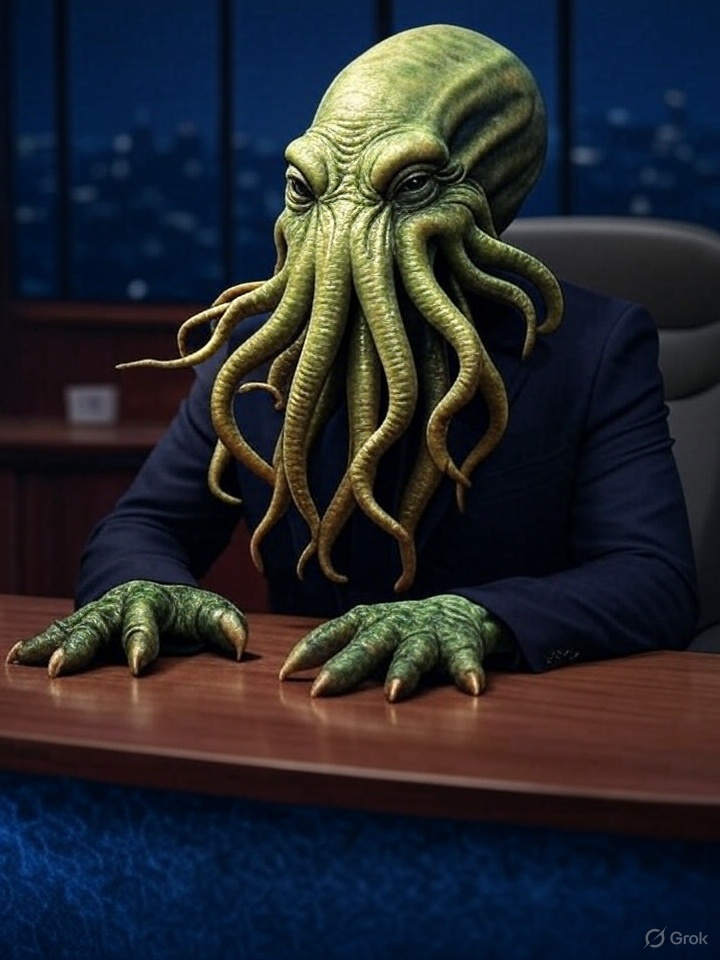
I was thinking about trying to start a YouTube channel. But I’m not sure if I can do it the way I want to. My idea is to host an animated version of First Selectman Cthulhu expounding for five minutes about whatever was on my mind that week. So, what this will require is some kind of free animation program that can be used to present the First Selectman speaking with a voice that would be appropriate for his status and personality. It would also be useful if from time to time he could do more than just stand there and talk. Possibly from time to time he could extract a human from a jar on his desk and swallow him. And I’d like to be able to make those humans recognizable images of famous people like politicians, film actors and other pompous asses.
Now I realize this is easier said than done. First of all, I have to develop an interesting persona for Cthulhu. Then I have to be able to produce these videos at least once a week. So that means they can’t take too long to produce and load onto YouTube. Also, I have to learn what rules there are on YouTube that I’m not allowed to break. I’ve seen that there are words like rape and murder that people cannot say on YouTube. I assume that is because using them results in demonetization. Now I wasn’t specifically trying to make money directly from YouTube. I wanted to use it to grow an audience for my writing but maybe demonetization goes hand in hand with throttling visibility so I need to learn all about those aspects of the site. If the restrictions are too limiting, I may not want to bother. After all humor can be kind of cruel and cruel seems to be the mortal sin of the woke generation.
I’m sure this will take a long time to roll out because my plate is already too full now. But I wanted to see if it’s doable. My website has never grown to the point where I can reach thousands of people. So, I figure I should try other platforms to see if I can expand my audience by several orders of magnitude. Obviously, I won’t interest the really largest segments of the population but I have seen where people who are adjacent to things I’m interested in can reach a larger audience. So, I figure I’ll try. Hopefully it will be fun.
Maybe I’ll have Cthulhu interview other supernatural celebrities like Dracula or the ghost of Lindsey Graham. Who knows, my version of Donald Trump might even show up. After all Cthulhu is a Great Old One and Trump is always talking about “great.” Or maybe he can do a cooking show where he shows how to make a jambalaya using Democrat and Republican politicians together. The possibilities are endless. But of course, all of this will be in bad taste so it may never see daylight on YouTube.