The Day After the Day After Tomorrow

In the comments for yesterday’s post on anti-matter there was some discussion about the methodology for interstellar travel; matter/anti-matter annihilation as a form of impulse power versus the use of a worm hole to poke in and out of space as needed.  As was intimated (being turned inside out) the current understanding of general relativity does not present any clear mechanism for human beings to utilize such a phenomenon and remain alive.  And that got me thinking.

Five hundred years ago if you wanted to go from Portugal to India you would get on a sailing ship and circumnavigate the continent of Africa and then cross the Indian Ocean.  And when you returned from this trip thirty months would have passed.  Today, a direct flight from Lisbon to Calcutta would take about twelve hours.  Call it a day for a round trip.  That’s about 900 times faster than the old way.  A trip to Mars at its shortest takes about six months.  Adding in the return trip makes the whole voyage something like 26–34 months.  If somehow, we could increase our speed by the same 900 times we could go round trip to Mars in a day.

Of course that’s impossible.  But only in the sense that we would be trying to improve the same means of travel in the future case.  So, if you told Vasco da Gama he could make a round trip to India in one day he would assume you were either joking or insane.  Because the very idea of a jet plane was an impossibility in his world.  Before you can have jet planes you need Galileo, Newton and Maxwell.  In other words, you need the mathematics, physics, chemistry and engineering of the seventeenth, eighteenth and nineteenth centuries to know that a jet plane could exist.

What if the mathematics, physics, chemistry, biology and engineering of the twenty second, twenty third and twenty fourth centuries conspire to make the round trip to Mars only one day by finding a completely novel approach to travel.  What if wormholes really could be harnessed for human transport?  Then a day long trip would just be a convenience for meals whereas actual travel time would be zero.  But you argue, “wormholes are a theoretical aspect of relativity that have never been observed and if they exist would be as inimical to human life as a black hole would be.  And I would counter that feeding flammable liquids like octane into a machine that produces electric sparks and depends on metal parts rotating thousands of times per minute is much too dangerous a method for transporting humans from place to place.

So, I won’t say I know that we’ll ever reach the stars.  But I think anyone who says categorically that we cannot is making assumptions that cannot be taken as fact.  They are conjecture based on the current understanding of physics and engineering.  So, I guess we’re free to fantasize about galactic empires and worm holes and warp drives and anything that makes us happy.  And some days I want to read about the day after tomorrow and other days I’ll dream about galactic empires.  Why not?
Practical Applications of Riemannian-Bishopian Dimensional Translations – Part 1

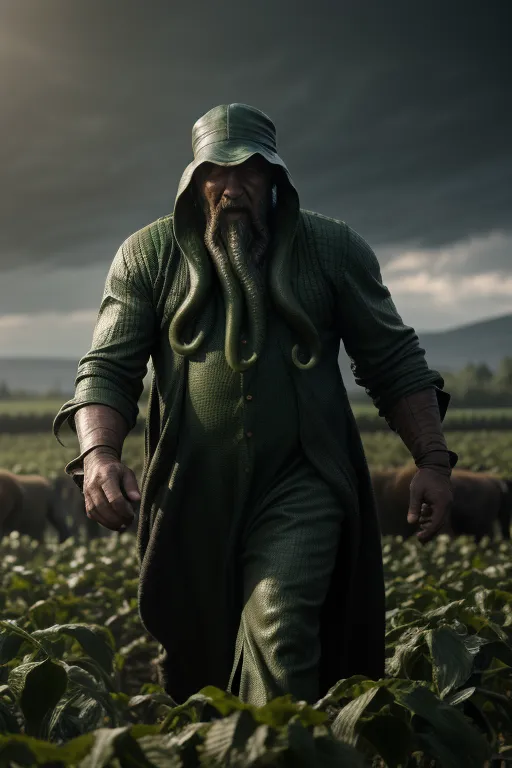
Farmer Cthulhu in His Fields

Dunwich is a very odd place.  First of all, you’ll notice that it does not appear on any map of New England.  And this is both an advantage and a disadvantage.  On the plus side it limits the amount of traffic that traverses its roads.  On the minus side it’s darn hard to enter and leave it.  For instance, there are no gas stations in Dunwich so whenever I need to fill up the old gas tank, I have to find a way out of town and find my way back in again afterward.  And it’s not a matter of just heading down any road until you reach the town limits.  Strictly speaking there are no limits.  If you travel on Aylesbury Pike past Sentinel Hill for about three hours you’ll come back to Sentinel Hill again.  And if you turn off at Whateley Lane and go for about two hours, you’ll notice a singularity in the middle of the road.  And if you get too close to it, you’ll be pulled in and find yourself in the alimentary canal of Yog Sothoth.  And that’s not a good place to be.  So, you can see that commuting is somewhat problematic.  But for all of the locals it’s really just an acquired skill that is taught from father to son.  It’s all a matter of geometry.  Einstein believed that our space time was a variety of non-Euclidean geometry called Riemannian.  And it is.  However, Dunwich has a different geometry called Bishopian after the famous Dunwichian mathematician (or wizard) Septimus Bishop who measured the curvature of Dunwichian space and codified the equations for translating back and forth between the two universes.

The mathematics is too complex for most people without advanced training to follow.  On a practical level if you close your right eye and squint your left and slam down the accelerator just at the right location on the Dunwich side, you’ll reach normal space.  And from normal space if you close your left eye and squint with your right eye while slamming on the breaks you can return to Dunwichian space from some well-known anomalies.

For the most part this kind of travel is a routine.  But every once in a while, something seems to go wrong.  I was driving at night in a snow storm in Dunwich a few years back and I sneezed too hard and must have activated an anomaly.  When I blinked my eyes open again, it was broad daylight and obviously a summer day in some warm climate.  I found out I was in Tallahassee Florida and it was six months in the past.  And this caused all kinds of problems when I got back to Dunwich and ran into my earlier self, watching tv in my living room.  I had a devil of a time murdering my doppelganger and sinking him in the swamp.  He seemed to know all of my fighting tricks and just refused to die like a good sport.  Some people are like that.

Cleaning Up the Wreckage

For years people have said in my presence that despite the leftist leanings of Hollywood, the people running it were there to make money.  But despite that I watched as Hollywood produced bomb after bomb that preached the leftist creed above all other ingredients in the film.  They sacrificed entertainment, artistry and certainly profitability on the altar of woke propaganda.  Probably the most egregious of these studios was Disney that sacrificed the virtually unlimited money-making machines of such franchises as Star Wars, Marvel Comics and even the classic Disney princess movies to bang away at woke agenda elements like LGBTQ identity, anti-white racism and feminist dogma.

Well, maybe, just maybe, the tide has turned.  I think this week we received two data points that signal a definite reversal.  The first is the news today that Sky Dance has cancelled the third season of “Star Trek – Starfleet Academy.”  This was a two-season installment that has been estimated to have cost somewhere between two hundred and four hundred million dollars.  Now that is an enormous amount of money but what makes it astonishing is that when this show ran it wasn’t one of the top ten shows on Paramount Plus.  It was regularly beaten out by reruns of “Everyone Loves Raymond” and “Sponge Bob Square Pants.”  In fact, it was even worse than this.  In order to build up buzz for the first episode, it was put on YouTube for free and less than a thousand people watched it the first day.  Think about that.

Paramount was bought by Skydance last year so they didn’t order this show.  And the production company (Alex Kurtzman’s Secret Hideout) is finishing its contract with Paramount in April and it’s looking like they won’t be doing anymore Star Trek for Skydance.  And Skydance is probably going to purchase Warner Brothers this year and that may have a very great impact on how the DC Universe movies look going forward.  So, there is an example of changing sensibilities going forward in Hollywood.  Enormous costs for productions that no one wants to watch are ending.  So that’s the negative case, what won’t be happening anymore.

As for what is happening on the positive side let’s look at what Amazon/MGM have released this week.  Andy Weir (the author of the book turned movie “The Martian”) wrote the book “Project Hail Mary” in 2021.  It cost two hundred million to make.  It made $141 million on its first weekend.  This is one of the biggest openings in the last four years.  And it is predicted to be a big hit.  It’s a movie whose only human character is a white male.  The only diversity casting is an alien creature that looks like a pile of small rocks.  There’s no woke elements at all.  Just an adventure story about a man light years from Earth cooperating with an unearthly creature to save both of their planets.  From all of the reviews I’ve read it’s a solid movie that the whole family can and probably will enjoy and it doesn’t say anything about the LGBTQ or how white people stole America from the Indians or enslaved black people.  And the fact that the astronaut is not a girl boss but a young white man I take to be aspirational for every white American boy who has been told for the last couple of decades that they shouldn’t get a turn at being the good guy.  So that’s the positive side.  Hollywood can make good movies and people will come to the theaters to see them.  And they can make money doing it.

Maybe the tide has turned.

The Tomorrow War (2021) – A Science Fiction Movie Review

This movie is an alien invasion/time travel movie.  Wow, that’s complicated.

(Spoiler Alert – Skip down to last paragraph to avoid spoilers and read recommendation)

This movie is a highly confusing science fiction story.  Chris Pratt plays Dan Forester a retired special forces soldier from Iraq who now works as a high school science teacher.  He has a wife Emmy and a young daughter Muri.  So far so good.  One day while watching soccer’s world cup game on tv they witness the beginning of the future war.  In the middle of the field a “wormhole” opens up and a bunch of humans dressed in military attire carrying weapons appear.

They explain that they are from the year 2051 and their world is fighting a war against aliens called the “whitespikes.”  They are about 8-10 feet long, have four running legs two grasping legs and two tentacles that can grab but also shoot “spikes.”  And they are always ravenously hungry for human flesh.  The aliens appeared in arctic Russia and quickly spread across the world and now the human population has been decimated (total world population down to 500,000) and they are begging people from 2021 to come through a portal and help fight the aliens.

Earth agrees to send its armies into the future but barely twenty percent return alive.  After that a draft is employed and all adults (men and women) are eligible.  Eventually Dan is drafted and is sent.  Enlistment involves surviving one week of combat after which the soldier is automatically returned to the present wherever he is.

Dan goes to the future and is immediately swept up in the “run for your life” action of fighting the whitespikes.  Eventually he meets his commanding officer Colonel Muri Forester (played by Yvonne Strahovski), in other words, his daughter now grown up and become a biologist working on a toxin to kill the whitespikes before they finish off what is left of humanity.  And with Dan’s help she captures a female whitespike and they synthesize a toxin that will kill all whitepikes injected with it.

But it’s too late.  The last human outpost where Muri and Dan are located is overwhelmed by a horde of whitespikes and Dan time jumps with the toxin just as Muri falls to her death in the grips of a whitespike.  Dan reaches home and is overwhelmed with grief and anger.  Grown-up Muri had told him that back in the “present” when Dan had returned from his seven-day assignment he abandoned his wife and daughter and eventually was killed a few years later in an auto accident.

Determined to get the toxin mass produced and sent back to the future Dan reaches out to the government but finds out that the portal is gone.  The whitespikes have finished off humanity in the future.  There is no place to send the toxin.

But Emmy reasons that it makes more sense to find the whitespikes before they conquered the world and destroy them at the beginning.  With a clue from volcanic ash present on a whitespike artifact they figure out that the whitespikes must have been frozen under the ice cap in northern Russia and thawed because of “global warming” in 2051 or shortly before.  Because of global instability caused by the knowledge that the world would be coming to an end, the US refuses to help Dan go to Russia to find the whitespikes.  So, Dan goes to his Vietnam War vet estranged father (played by J. K. Simmons) who happens to have access to a large cargo plane and they mount a small expedition.

They find the alien ship by its magnetic field and use thermite to reach it through the ice.  Then they find out that the whitespikes are not the astronauts but rather a bioweapon cargo on a ship that crashed into earth long ago.  They use the toxin to kill about half the whitespikes on the ship but another five or six escape.  Two of the humans use a C4 explosive to kill the whitespikes in a suicide maneuver.  But one female escapes and after an extended chase and fight scene Dan and his father kill the monster.  The movie ends with Dan reuniting with Emmy and introducing young Muir to her grandfather.  Wow, what a mess!

Okay, what the hell do I say about this crazy mixed up movie?  From a science fiction plot perspective, this thing is a turkey.  There is no indication of how the 2051 humans in the middle of their existential alien crisis were able to create time travel.  And the workings of this time travel also seem goofy.  The 2051 people can only go back and forth thirty years.  So, they can’t go back five years and search for the whitespikes before they became overwhelmingly numerous and unstoppable.  Also, grown-up Muri tells Dan about what he was like after he came back from the future but then Dan followed a completely different course of action when he returned.  How?  Alright the plot is as full of holes as Swiss cheese.  But is the movie any good?  Well, yeah.  Chris Pratt portrays a likeable character and so does Yvonne Strahovski.  There is a good family chemistry there and the action sequences although quite a mess aren’t boring.  And it isn’t woke.  Chris Pratt is allowed to be a white man and the hero of the movie.  That’s something to be amazed at in a movie made in 2021.  It’s a silly sci-fi action movie.  But I kind of liked it.  You have to decide if it’s something you want to waste a couple of hours on.

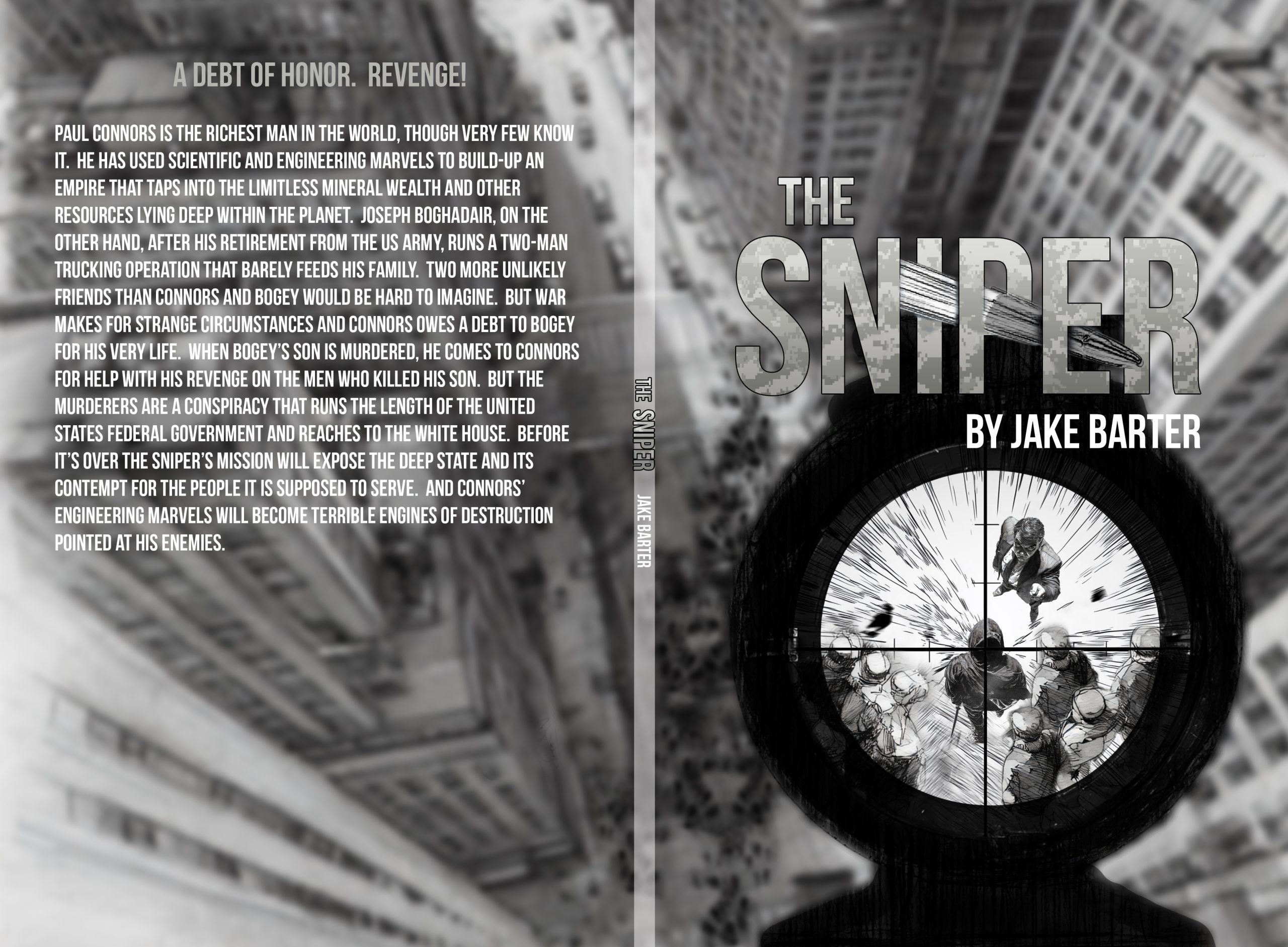
OCF E-Book Giveaway of “The Sniper”

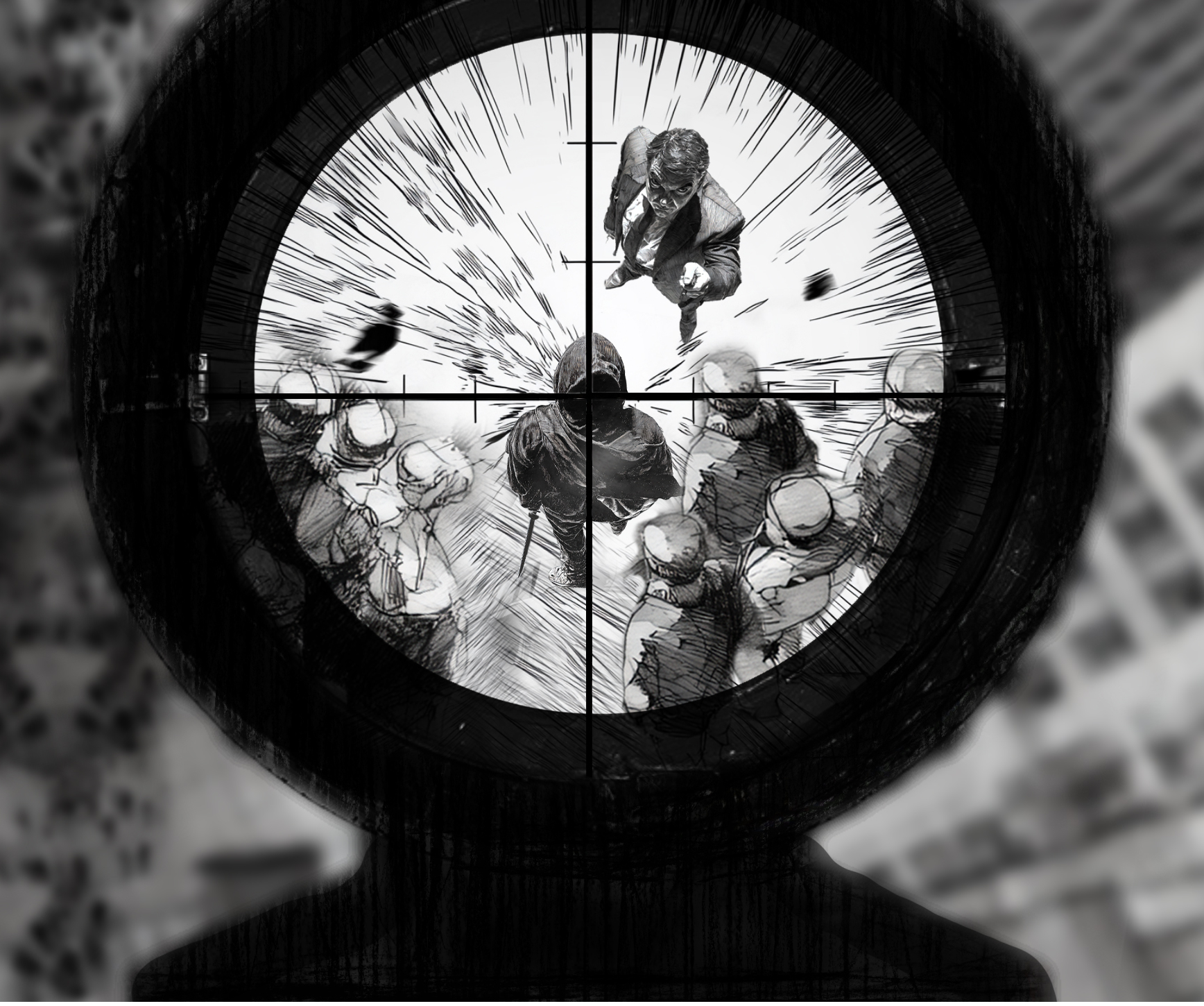
Today I sold my 150th copy of “The Sniper” on Amazon and I’m looking to get more reviews and ratings.  So to increase the availability of the book I’m looking to send complimentary (free) e-book copies to folks here on the website who want one.

Just e-mail me here and I’ll send one back to that e-mail address.  Feel free to be honest with your review.  It’s better to get honest criticism than fake praise.

Edge of Tomorrow (2014) – A Science Fiction Movie Review

This is a time loop movie.  It’s Groundhog Day crossed with Starship Troopers.

(Spoiler Alert – Skip down to last paragraph to avoid spoilers and read recommendation)

Tom Cruise is Major William Cage.  He’s the US Army’s public relations man during a war against aliens called the mimics who have conquered mainland Europe and are about to be counter-attacked by humanity’s attempt at D-Day from a London staging area.  But instead of staying behind in an office to edit commercials his superiors have loaned him out to the Brits as a warrior.  He tries to desert but is handcuffed and handed over to Master Sargeant Farell (played by Bill Paxton) and put into powered body armor and dropped into battle in France.  And of course, since he’s not a real soldier, he’s killed in the first few minutes of the horrific battle.  But right before he dies, he manages to kill a special mimic called an “alpha.”  And because some of the alpha’s blood gets on him, he ends up in a time loop that always brings him back to the same day of the battle.  And as long as he’s always killed he’ll come back again.

And from starting out as a hopelessly incompetent soldier, by virtue of getting to endlessly re-live and re-die on that day, he becomes adept at fighting mimics.  During one of these replays, he meets Sergeant Rita Vrataski (played by Emily Blunt) and just before she dies, she tells him to find her the next time he wakes up.  In other words, she has had the same time loop ability.  Through endless additional replays, Cage and Vrataski figure out that the mimics are aware of all the humans’ plans and fighting them is futile.  But if Cage is exposed to a device that was made to read the mind of alphas he will discover where the head mimic (the omega) is hiding.  But in the effort Cage loses his ability to reset time and come back to life.

And so, there is a kamikaze mission with Cage, Vrataski and some comrades to storm the Louvre where the monster hides.  As it works out everyone but Cage is killed and he is mortally wounded just as he blows up the omega.  But somehow killing the omega (I think) resets his looping ability and he wakes up with all of them alive but the omega destroyed and the mimics basically defeated.

Alright, so what about all this.  This is a pretty good sci-fi war movie.  The special effects are good.  The acting is good and the plot is pretty well worked out.  And even Emily Blunt’s Rita Vrataski character isn’t a complete girl-boss super hero.  She is annoying from time to time but not hopelessly.  Cruise carries the movie with a decent amount of character acting from his “comrades” and with even a little humor thrown in to lighten the mood.  The endless live/die repetition is handled very well for most of the movie with only a couple of spots where they seemed to over do it.  I will say that in the final assault the image on the screen is sort of too dark and hard to really understand.  It’s at night in an underground vault and under water so maybe that’s realistic but it feels confusing and unhelpful to the viewer.  All in all, I recommend this movie to fans of sci-fi action movies.  It’s pretty good.

Refocusing Science Fiction – Part 1

I guess strictly speaking, science fiction starts with Jules Verne and evolved into H G Wells and then expanded into a plethora of subgenres that include every imaginable kind of story that involves “science” in some aspect of the story.  And the types are endless and the mixing of the types with each other make the number of different subtypes equal to the cardinality of the continuum (a very big number they say).  You have space travel, time travel, dimensional travel, multi-verse reality.  There’s solar system colonization (with and without terraforming), interstellar exploration with and without colonization), there’s first contact with different alien species, there’s interplanetary war, interstellar war, there’s the human galactic empire, there are galactic civilizations made up of many species.  There are stories about the origins of the human race that involve older races either creating it or influencing it (with or without monoliths and xenomorphs).  We have futures that include artificial intelligence as our servant or as our master or locked in a mortal combat with us.  There are stories about our future that involve evolution either natural or induced that change us in any number of ways; physically, mentally or supernaturally where we develop abilities that give us almost godlike powers.  There are comic stories, love stories, war stories, literary stories that concentrate on the psychological effects of technology and stories that try to extrapolate what the future of technology and science will do to humans in the future.  There are even stories about our extinction.

But almost all of these stories have been terribly far from reality.  Even the “hard” science fiction writers who have tried to base their stories on science fact have for the sake of making an interesting story, diverged very far from what the future will really look like.  For instance, interplanetary space travel.  What has been imagined about exploration of the solar system for the last hundred years or so has been mostly wrong in several aspects of the science.  The only exception has been manned travel to the Moon.  Looking at Heinlein’s Moon landing in the movie “Destination: Moon” it really wasn’t that terribly different from the reality of the Apollo missions.  Now granted he used a single vehicle and not the orbiter plus lander arrangement, but the overall effect was pretty close.  Three or four Americans rocketed to the Moon and came back just as quickly as they could to avoid the difficulties of carrying enough rocket fuel for the return trip and air to breath for a few days.  But every other space flight in science fiction history has ignored things like micro-gravity health hazards and cosmic and solar radiation damage to the human body.

And as for interstellar flight they’ve hand waved themselves past the realities of just how insanely far away even the closest stars are in terms of travel time.  I won’t even begin to talk about anything like time travel.  There just isn’t any scientific evidence that it can even possibly exist.  As for Skynet deciding to kill off humanity using a cadre of cyborgs that look like Arnold Schwarzenegger, well I won’t say it can’t happen but I think maybe liberties have been taken with the likelihood.

So, what should science fiction be about?  Let’s talk about that in Part 2.

Arrival (2016) – A Science Fiction Movie Review

What is it with YouTube lists of science fiction movies.  Every other choice is some incredibly unwatchable movie!

Already you can tell I didn’t like this movie.  And that is an understatement.  I despised it.

(Spoiler Alert – Skip down to last paragraph to avoid spoilers and read recommendation)

The movie starts out with us meeting the protagonist Louise Banks (played by Amy Adams).  We see her with her daughter Hannah starting with her as a newborn and progressing with her as an adolescent dying of what appears to be cancer.

Switch scenes and Amy is teaching a class in Portuguese language at a university but just then the world finds out that twelve alien spacecraft have landed in different areas of the Earth and Amy is needed by the US government to figure out the aliens’ language and find out what they want.  Her contact is Colonel Weber (played by Forest Whitaker).  Louise is teamed with a scientist, Ian Donnelly (played by Jeremy Renner) to solve the mystery of why the aliens are on Earth.

There’s a lot of hand-waving (literally) but eventually Louise takes off her quarantine suit so they can see her pretty hair and slowly but surely, she translates the language of the aliens; heptapods which are represented as some kind of hyperintelligent cephalopods that spell out words with their ink (seriously!).

Through misunderstanding the difference between the words for tool and weapon, all of the major military powers come to believe that the aliens are attempting to start a war by providing some kind of advanced weapons to all of them separately.  Rogue American soldiers even try to blow up the heptapods and Louise is almost killed.

But just as the world is about to attack the heptapods and cause an interstellar incident Louise reenters the ship and has a magical epiphany and can understand everything the heptapods are saying.  She finds out the tool they are giving humanity is their language which if studied allows the user to see the future and experience time as “non-linear.”

Louise then is able to see into the future and know something that will convince the Chinese leader not to attack the heptapods and save the day.  Then we find out that Louise’s daughter Hannah didn’t die in the past but is going to be born to Louise and Ian in the future.  And apparently Louise is accepting of this future tragedy including the fact that Ian will leave her when he finds out she conceived Hannah regardless of knowing she will be doomed to an early death.  The End.

How do I hate this movie?  Let me count the ways.  This movie epitomizes the “girl boss” stereotype.  Louise is the omnicompetent protagonist who can do seemingly anything needed without any rational explanation for her abilities.  Everyone else is always stumped but she always finds a way.  And it’s always ridiculous.  The military are always arrogant, murderously enraged and completely incompetent.  And the action of the movie is non-existent.  The highlight of the film is Louise writing the word “LOUISE” on a white board and holding it up for the heptapods to see.  I’m not kidding.  And then in the last five minutes of the movie Louise figures out all of that stuff and we live happily ever after (except for her daughter dying of cancer).  This movie sucks.

03MAR2026 – Sales Update and Begathon

Update:

Yesterday’s total was 18 books and my book ranking has also improved markedly.  Overall rank now close to 20,000 and categories in the top 100s!  Look out Tom Clancy (or whoever the new alive guy is).

Well, things are looking up.  So far today, I’ve sold ten copies and pretty soon I’ll reach a hundred sales.  Cool!

And I broke through the 40,000 overall rank in Kindle Store and the 200’s in some major categories (see below)

And so now that some momentum is building up I’d like to make one last plea (on bended knee mind you) for anyone who liked the book to put a good review up on Amazon.  You can use any name you like and you don’t even need to have bought the book.  Just tell the world why you liked it and help me become independently wealthy ( or at least cheer up a poor hard-working author.

Thank you for your attention.

Jake Barter

Dune – Part 2 (2024) – A Science Fiction Movie Review

Just as with my review of the first installment of Dune, this will not be one of my usual reviews where I describe the plot.  Once again, I’ll give my impressions of the movie as someone hitting the story for the first time, since, as I mentioned before I’ve never read the books and only have a vague sense of the story and the author’s message, if there is one.

First off, the cinematography is top notch.  If the movie is blending actual desert landscapes with CGI it’s seamless and extremely realistic.  Or maybe the whole thing is CGI in which case it’s even more remarkable.  The acting is very good although casting Christopher Walken as the galactic emperor is jarring for me.  It’s almost impossible for me to see him in a film and not expect some kind of joke.  But he has very little screen time and the rest of the cast is very, very good.

The plot seems to be a combination of Lawrence of Arabia with a science fiction galactic political intrigue story.  And that may sound sort of flippant but actually I think the storyline is handled very skillfully by the director.  The pacing and the building to the climax is done with great skill and the final battle and its outcome are great.

What the filmmaker went for here was a combination of a personal story about Paul and his friends and family against the backdrop of a spectacle which is the revolt of the Fremen against the off-worlders who have dominated their world for centuries.  The reason I mentioned Lawrence of Arabia is because Paul is an outsider who is accepted by the Fremen just as Lawrence was accepted by the Arabs in their struggle to liberate themselves from the Turks.  And the Fremen are obviously modeled after the Arabs with “spice” as a stand-in for oil in the real world.

I don’t know if the movie is very faithful to every detail in the novels but in my opinion both this installment and the previous movie provide top-notch science fiction cinematic entertainment.  The protagonist and his friends are extremely likable and their adversaries are almost literally cartoon villains that in some cases seem hardly human.  And watching their defeat is almost as much fun as seeing Paul victorious.  One thing though, Paul’s mother belongs to some kind of female religious magical cabal that has a lot to do with control over the nobility of the empire.  I find myself repelled by all of them including Paul’s mother.  I’d like to see all of them burned at the stake as witches.

So, my take on all this is simple.  The plot is consistent enough to pass the suspension of disbelief hurdle and the action of the plot is lively enough and entertaining enough to keep you watching right through to the end.  I can’t see how I don’t rate it as highly recommended.  And the movie ends in the middle of a giant war so obviously we all have to save up our pennies to see the third and possibly further installments when they arrive.  So, three cheers for Dune: Part 2.