My experience with PKD through The Man In The High Castle is similar. It is beautiful prose and a fascinating idea but the sheer unpleasantness of the reading experience is off-putting. This is not to say I totally hate Dystopias. I think one of the most beautiful pieces of Science fiction (let alone Dystopias) is Walter M. Miller’s A Canticle for Liebowitz . With it’s Sarcastic Humor, and it’s crazy story that interweaves (Spoiler to a 60+ year old story the Wandering Jew wanders through all three sections and it MAKES SENSE) all sorts of mythology and Catholic and Christian trivia into a very odd resolution it is very compelling. I reread it, but not too often, it tears at the soul. Both PKD and Walter Miller (who later commits suicide likely due to PTSD from being a B-17 gunner in WWII in the raids on Dresden) were clearly troubled men. They are also very skilled writers. Their writing, to some degree, drags you into their madness, and this can be a very uncomfortable place to go. I do not find The Man in the High Castle compelling enough to experience the discomfort where A Canticle For Liebowitz seems to ultimately yield some release,
Category: Guest Contributors
Guest Contributor – Tregonsee – 19MAY2026 – Politics
Hard to call for 2026. Right now the house is held by 5 republicans plus an independent who caucuses with them. with the California redistrict vs Florida and the lame one seat win in Louisiana (which could have been 2) AND Indiana going AWOL I think it’s going to be very tight, likely slightly Democrat (5-10 seats). The big question on the Senate side is Platner vs Collins. Collins is not the best candidate from a conservative view, But probably better for us than Platner most days. Platner is such a fricking mess and there’s likely far more dirt that Collins can use that the elderly and upstate folks probably will swamp Portland and Southern Maine. The thing that would be good to do is close out Iran but resolving that such that things recover before 11/3 will take some really lucky breaks that I just don’t see happening. We HAVE to stop them from getting a nuclear weapon they make North Korea look like a calm reasonable opponent.
One race to watch is the LA mayor. If LA unblues enough to elect Pratt all then things get really odd.
2028 is a totally different situation. Likely, the major issue (Iran) will be resolved at some level. That unblocks large parts of the economy. Although the last half of the Trump administration probably gets stalled due to a blue house (and tied or slightly blue senate) they really cant do much as they haven’t got a veto proof majority and are unlikely to get one. So we get 2 years of sitzkrieg unless a miracle occurs.
Problem is the Democrats have no one that can easily steal states from the electoral coalition that Trump used. Newsome is an idiot and anathema to middle America, AOC is worse. Spanberger might have been an option but her run at the gerrymandering and the gun nonsense makes it clear she is just a traditional far left Liberal cosplaying as middie of the road. Buttigieg? Please don’t make me laugh. Shapiro from PA? If they would take him he MIGHT have a chance. Except he is never getting by the primaries because of the massive antisemitism of the democrat far left base. Kamala? She couldn’t even hardly touch Trump who had massive negatives in her base. The blue Gerontacracy that was boosted by Obama backstabbing any up and coming Pols means their bench is essentially all folks politically based in deep blue one party states. They have no clue where the middle is and any attempt to go there will get you slammed in the primaries. And because these are such lame candidates they will have basically no coattails. I’d expect things in 2028 to swing back to a more 2024 like situation with likely small Republican margins. And that takes us to 2030 where the big prize is fixing the ersatz 2020 census. That census is going to be absolutely critical, not controlling it will mean you’re headed to the edges for up to 10 years. It will already slame the blue states even if the questionable practices of 2020 are not removed. If they are removed the house might lean 20+ seats red in the 2032 elections.
The one big worry is we have 2 fairly old Supreme Court members who are the bulwarks of originalist interpretation (Thomas at 77 and Alito at 76). Should we lose them and the Senate is blue or evenly divided replacing them with other than some squishball moderate gets REAL hard. Add Roberts at 71 who although not SUPER dependable tends more to the originalist side unless he is trying to curry favor or look wise.
Tom’s World – 17MAY2026 – Functional differences between a $1,600 ASP-C Sony camera body and a $3,300 full frame Sony camera body.
I’ve long been an avid photographer and have, on a number of occasions, been paid for my work. My actual profession is (was) Civil Engineer and Project Management in the construction industry.
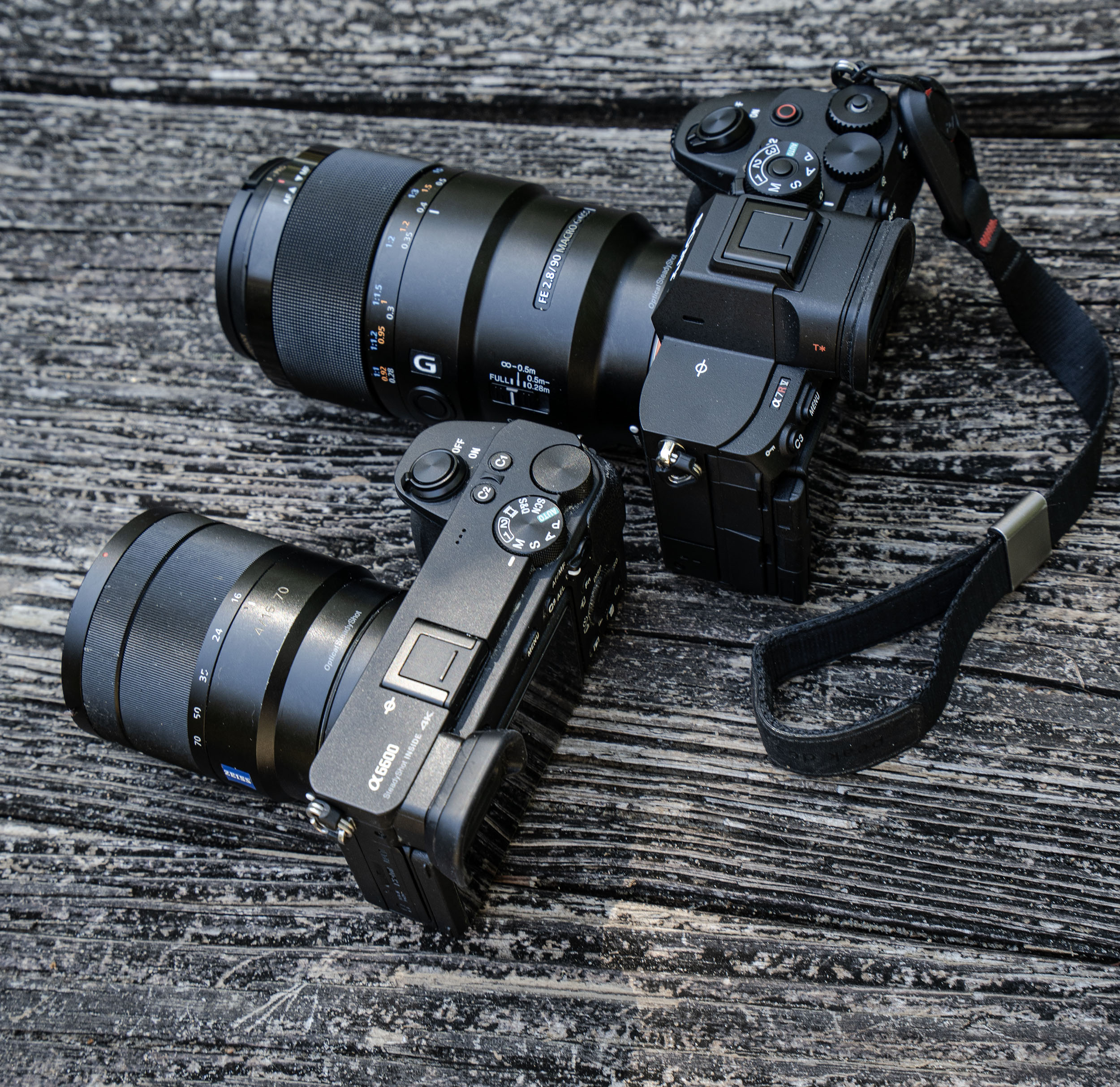
I have 2 cameras for different functions, a smaller, lighter and cheaper “carry around” camera to have with me for targets of opportunity and a larger, heavier and more expensive camera that I use for shoots and studio work. The specific cameras that I use have changed over the years but have followed that format. Currently, the small/light/less expensive roll is covered with a Sony A6600 which retails for in the $1600 range without lens though you could get a good used one for a little more than half that. The larger camera is currently a Sony A7RV, which are retailing in the $3300 range without lenses. Notice both are Sony. Because of the cost of the lenses which will only fit that brand camera, once you start with a brand (Sony, Nikon, Canon, Fuji, Fuji, etc.), you tend to stay with it. No way on earth am I gonna start over on a lens collection, which cumulatively over time can represent far more money than the bodies, if you’re a fanatic. Most normal people can buy one good multipurpose lens and live happily ever after.
I’ve notice that I shoot as many of my favorite shots with the A6600 as with the A7R5 and really haven’t noticed much in the way of quality differences between the two, so I decided to do a test. Shoot the same object with both cameras while eliminating or adjusting for as many of the variables as possible. Then taking the images to do a side by side to see the actual differences between the camera images.
Below is a picture of the two cameras side by side wearing typical lenses.
Here’s how I set it up:
All shots were taken from a tripod
I put the subject, an old Rollei camera on a wood tripod in my yard, in the shade.
The same lens was used on both, a 90mm f2.8 Sony branded macro.
ISO was set to 400. I should have set it to 100 but———
The shots were manual mode 5 sec timer to eliminate camera shake, f5.6, 1/100th sec
Focus was center
For technical reasons, the effective magnification of any given lens is different depending on the sensor size of the camera. To keep the included image the same, I had to move the tripod to equalize a 1:1.5 magnification difference. The shooting distance was 9’ for the A6600 and 6’ for the A7RV.
There were no post production modifications, the images were straight out of the camera as RAW files.
The original images are far too large (24 meg and 70 meg respectively) to put on the net so these images have been changed to jpegs at a more usable file size. But still with no modifications.
Results
The images are below, with the top being from the A6600 and the bottom the A7R5.


Looking at image quality, there is very little detectable difference. There is a slight difference in white balance and color saturation but I easily and commonly alter any of those attributes in a few seconds with Photoshop. The bokeh is slightly different mostly because ASP-C cameras all have a slightly greater depth of field than full frame. That’s due to optical physics, not camera quality. Usually, you have to shoot an ASP-C camera 1 stop lower to match full frame bokeh.
Looking at image resolution (sharpness), below is a side-by-side isolation of the camera face. Just above the top lens is printed “Made in Germany” in small (less than 1/16’’) print. In addition, there is the company logo on the bottom lens with the line thickness in the 1/100” range. If I was required to choose a clear winner, I would have to bore in to the point that the test would have no relevance to what most of us do. Astronomers, perhaps.
The image from the A6600 is on the left and A7Rv on the right

Conclusion:
I really don’t see any substantial differences in image quality I have no doubt that the differences are there but only at levels that would make it moot for the great majority of people. My self too, probably though some of my studio work pushes it hard enough that I’ll keep the full frame.
If you and a friend go on a shoot armed with one of these cameras, given close to equal skill levels, who ever has the best lens is going to get the best images.
Here’s a parallel: For a number of years in my native Atlanta, my profession commonly had me evaluating old abandoned buildings in the downtown area. I was usually by myself and there was almost always lots of evidence of “tenants”. I’m ex-Marine and life time competitive shooter in several different disciplines, so I commonly carried a weapon. When anyone asked my for my recommendation on the best carry pistol, I would reply, “The one you’re most likely to have with you.” That works in cameras too.
Given the marginal differences in image quality between the two formats coupled with the anything but marginal differences in camera weight, size, camera costs, lens cost, & camera portability, it’s hard not to conclude the ASP-C format is superior for 90% of the population. There are advantages to full frame, making large prints for example. A full frame camera will usually be better at low light, high ISO situations such as indoor sports, concerts, night time street photography, some wedding shots, etc. I’ve gotten some indoor shots at an ISO of 12,000 that look fine right out of the camera. An APS-C would be close (at least) to useless at that ISO.
This is based on Sony because that’s what I have but you can get equivalent models with equivalent performance at equivalent price from any of the major camera makers. I also recommend exploring the used markets. Skip Ebay though and look at major camera dealers like B&H or Adorama. Cameras these days are engineered to make it well past 100,000 snaps. An average photographer shoots, what, 1000/year?
Cell phones? Cell phones make decent snapshots but if you want a photograph— Also, cell phones do fairly well as long as the conditions are ideal but the images degrade rapidly otherwise. Then, there is no adjustability. Say, you’re shooting photos of mostly still subjects and everything is fine but later you want to shoot something moving, maybe rapidly. You’re SOL. Cell low light capability truly sucks.
Better a cell than nothing but if you aspire to more.
Below is a sample of one of my high rez product photos taken with a full frame. This is one of a series on Mexican coins taken for a online dealer.
TomD

Tom’s World – 17MAY2026 – The Blue Tribe
I would think that the principle and purpose behind the concept of government was an outgrowth of earlier tribal organization. A chief by whatever name, usually the strongest, surrounded by his warriors and “wise” elders or something very similar was the precursor to organized government. The purpose wasn’t necessarily the aggrandizement of individuals but to protect the tribe members from predation from within and without of the tribal structure.
In dense blue run cities it seems that the basic purpose has been inverted to center on the increase of the wealth and power of a central elite and the public can be damned.
The only valid purpose of government should to provide a framework of protection from predators physical and economic, codify limits of behaviour and enforce same so the population can thrive without fear to whatever extent possible.
Seems to me that Brandon has flatly failed at his warrant and is flailing around blaming the ramifications of his failure on whoever seems to be semi-plausable while the predators swarm and prosper. Essentially chaos.
Multiply that by a large enough factor and it is civilizational failure.
Guest Contributor – Tregonsee – 12MAY2026 – Good Stories for the Movies
Interesting thought what would make good Sci-fi/Fantasy Movies. Previously much of sci-fi and fantasy was off limits as the settings (and other races) were unachievable at any price. Movies like the Avengers pictures, Project Hail Mary, Lord of the Rings and the recent Dune show that the capability is there (although at a steep price in some cases.
Some I can think of are:
Lensman series: Start with Galactic Patrol, tweak SOME of the characters (e.g. make C. MacDougall a full blown doctor instead of a nurse). The No Female Lensman will be a hard sell (with one exception) but I think it has to stay. At one point J Michael Straczynski of Babylon 5 fame was looking at this in the early 2010’s but I think the rights expired
Zelanzy’s Amber Series. Nine Princes in Amber starts as a noir pulp mystery and then goes weird. Casting will be hard, the initial movie shouldn’t be too hard/expensive, though, as we move through things, the movie cost goes up. Do it right, and it will be no problem
Heinlein The Moon is A Harsh Mistress, No aliens, mostly indoor shooting, a rogue AI this actually might be a cheap one and done right would be a stunner.
Connie Willis To Say Nothing of the Dog . Again mostly indoor shoots and outdoor in some equivalent to the River Thames River C. 1890. Get all the Victorian costumes from the BBC for a few pence. A comedy, a time travel story, a mystery, rescuing an extinct species, and some romances rolled all into one. It’d make a great date movie. Again, I think casting will be critical, people are going to have to really sell their roles and the number of modern actors who do that well are limited.
Matt Dinniman Dungeon Crawler Carl series: I just ran into this. It is a riot about how Earth and its populace get turned into a reality show of a dungeon. all the fantasy animals will be a bear and having a magically enhanced Persian cat as a main character may present issues, but again, limited sets, and this will draw the male/gamer audience back to the theater (and their Dates may just enjoy themselves in the process)
Any other thoughts on these (or others)?
Guest Contributor – Tregonsee – 07MAY2026 – Things to Come
Yeah 2026 is looking dicey to say the least. 2028 looks good for Presidential unless something goes wrong (or is made to go wrong A La 2020). The Democrat presidential slate is looking very weak in comparison to either Vance or Rubio. The 2028 Senate and House I would say LEAN republican, but it depends heavily on local status, especially the economy, and if the Dems get the House or Senate in 2026 they can play havoc with that.
2028 is critical as whoever holds the executive in 2029 on the lead-up to the census controls how that counting is done. It would help to have Congress just in case some Judge (I’m looking at YOU Boasberg ) gets feisty and throws a hissy fit (sorry, injunction) against counting methods. As it is several blue states are due to lose representation (CA, NY RI and a couple others) to several Red States (Especially FL and TX). The magnitude of those losses depends on how you count. The Constitution says (Article I, Section 2, Clause 3)
Representatives and direct Taxes shall be apportioned among the several States which may be included within this Union, according to their respective Numbers, which shall be determined by adding to the whole Number of free Persons, including those bound to Service for a Term of Years, and excluding Indians not taxed, three fifths of all other Persons. The actual Enumeration shall be made within three Years after the first Meeting of the Congress of the United States, and within every subsequent Term of ten Years, in such Manner as they shall by Law direct.
The Thirteenth Amendment and the Indian Citizenship Act of 1924 essentially reduce it to “the whole Number of free Persons”. As it is free persons, the clear interpretation is any human beings you find (sadly) not Citizens or Voting age Citizens or similar that would make better sense. Changing that would likely take a constitutional amendment. However, two issues would require at most Congressional support (and possibly are within the realm of the Executive branch).
The first is that currently, many populations are estimated, especially in large cities, and those estimates include folks who may or may not exist. The constitutional language seems clear: “The actual Enumeration” estimation is NOT by any means enumeration/counting and certainly is NOT within what the writers likely envisioned with that language. Certainly, the aspect of recording names and addresses of each person is contrary to just estimating. Throw away the estimates, and large Cities (Los Angeles, San Francisco, Chicago, and NYC, as well as likely some Red cities like DFW, Austin, Miami and Atlanta) lose large swaths of their populations.
The second is the last half of the census sentence “and within every subsequent Term of ten Years, in such Manner as they shall by Law direct”. This seems to give great latitude to Congress on how the Census should/must be run. It may be that Congress long ago delegated this power to the Executive.
So control of the 2030 Census could drive control of the House delegations through 2040. It will be interesting to see if the Democrat side understands/admits this quandary. If the Democrats find some Abigail Spanberger (run from the middle until elected) type candidate, they might be able to squeak things out in 2028. The problem is their base loves the Squad/Mamdani/Platner/etc and the base is who turns out for primaries. That is going to drive the Democrat candidates hard left, and Hard Left does NOT win the presidency. On top of that a Hard Left candidate will only have “coattails” in blue or bluish states, That means getting the House in opposition to a popular Republican candidate will be a challenge (or so I dearly hope).
Tom’s World – Joke of the Day – 19APR2026

Tom’s World – Joke of the Day – 18APR2026
Feel free to comment with your own jokes.
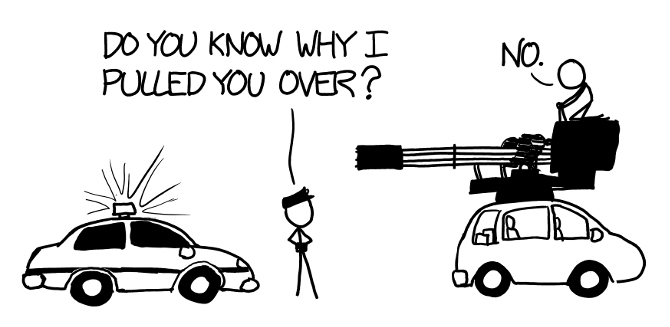
This is by XKCD, aka Randal Monroe, a PHD physicist, who used it in a whimsical study on the practicality of using the recoil from an A-10 30mm rotary cannon as a method of propulsion.
Tom’s World – Joke of the Day – 16APR2026
Feel free to comment with your own jokes.
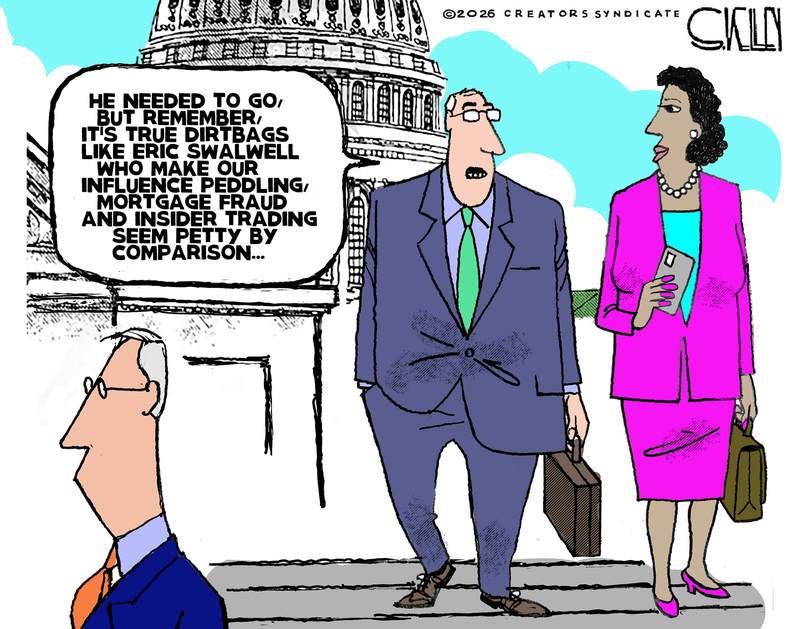

I took this shot at the Pensacola Mardi Gras. Not sure what to think or say about it other than to note I’m pretty sure I wouldn’t do that unless possessed by demons and maybe not even then.
Tom’s World – 11APR2026 – Music – The Prayer
Here’s a link to a youTube of a brother/sister duet that starts out normally enough but quickly evolves into something startlingly beautiful. Absolutely exceptional, to me anyway.
But I use a full desktop with pretty good speakers. Probably wouldn’t have the same effect on a phone.