Eastern Promises (2007) – A Movie Review

This is a movie about some Russian mobsters in London.

(Spoiler Alert – Skip down to last paragraph to avoid spoilers and read recommendation)

Anna Khitrova is a nurse in the maternity ward of a London hospital.  One day a pregnant underage girl Tatiana shows up hemorrhaging and in cardiac distress.  We’re shown the needle marks on her arms.  She’s rushed into surgery and the baby is saved but the mother dies.  Anna finds a diary written in Russian in Tatiana’s possessions.  She asks her uncle Stepan to translate the diary but after looking through it he tells Anna not to get involved.

But Anna wants the baby to go back to Tatiana’s family instead of into foster care.  She finds a card for a Russian restaurant in the diary and goes there to find out about Tatiana and to get the diary translated to find her family.  She meets the restaurant’s owner Semyon a courtly old man and his son Kirill and their “driver” Nikolai (played by Viggo Mortensen).  In reality Semyon is the head of the local Russian mafia family.  Semyon tells Anna he has never heard of Tatiana but agrees to translate the diary for her.

Meanwhile we see what Kirill and Nikolai are up to.  Kirill has ordered a hit on another Russian mobster and Nikolai helps to “process” the body by removing the teeth and cutting off the fingers in a scene that tells you how cold blooded he can act.  They dump the body in the Thames but all this was done behind Semyon’s back.  Kirill is a loose cannon who acts out of emotion.  The murdered gangster has an organization that will be looking for revenge.

Semyon reads the diary and realizes that it implicates Kirill and himself in statutory rape and much more.  He orders Nikolai to murder Anna’s uncle because of his knowledge of the diary’s contents.  When Semyon’s contacts tell him that a Chechen hit squad is hunting for Kirill but does not know what he looks like he hatches a plan.  He decides to elevate Nikolai to a “made man,” so to speak, in the organization.  He is given the “star” tattoos on his shoulders and knees.  And he is invited by one of the organization to a meeting at a bathhouse.  It’s a set up for a hit.  The two Chechens are told that Nikolai is Kirill and they attack him as he sits in a towel in the sauna.  After a harrowing battle in which he sustains numerous knife wounds he kills both hitmen.

At the hospital where he is recovering from his wounds Nikolai is visited secretly by a high-ranking Scotland Yard officer named Yuri.  We learn that Nikolai is an undercover FSB agent infiltrating the Russian mafia with the approval of the British government.  Nikolai insists that what must be done is arrest Semyon for the statutory rape of Tatiana based on DNA evidence of his paternity of her child.  This will allow Kirill to assume titular control of the family but leave Nikolai in actual control to do his work from the inside.  Anna finds out that Nikolai did not murder her missing uncle but sent him out of town (Scotland) to hide from Semyon.  She now believes that Nikolai is not part of the plot to hide Tatiana’s abuse.

But when the police demand a blood sample from Semyon, he figures out what’s going on and sends Kirill to the hospital where Tatiana’s baby is being held to kidnap her.  He intends to drown her in the river.  But Kirill is guilt ridden over the idea of murdering the child.  By the time he steels himself to commit the murder Nikolai and Anna arrive to talk him out of it and save the child.  Nikolai convinces Kirill that his father must be allowed to go to prison in order for the two of them to gain control of the business.  Kirill begs Nicholai to believe that he had nothing to do with the Chechen hit squad going after Nikolai and they are reconciled to this new partnership they are forming.

In the last scene Semyon is in prison and Tatiana’s baby has been adopted by Anna.  The last image is of Nikolai now dressed as a prosperous business man in the restaurant apparently wondering what has become of his life.

This is a brutal movie.  Scenes involving the degrading treatment of the prostitutes in Semyon’s bordello and the graphic violence is disturbing.  The depraved nature of Kirill and the various other “soldiers” is depressing to watch.  It’s hard to imagine that a government agent would go through all that Nicholai does even if it is the means by which a large criminal organization is destroyed.  The depravity and the suffering he goes through is mind altering.  Who can I recommend this movie to?  Well, not the easily offended.  Sexual content and violence are pretty extreme.  In addition, I’d say this movie is for people who go in for gangster movies.  If you fit into both those categories then this is actually a legitimate film.  The acting is mostly very good.  Viggo Mortensen does a superb job as the fake hitman.  And if action scenes are what you crave then the hit in the sauna is one for the record books.  It’s extremely harrowing and effective.  Hopefully I’ve spelled out what this movie is.

The Amazing Dr. Clitterhouse (1938) – An OCF Classic Movie Review

I think the chief interest in this movie is that it comes across as a light-hearted crime drama.  In a real sense I think it could be considered a comedy.

(Spoiler Alert – Skip down to last paragraph to avoid spoilers and read recommendation)

Edward G. Robinson is the eponymous Clitterhouse, a surgeon with a keen and inquiring scientific mind.  When we first meet him in the opening scene, he is in a darkened bedroom rifling through a wall safe.  Just then a burglar enters through the second story window.  Clitterhouse trains a strong flashlight on the burglar and convinces him that he’s being covered by a gun.  He gets the burglar to stand facing the wall with his hands up.  Just then a second burglar who’s on the ladder looks in.  It’s Bogart playing Rocks Valentine (some name, huh).  He sees the situation and heads back down the ladder to escape.

Clitterhouse leaves the burglar in the bedroom and reenters a society party that’s going on downstairs.  A coloratura soprano is singing an aria.  Clitterhouse accepts a brandy from a butler, calls one of his associates about a patient he is treating and then calls the police and an ambulance just as a woman screams from upstairs and someone in the house shoots the burglar as he attempts to exit the house.  Clitterhouse treats the wounded burglar but he is recognized by his voice.  But Police Inspector Lane played by Donald Crisp laughingly allows Clitterhouse to be on his way to a surgical appointment without even inspecting Clitterhouse’s medical bag filled with the pilfered jewels.

Thus, the scene is set.  Clitterhouse is engaged in research on the physiological aspects of crime.  For this experiment he has committed four burglaries.  Now to expand his research he is reaching out to a jewelry fence, Jo Keller (played by Claire Trevor) and a gang of burglars headed by Rocks that includes such familiar character actors as Ward Bond, Vladimir Sokoloff and Burt Hanlon.  Clitterhouse identifies the victims and meticulously plans the heist.  The gang and Keller provide the manpower and the connections to perform the thefts and sell the loot.

In the final crime, a theft of furs from a warehouse, Rocks tries to double-cross Clitterhouse by locking him in the refrigerated vault.  But one of Keller’s men saves him.  At this point Clitterhouse has completed his research.  He has taken blood samples, blood pressure and other diagnostic tests on the gang members and now he wants to end his association with the underworld.  But Rocks figures out Clitterhouse’s true identity and tells the doctor that he will be forced to continue his criminal activities indefinitely.

Clitterhouse seems outwardly to agree to Rocks’ ultimatum but actually he doctors Rocks’ drink with a deadly dose of a drug.  Rocks falls asleep and then Clitterhouse and Keller dump the body in the river.  Eventually the police discover Clitterhouse’s guilt in Rocks’ murder and he goes on trial for murder.  His lawyer uses an insanity defense.  The prosecution gets Clitterhouse to testify against himself by stating that his scientific study is completely accurate and therefore the work of a sane man.  But the jury finds him insane based on the idea that only a madman would knowingly admit his sanity when he knows it would cause his own death.

Despite the fact that Clitterhouse murders Rocks in cold blood I see this movie as a comedy.  Throughout the story the atmosphere of the whole thing is light-hearted and I find it impossible to take any of it seriously.  There are a number of silly moments when the various gang members come off more as clowns than criminals.  The only menacing character is Bogart’s Rocks.  And as we see he is no match for Robinson’s genteel madman.  So, what can I make of a whimsical film noir?  Well, not too much.  It’s not a great movie but it is amusing in its own way.  I’ll recommend it to fans of the 1930s.  If we need a serious movie with Bogart and Robinson we’ll have to wait for their rematch in Key Largo

Kwaidan (1965) – A Movie Review

Kwaidan means ghost story and was directed by Masaki Kobayashi.  This movie is a collection of four stories that I guess could be called supernatural tales.  They are based on stories written by Patrick Lefcadio Hearn, an ex-patriot of Irish/Greek extraction who settled in Japan in 1890.  Each of the stories deals in an unrelated supernatural event.  The stories are based on old Japanese folktales.

(Spoiler Alert – Skip down to last paragraph to avoid spoilers and read recommendation)

In the first story (The Black Hair) a samurai decides to divorce his wife who is a weaver of cloth.  He is tired of poverty and has orchestrated a marriage to the daughter of a nobleman.  But when he goes through with his plan his new marriage is a disaster.  His new wife is selfish and spoiled.  He misses the good-hearted weaver and after a few years he leaves his new wife and heads home to Kyoto for his old life.

When he gets there his old house is strangely changed but the samurai finds his wife overjoyed to see him.  She looks completely unaged and comforts her ex-husband not to blame himself for his actions.  She mysteriously mentions that they have only a short time together.  When he wakes up the next morning his wife is a shriveled corpse on the bed next to him. He tries to flee but her hair pursues him and while we watch he grows visibly much older as it attacks him.

In the second story (The Woman of the Snow) a young woodcutter and his older partner become trapped in a heavy snowstorm and seek shelter in a hut.  During the night a Yuki-onna, a female snow vampire freezes the older woodcutter and steals his life-force.  She tells the younger woodcutter that she had planned to kill both of them but because he was young and attractive, she decided to spare his life but on condition that he never tell anyone what happened that night.  If he does tell anyone she will know and then come to him and kill him.

Out of fear he tells no one including his mother with whom he lives.  Shortly after, a young and beautiful woman travels through their town and the young man invites her to stay at his house.  Both the young man and his mother are impressed with her qualities.  Eventually they marry and she bears him three children.  But one day as she is talking to him, he notices that she bears a resemblance to the snow vampire and he tells her the story.  His wife then reveals to him that she is the snow vampire.  Because they have children that she loves she will not kill her husband but instead will leave him forever.  But she warns him that if he is ever a bad father she will return and kill him.  After she leaves, he puts a present outside his house for her.  Later she takes the gift thereby signifying an abatement of her anger.

In the third story (Hoichi the Earless) Hoichi, a blind singer of heroic songs who lives at a monastery is visited by a samurai at night who brings him to a noble house lost in the fogs of the night.  There he sings The Tale of the Heike about the Battle of Dan-no-ura, a sea battle fought between the Taira and Minamoto clans during the last phase of the Genpei War.

Eventually his brother monks go looking for him and find him in a cemetery.  It seems that the ghosts of the defeated Taira leaders want to hear the story of their heroic defeat sung by a great artist.  The monks tell Hoichi that the ghosts will come back to claim his soul permanently so to protect him they cover his whole body including his face with the text of the “Heart Sutra.”  But they forgot to write it on his ears.  When the ghost of the samurai reappears, he can only see Hoichi’s ears.  To obey his master’s order to retrieve Hoichi he rips off the ears and takes them away.  Hoichi survives this injury and recovers.  When the rumor of this ghostly action spreads, rich patrons of music pays great sums to have Hoichi sing the tale of the battle.  And Hoichi becomes famous and very rich.

In the fourth story (In a Cup of Tea) a writer of old tales (sort of like Patrick Lefcadio Hearn) relates a folk story to his wife that he is planning to sell to a publisher.  The story is about a samurai who is part of the escort for a great lord who is travelling home.  The samurai goes to drink a cup of tea and sees the face of a man staring up at him from the tea.  He is shocked and angered by the occurrence but drinks the tea anyway.  When he arrives back home a man appears in the great house with the same face as the man in the tea.  The samurai attacks him with his sword but the man disappears.  Later that night the samurai is accosted by three men who say they work for the man from the tea cup whom he has injured.  The samurai battles all three men.  Now the writer tells his wife that this is where the story ends uncompleted.

That night the publisher arrives to see the writer but when the wife and publisher look for him, they see his image in a large pail of water just as in the story and they run away screaming.

As you can tell these are very unusual stories.  They don’t fit the category of western horror stories.  They’re reminiscent of European fairy tales or folk tales.  I wouldn’t describe them as frightening but instead odd.  I can’t say that I highly recommend them to a general audience.  They’ve been praised for the artistry that they display as visual cinema.  But I think that for a Western audience they might lack immediacy.  So, let’s call these a curiosity that probably only would interest connoisseurs of Japanese folklore or Japanese cinema.  I thought they were interesting and some scenes, specifically the sea battle portions were well crafted.  Your milage may vary.

Of Ricotta Cheese and the Seventh Circle of Hell

What to write about tonight?  Today was a day for chores.  One was my semi-annual trip to the dental hygienist.  Such a strange thing we have to do.  Twice a year someone has to torture you with dental tools while trying to make small talk with someone who can’t speak.  You know it’s an interesting thing.  Someone who’s good at that must be a gifted person.  My hygienist only sees me twice a year but somehow manages to continue the conversation from where it left off six months earlier.  Quite the trick.  Either she has an incredible memory or she takes notes.  Either way it’s kind of remarkable.  And it’s funny.  This time she told me that my teeth and gums looked better than usual.  For some reason this slight praise filled me with a sense of accomplishment.  I was now some kind of flossing ninja!

Anyway, when I got back home with my slightly whiter teeth and my “free” new toothbrush I read through the news articles and I even commented on the OPEC move to screw Joe Biden to the wall.  And that was fun.  But nothing struck me as the nucleus of a post.

So, I watched an old movie that I recently bought.  I got it used at a library sale.  I’d never consider buying it new because it’s not that good.  It’s “Constantine” with Keanu Reeves as a freelance exorcist who battles demons while smoking a lot of cigarettes.  It’s really a goofy concept.  Constantine has a gift that allows him to see demons.  But he is damned to Hell for a suicide attempt he sort of succeeded at when he was a boy.  He was “dead for two minutes.”  During those two minutes he experienced a lifetime of torment in Hell before the doctors revived him.  In this movie he is battling semi-demons, a renegade angel and lung cancer.  As I said it’s a goofy movie but every three years or so I seem to watch it again.  Another problem with the movie is it costars Shia LaBeouf.  Well, what can you do?  But it was a good way to stop thinking about Joe Biden for an hour or two.

Camera Girl put together a nice manicotti and meat ball dinner for us.  Now that’s comfort food.  So, I complemented her on this delicious meal and then she told me that the cost for the meal had doubled in a little over a month.  She said, for instance, that ricotta cheese went from $3.50 for a container to $7.00.  Being the frugal and practical shopper, this kind of thing strikes her as madness.  I started to explain to her how energy costs associated with the green new deal cascaded through the economy and caused multiple increases in the costs of food because of transportation, refrigeration, fertilizer and of course the ever-popular supply chain problems.  She gave me a look as if I had blamed it on the demons from the Constantine movie.  So, I stopped beating that drum and told her we’d find a way to save money by eliminating something “scholastic.”  That’s the word she uses for anything that she deems pseudo-intellectual.  Which covers anything that I am interested in that she is not.

But there was Joe Biden again.  Annoying my wife by sabotaging the economy.  This monster had doubled the price of ricotta cheese in a single month.  Looking back at the logic of the Constantine movie I decided that for this monstrous act Creepy Uncle Joe should be consigned to one of the worst circles of Hell, possibly the one where an arch-demon gets to clean the teeth of the damned with a pickaxe for all eternity and where they’ve completely run out of free toothbrushes.  I started to wonder if Joe’s fake teeth would be more or less sensitive to pain.  But then I remembered that arch-demons really know their stuff so he would be in for it either way.  So, I felt a little better.

You know all the little problems that come out of the sabotage of the economy seem trivial compared with crime waves, nuclear war and the sexual mutilation of children.  But those little things add up to something important.  The United States was called the land of opportunity because a good chunk of its citizens, the middle class, was prosperous.  They weren’t rich but they weren’t poor.  They couldn’t buy a new car every three years but they always could go out when they felt like it to a burger joint or a Chinese restaurant and enjoy a good meal to give everybody in the family a boost.  Not since the days of Jimmy Carter have we been worried about having enough money to pay for the groceries and the mortgage.  Now we do.

And so, if I was going to consign Joe Biden to Hell for his crimes, I wouldn’t leave out this charge.  Because along with everything else he’s done he’s killed the natural cheerfulness of the American people.  That’s a pretty monstrous thing.

Well, that’s what I’ve come up with.  It seems a bit random but life is a stew.

The Northman (2022) – A Movie Review

The Northman is a retelling of the Amleth story from Danish historian Saxo Grammaticus.  This is the story that forms the basis of Shakespeare’s play Hamlet.

(Spoiler Alert – Skip down to last paragraph to avoid spoilers and read recommendation)

The story begins when Amleth is an adolescent.  His father King Aurvandill (played unrecognizably by Ethan Hawke) has just returned from a Viking raid.  He was wounded badly and tells his Queen Gudrún (played by Nicole Kidman) that he’s decided it’s time to initiate Amleth into the rituals associated with being king.  The father and son participate in a rite that involves them howling like wolves and lapping food off a plate on the floor of an underground temple.  During the ceremony Amleth has a vision of the chain of life from generation to generation and he swears to avenge any attack on his family.

Immediately afterward, his father is set upon and murdered by his bastard half-brother Fjölnir and his followers.  Amleth barely escapes with his life but as he rows away from his island home, he swears to revenge his father and rescue his mother who has been seized by his uncle.  He swears to kill Fjölnir.

Next, we see Amleth years later.  He’s a grown man who has become a berserker who participates in Viking raids for some chieftain.  He is fierce beyond the bounds of his comrades and he cuts through his enemies like a knife through butter.  While involved in the sack of a Slav settlement he meets a priestess in the local temple and learns that his fate is still determined by the vengeance he has sworn against his uncle.  She tells him that his fate is to kill Fjölnir surrounded by a lake of fire.

Back in Scandinavia he learns that his uncle was dispossessed of his island kingdom by the King of Denmark.  Fjölnir has fled to Iceland and is now a petty chieftain with just a few retainers and using a small slave force to raise sheep.  Amleth decides to disguise himself as a slave and work on Fjölnir’s farm in order to have his revenge and free his mother.  During his voyage to Iceland, he meets a Slav prisoner named Olga to whom he is attracted.  The two slaves form a bond and when Amleth manages to rise in the slave ranks to foreman Olga is given to him as his woman.  The two plot Amleth’s revenge and their escape.

Now Amleth meets another seer who tells him the details of his fate.  He must go to the gates of Hel and there recover the magical sword Draugr.  Accomplishing this feat, he prepares his revenge.  Under cover of darkness, he kills some of Fjölnir’s men and nails their bodies to a cabin wall.  Using a drug that Olga prepares for him he poisons the garrison and they become confused and slay each other during the night.  While this is going on Amleth goes to Fjölnir’s house to kill him but instead meets Gudrún.  He reveals his identity and tells her he is there to kill Fjölnir and free her.  But she laughs and tells him that she planned his father’s murder because she was a slave and never loved Aurvandill.  Amleth is horrified and kills Fjölnir’s son Thorir and cuts out his heart.

Fjölnir threatens to kill Olga and Amleth exchanges himself for her.  While Fjölnir performs his son’s funeral Amleth is freed from his captivity by ravens (Odin’s messengers).  Then Olga carries him away on a horse to the coast.  There he finds out that she is pregnant with his children (twins).  They plan to escape to the Orkneys where Amleth has kin.  They embark on a ship but as they’re sailing away Amleth has a vision of his fate.  He knows that Olga will give birth to his son and daughter who will carry on his line.  But he knows that his fate is to fulfill his oath.  He jumps from the ship and swims back to shore.

Amleth kills the retainers and sets the slaves free to burn down the farm.  He heads for Fjölnir’s house but finds Gudrún.  He does not intend to kill her but she attacks him with a sword and finally he stabs her.  Then her young son attacks Amleth with a knife and finally Amleth kills him.  At this point Fjölnir arrives and tells Amleth to meet him at the Gates of Hel to settle things.  Then he carries away his wife and son for burial.

Badly wounded by the wounds he’s already gotten Amleth fights Fjölnir amid the flowing lava of the volcano.  As Amleth is weakening he gathers his strength for one last flurry.  As Fjölnir buries his blade in Amleth’s chest he beheads his uncle.  And as Amleth is dying he has a vision of Olga telling him that his children are safe and to relax into his fate.  He does so and we see him carried by a Valkyrie to Valhalla.

Wow.  That’s a lot.  Okay, so this is an unusual movie.  It’s a mixed bag.  The intent is to recreate the frame of reference of a Viking prince of the ninth century.  In some ways this seems successful.  But as a movie the dramatic content is difficult for a modern audience to accept.  Seeing a man and a boy howling like wolves seems bizarre, almost silly.  But I can see how this might be a way to convey the berserker mindset.  The fighting scenes are well done.  Despite the unusual content of the plot, I thought the main characters were very well acted.  But I had a hard time empathizing with any of the characters.  Their worldview was so far from my reality that I just couldn’t believe in it. This being said I enjoyed the movie.  It was grim and bizarre but I saw what they were trying to do and I enjoyed the experience of trying to believe in that frame of reference.  I can’t recommend this movie to anyone who doesn’t think this description is interesting.  It’s not a normal movie.  Probably people interested in Viking history are the primary audience.  Your milage may vary.

The Great Man (1956) – A Movie Review

Jose Ferrer directs and stars in this drama about the manufactured quality of mass media celebrity.

(Spoiler Alert – Skip down to last paragraph to avoid spoilers and read recommendation)

Jose Ferrer plays Joe Harris, a reporter who covers the entertainment beat for a local New York City newspaper, radio and television network.  When Herb Fuller, the network’s leading broadcaster dies in an automobile accident Harris is dragged into the story to provide a reverential eulogy of the beloved broadcaster during the extended network coverage of his funeral.

Dean Jagger plays Philip Carleton the head of the network.  Carleton dangles Fuller’s vacant network shows in front of Harris as an incentive for him to dazzle the audience with a masterful hagiography of “the great man.”  Sid Moore (played by Keenan Wynn) was Fuller’s producer and he’s responsible for lining up Fuller’s associates for Harris to interview in the few days left before the broadcast.  But aware that Harris is being groomed for Fuller’s old spot Moore is suspicious of Harris’s motives, surly toward him and quickly berates Harris for overstepping his place in the network hierarchy.

As Harris begins interviewing people, he realizes that there is an inverse relationship between how well people knew Fuller and how well they liked him.  People who only knew him from his broadcasts revered him as a good man and as almost a member of the family.  But the people who knew him most intimately revealed him to be an awful human being.  He was an abusive alcoholic.  His wife only stayed married to him to avoid scandal.  He was an indiscriminate womanizer who tossed away girls as soon as he became tired of them but expected them to always be available to him if he was bored or lonely.

His first job in radio was for a small radio station in Worcester Massachusetts owned by a religious man named Paul Beaseley (played by Ed Wynn) who was hoodwinked by Fuller’s incredible eloquence about his supposed spirituality.  Eventually he revealed himself to Beasley as a completely phony opportunist who preyed on people’s better natures.  But Harris also discovers that Fuller was a powerfully gifted writer and actor whose powers of persuasion and charm could win over any audience that didn’t happen to know him personally.

In one of the most powerful scenes Harris listens to one of Fuller’s most masterful broadcasts.  Ostensibly Fuller was in a forward line battleground at the German front in World War II and he was reporting on the American soldiers wounded and dying.  And he was describing an American soldier on a rude operating table in a barn having his leg amputated.  Fuller is describing the need for blood for these wounded men and starts berating, practically shouting at the American public for not immediately beating a path to their local hospital to donate blood for the cause.

Harris is powerfully moved by this recording and thinks he finally sees a humanity in Fuller.  But later on, Moore tells him the truth.  Fuller never got out to the battlefields.  He spent the trip in a drunken debauch in Paris where he was arrested in a brothel.  Moore went himself to the front to get the recordings and Fuller merely recorded his monologue over that background later on.

While this is going on Carleton reveals to Harris that there is corporate intrigue that involves forcing Moore away from the future of the shows that Harris may be given.  Harris is disgusted with both Carleton and Moore and almost everyone else he’s come in contact with on this story.

Finally, the night of the broadcast Harris is preparing to give the eulogy along with all the glowing tributes he’s recorded from those that didn’t really know Fuller or who would benefit from maintaining the myth about him.  But he stops.  Unable to stomach the lies, he tells the audience the truth.  He begins to relate the facts that he has discovered about the real Herb Fuller.  Back in the executive office Moore and Carleton are listening to the broadcast.  When Harris begins spilling the beans, Moore calls up the control room to cut Harris off.  But Carleton stops him.  Harris is about to become a symbol of crusading integrity and the network can utilize that to jumpstart their new star reporter’s career.  Carleton knows that advertising time can be sold with Fuller as either a sinner or a saint.  The story will come out.

I had never seen this movie before.  I’m glad I have.  This is a very well-made drama.  Jose Ferrer is a very good actor.  It seems he’s a pretty good director too.  The story is intriguing and the cast is full of good performances.  The one that stands out for me is Ed Wynn as the New England radio station owner.  His small-town sincerity is such a contrast to the cynicism and phoniness of the New York media crowd that it is almost shocking.  When we read the first broadcast that Fuller wrote for him and measure it against the values that are on display from the rest of the characters, we can feel Harris’s embarrassment at having treated this good-hearted man with faint mockery at his provincial manner.  Like him, maybe we feel a twinge of remorse that our lives have become coarsened too.  We feel a sadness that the world is really more Fuller’s world and not the better place it should be.

Anyway, I recommend this movie.  It has a good story to tell and it does it well.

It Came from Outer Space (1953) – A Science Fiction Movie Review

I won’t put in the typical spoiler alert because it just doesn’t matter.

In this movie an amateur astronomer, John Putnam, happens to be out in his backyard in what looks like Arizona, looking through his telescope when what appears to be a meteor hurtles to earth in his vicinity.  Being a man of action, John gets his friend Frank to helicopter him to the scene of the crash.  And of course, he brings along his girlfriend Ellen.

When they get to the crater John goes down to the “meteor” and finds that it is a spacecraft with something alive in it.  But somehow the ship causes a landslide that covers itself up.  From this point on John attempts to convince everyone that he isn’t crazy when he claims there is a ship from outer space in the crater.

Only Ellen believes him and they go around town trying to convince the sheriff and the scientists from the local college.  Eventually the aliens start kidnapping humans and replacing them with look-alikes.  But because these aliens are so boring people start suspecting something is wrong.   And here is where we meet the biggest “star” in the cast.  One of the kidnapped humans is George played by Russell Johnson, better known to the world as the “Professor” on Gilligan’s Island.  Johnson plays his part with all the acting skill that he would later demonstrate on that famous island.  Amazing.

Anyway, eventually the rest of the town figures out that John knows what he is talking about and under the leadership of Sheriff Matt Warren they organize a posse to go and put the smackdown on these aliens.  But by this point John has finally located one of the aliens and gotten their side of the story.

Apparently, the aliens crashed to Earth and have been attempting ever since to repair their ship.  They’ve impersonated humans to obtain supplies for the repairs.  Apparently copper wire is an important part of faster than light technology.  The humans they captured have not been harmed and will be released if the aliens are able to repair the ship before the humans have a chance to interfere with them.

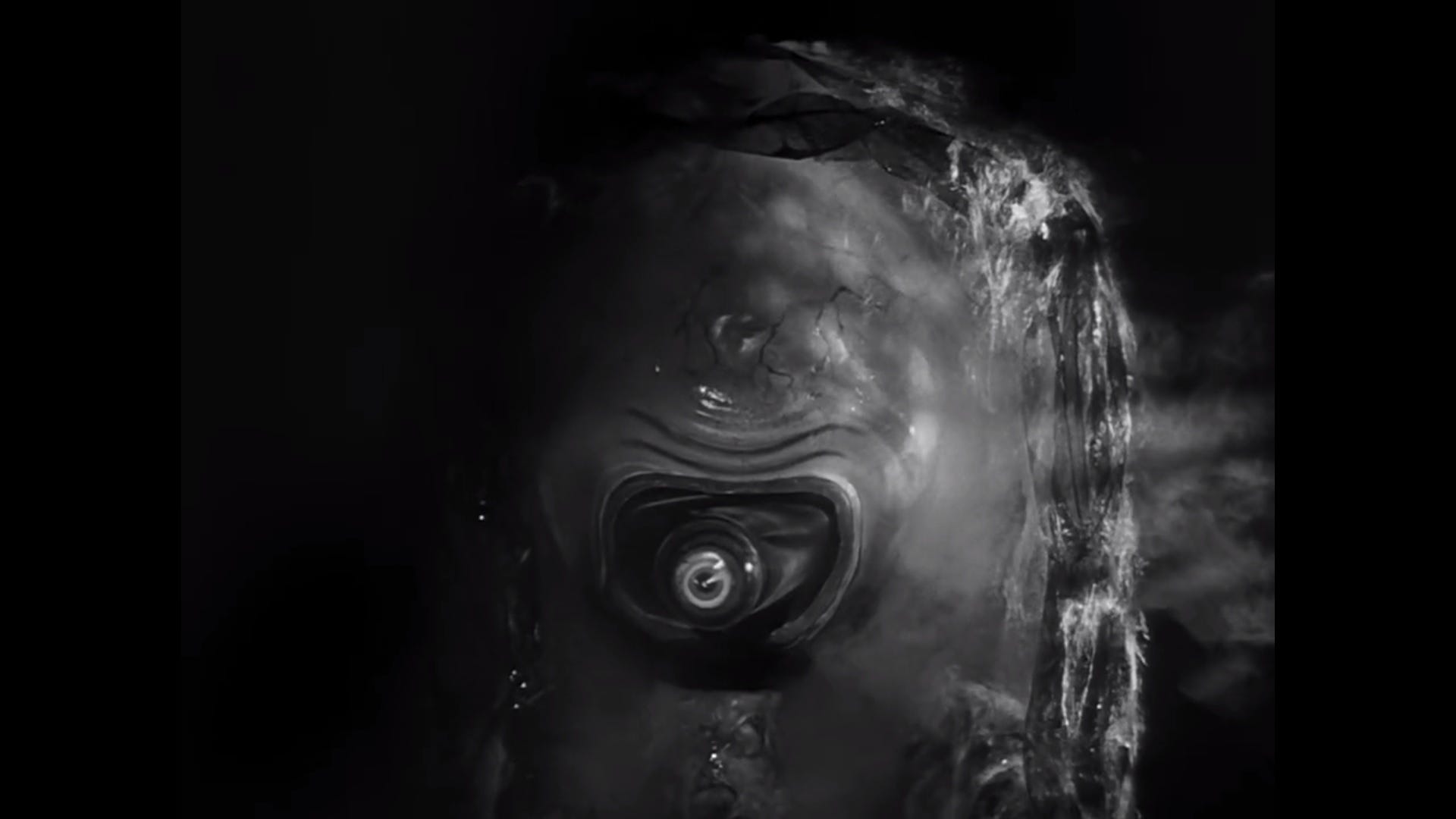
When John asks the alien why they don’t just come out in the open and meet the humans, he comes out of the cave he’s hiding in and reveals his appearance to John (1), (2).

Apparently, their appearance is so terrifying that John goes into hysterics for a few moments.  Personally, I think it would be more likely that most people would break out into laughter if the aliens showed up in town.  They sort of resemble what a giant Mr. Potato Head toy would look like if only one eye was stuck on where the nose should go and then asbestos was glued on as hair.  After his hissy fit John agrees to help the aliens escape by preventing Sheriff Matt from rousting them out of their cushy lair in the convenient old gold mine outside of town.

It is while John is trying to prevent the sheriff from attacking the aliens that Matt makes a speech which was the only part of the movie I remember from when I saw it fifty some-odd years ago.  Matt looks at the thermometer and says, “It’s ninety-two degrees!  I remember reading that more murders are committed at ninety-two degrees than any other temperature.  Below that temperature people are in their right minds.  Above ninety-two it’s too hot to do anything.  But at just ninety-two people get irritable!”  I really enjoyed that scene.  In fact, I enjoyed it more than the whole rest of the movie put together.

Anyway, the posse is rounded up and on the way to the mine they manage to kill one of the aliens driving a pickup truck.  It was a pretty nice truck.  John heads down into the mine first and one of the aliens disguised as Ellen tries to kill him with a laser wand.  But John manages to shoot her and she falls into a puddle in the mine.  Then John finds the leader of the aliens who is disguised as John(!) and talks himself into waiting before attacking the humans with his death ray.

John gets all of the hostages out of the mine and uses some handily placed dynamite to close up the mine entrance to prevent the posse from lynching the potato heads.  As the posse and the freed hostages watch the space ship breaks free of the earth and heads back into space.  And John tells us that one day they’ll return and human and potato heads will live in peace together.

Wow!  This movie was based on a story by Ray Bradbury.  I’ll have to go back and read that story.  If it really resembles the plot of this movie, I’ll have to rethink my appreciation of Bradbury.  Anyway, this is all harmless stuff from the early days of B-movie sci-fi.  I’ll recommend this thing as campy nostalgia from simpler times.  It would have made a good movie for a drive-in date.  Something you wouldn’t have minded missing during the clinches.  Your milage may vary.

When Worlds Collide (1951) – A Science Fiction Movie Review

I haven’t seen this movie since I was a kid.  Back then I had read the book and the sequel, “After Worlds Collide.”

(Spoiler Alert – Skip down to last paragraph to avoid spoilers and read recommendation)

The plot is relatively straightforward.  Astronomers discover a small star and a planet circling it entering the solar system.  It is calculated that within a year the star will collide with and destroy the Earth but the new planet will be captured by the sun and might provide a possible home for some humans to colonize if a rocket can be launched.  At first most scientists discount the crisis.  But a few industrialists believe the danger and begin building a rocket for the journey.  One selfish millionaire, wheel-chair-bound Sydney Stanton, agrees to finish funding the rocket only if he is on the passenger list.  The project team races desperately against time to complete the rocket before the end of the world.

The project is run by Dr. Cole Hendron who along with his daughter Joyce and Dave Randall provide the human interest for the story.  Randall doesn’t want to go along on the trip because he doesn’t believe he is entitled due to a lack of needed skills that the mission requires.  But Joyce (of course) is in love with him so eventually they trick him into going based on his abilities as the only qualified but unnecessary co-pilot.  As the moment of truth comes, we see Earth devastated by volcanic eruptions, earthquakes and tidal waves that destroy all the coastal cities.  Finally, the fifty passengers are drawn by lots and just as the ship is preparing to launch the unlucky lottery losers attack the ship with guns.  Dr Hendron decides at the last minute to remain on the ground to provide a margin of error for the fuel and while he’s at it he prevents Stanton from getting on the ship too.  As the ship launches Stanton staggers to his feet.  An Armageddon miracle.

We get to see Earth destroyed.  Improbably the Earth blows up in a giant fireball without coming in contact with the star.  The ship reaches the new world and Randall finally has to glide the rocket to a landing after its fuel tanks are completely emptied during the braking maneuver.  The landing is rocky but doesn’t kill them.  And of course, the air is good and there’s green life growing on the ground and it looks like there may be the ruins of cyclopean buildings nearby.  Joyce and Randall embrace, a dog gives birth to puppies and everybody rejoices at the first dawn on their new world.

The only familiar faces were Larry Keating playing Dr. Hendron and John Hoyt as Stanton.  The rest of them were completely unknown to me.  The special effects aren’t very good.  But they weren’t awful.  The acting was sturdy B movie Hollywood acting of the time.  About what you’d expect in a decent western or a melodrama.  I quite enjoyed it.  The plot is simple but quite relatable on both a human-interest level and as a science fiction story.  I’ll say this is recommended for science fiction fans especially for connoisseurs of the 1950s period in the genre.

Murder, My Sweet (1944) – An OCF Classic Movie Review

Murder My Sweet is based on Raymond Chandler’s book “Farewell My Lovely,” one of his books about the fictional detective Philip Marlowe.

(Spoiler Alert – Skip down to last paragraph to avoid spoilers and read recommendation)

Marlowe (played by Dick Powell) is contracted by an ex-con named Moose Malloy to find an old girlfriend named Velma.  Malloy is a hulking brute who has just spent eight years in prison for some violent crime and several times in the movie he overreacts over some disappointment by strangling or roughing up one of the protagonists.

As Marlowe begins to get a lead on someone who knew Velma, he is sidetracked when he is hired by Lindsay Marriott to assist in an attempt to pay ransom money for the return of an expensive piece of jewelry.  The two men head out to a lonely stretch of road to perform the exchange but when they split up both Marlowe and Marriott are attacked by an assailant using a lead sap.  Marlowe eventually regains consciousness but when he returns to their car, he finds that Marriott has been bludgeoned to death.

The police, in the person of Lt. Randall, grill Marlowe on the details of the murder and after threatening him with indictment over his involvement finally let him go.  They do ask whether Marriott mentioned a Jules Author in regards to the stolen jewelry but they refuse to give him any details about Amthor and warn him to not get involved in the case any further.

The next day a woman pretending to be a reporter questions Marlowe about the jewelry theft.  She refers to it as a necklace.  Marlowe figures out that she isn’t a reporter and finally gets her to admit that she is Ann Grayle, the daughter of the man who lost the necklace.  Or rather she is the stepdaughter of the woman, Helen Grayle, who actually lost it.  She hates her stepmother but is trying to recover the very expensive jade necklace that her father gave to Helen.

Ann and Marlowe drive to the Grayle estate.  The house is a palace and we find out that Mr. Leuwen Grayle is a collector of fine jade and the necklace cost over $100,000.  We then meet Helen who is a beautiful blonde who barely waits for her husband to leave the room before she comes onto Marlowe and hires him to recover the necklace.  At that point Jules Amthor shows up at the Grayle residence and Marlowe finds out that he is a quack doctor who is mixed up with both Helen and the deceased Marriott.  Later Ann tries to persuade Marlowe to give up the case because of the unscrupulous nature of her stepmother.  But Marlowe refuses.

Amthor gets in touch with Moose Malloy and has him bring Marlowe to Amthor’s penthouse.  He questions Marlowe about the whereabouts of the necklace but when Marlowe assures him, he hasn’t got the necklace Amthor convinces Malloy that Marlowe is hiding Velma from him so Malloy chokes Marlowe into unconsciousness and Amthor has Marlowe installed in the private sanitarium of a Dr. Sonderborg where narcotics and truth serum are used to try to pry the necklace’s location from Marlowe’s mind.  After three days of this treatment Marlowe manages to escape his captors and when he meets up with Moose Malloy again, he convinces the dimwitted giant that Amthor was lying to him.

Fearing that the police and Amthor might have his apartment staked out Marlowe shows up at Ann Grayle’s home and tells her about Amthor’s actions.  She decides to help Marlowe and after updating the police on Amthor’s involvement in the necklace theft Marlowe and Ann head to Marriott’s beach house to try and figure out what was actually going on among all the shady characters involved in the case.

And there they find Helen.  She chases off Ann and then provides the real situation with the necklace.  Amthor was blackmailing Helen over things in her past.  The necklace was the price he was demanding.  Marriott was working with Amthor.  Helen admits that she murdered Marriott in order to get back the necklace.  Now she wants to enlist Marlowe to murder Amthor and thus get herself clear of his blackmail.  Marlowe appears to go along with her plan.

When he gets back to his office, he finds Moose there and discovers that Moose has killed Amthor by accident.  Marlowe brings Moose back to the beach house and leaves him outside waiting to bring him in to see Helen whom he has figured out is Moose’s “Velma.”  Helen is in the house and Marlowe brings her up to date on Amthor’s death.  Now Ann and her father show up.  Helen then reveals that she’s had the necklace all along and was only toying with Amthor.  When she finds out that Marlowe is going to turn her over to the police for Marriott’s death, she pulls a gun on him and has her husband take Marlowe’s gun from him.  But when she points the gun at Marlowe to kill him her husband shoots her with Marlowe’s gun and she dies.

The gun shot causes Moose to enter the house and seeing his “Velma dead he goes to attack Mr. Grayle.  When Grayle raises his gun at Malloy, Marlowe tries to stop the gun play but he instead has his face near the gun muzzle as it goes off and his eyes are scorched by the muzzle flash.  The scene shifts to Marlowe with his eyes bandaged telling his story to the police.  Unbeknownst to him Malloy was killed by Mr. Grayle but not before he had a chance to turn the gun on Grayle.  In the final scene we see Ann Grayle drive off with Marlowe in passionate embrace.  Somehow love has triumphed over murder and greed!

As with all Raymond Chandler stories the plot is convoluted, confusing and loaded with bizarre characters.  Moose Malloy is definitely a cartoon character.  And several of the female characters seem unable to resist Marlowe’s debatable charms.  There is a decidedly frantic aspect to the constant action.  Maybe some people would find this off-putting and unreal.  I think of it as the hallmark of the film noir style that this film exemplifies.  Humphrey Bogart played Marlowe a few years later in “The Bid Sleep.”  But I think Powell in Murder My Sweet is the quintessential Marlowe.  I recommend this movie to anyone who enjoys film noir and anyone else who would like to try out the genre.  Highly recommended.

Obsession (1949) – A Movie Review

“The Hidden Room” is a crime drama that was made in England.  It was released in the United States with the title “Obsession.”

(Spoiler Alert – Skip down to last paragraph to avoid spoilers and read recommendation)

Dr. Clive Riordan’s wife Storm is cheating on him with an American named Bill Kronin.  After catching them together when they thought he was out of town he kidnaps Bill and imprisons him in a bombed out building on the outskirts of London.  He plans to murder him and then liquify the body with a corrosive chemical that he formulates in a lab in his medical office.  But Riordan has decided to wait before killing Bill until he is sure that the authorities don’t suspect him in Bill’s disappearance.  The majority of the movie is made up of Riordan’s visits to provide food and drink to Bill in his improvised prison cell.  Bill is shackled to a wall and Riordan has marked on the floor in chalk the areas of the room that are outside of Bill’s reach.  Riordan is a polite and even accommodating host, providing Bill with his choice of books and even cocktails.  And being a psychiatrist, he explains the psychological reason for his need for revenge.

But finally, after four months Riordan is convinced that it is safe to dispatch his guest.  However, Riordan’s wife has been in touch with Scotland Yard and eventually Superintendent Finsbury pays a visit to Riordan and this buys Bill a reprieve.  When Riordan overhears his wife on the phone with Finsbury, he decides to finish off Bill and he mixes a poison in Bill’s martini for the night.  But thanks to Finsbury’s actions Bill is rescued before the poison can take his life.  Riordan is arrested by Finsbury and Storm says goodbye to Bill in his hospital room before she leaves on a sea voyage to find a new man with which to stave off boredom.

None of the actors will be familiar to an American audience but this movie is interesting because of the scenes between Bill and Riordan.  Their strange companionship in these scenes is amusing and surprisingly compelling.  Since neither has anything to lose by being honest they both portray their thoughts candidly.  Not that murder is an acceptable social action but Riordan does explain openly his decision to punish his wife’s infidelities as a salve for his pride.  And Bill maintains his spirits believing that Riordan will back away from his murderous plan when the authorities maintain their pursuit of his disappearance.  The story is somewhat preposterous but I very much enjoyed it for the scenes with the prospective victim and murderer.  Their pleasant discussions of Bill’s upcoming demise make this a movie I can recommend.