A Great Science Fiction Story?

Lately I’ve been thinking about this topic.  What makes a great science fiction story?  Can it be a great science fiction story if the story’s not great?  How about if the science isn’t great?  I think you know what I’m saying.  A great story, meaning great fiction, has characters drawn in a way that makes them compelling.  It doesn’t have to be Shakespeare but it can’t be two-dimensional cut-outs that wouldn’t make it through a toothpaste commercial.  And by the same token, what if the science is just stupid?  Sure, you can just say it’s fantasy instead and then the sky’s the limit.  But let’s stick to science fiction.

When I was a kid, I would have said that “great” science fiction needed the science but the fiction was not that important.  If there were enough star cruisers and anti-matter bombs and giant amoebas then all was right with the world.  In fact, the fewer human relations involved in the story, the better.  I was much more interested in the non-human characters acting “realistic” than any dialog between humans.  And the male/female dynamic was completely off the table.  The last thing a Lensman needed before, during or after a battle was a woman getting in the way.

Suffice it to say that time changes things.  I look at some of the “classics” of the golden age and I see a flatness to the story.  Now, this isn’t an all-encompassing criticism.  There are plenty of stories from the day that have nuanced characters and plots that reflect actual human personality types.  So, it’s not black and white.

Now, the modern literary science fiction has been described as having the opposite problem.  It’s all about human feelings and relations.  What isn’t as important is the “science.”  When that’s the case I will just declare that if a story doesn’t have any science at all then it isn’t a great science fiction story because it isn’t science fiction.  Period.

And without a doubt if a story has an exciting plot and memorable characters and also a clever science fiction premise then without a doubt it’s great science fiction.

So that leaves the other extreme.  What if a story is built on incredibly imaginative science fiction plot devices but the characters are cardboard cut-outs of human beings?  Can that be a great science fiction story?  In this category the works of Arthur C Clarke comes to mind and specifically 2001: A Space Odyssey.  Here is an epic tale stretching all the way from the dawn of Man to the first human interstellar voyage.  And yet the most human character in the book is HAL9000; a schizophrenic homicidal computer.  Now, is it an interesting story?  Well, yeah.  There are cave men and monoliths and moon bases and worm holes.  But honestly, do you find yourself rooting for anyone?  There’s just something so inhumanly stolid and wooden about everyone in the story that I feel that each one being murdered by HAL might be his happiest moment.  At least liveliest.

But anyway, I want to pose this as a question.  Can a technically engrossing sf story be considered great if the characters are ciphers?  What do you think?

Short Fiction Collected

I have an old beat up collection of Ray Bradbury’s short fiction.  It’s called “The Stories of Ray Bradbury.”  It was published in 1980 and contains about a hundred of his stories.  These stories appeared earlier in a number of short story collections that came out over the years that Bradbury was writing.  And he also wrote after this collection came out so there’s nothing original or definitive about this collection but it contains most of the short stories that his reputation was based on.  And because it is such a large selection (almost nine hundred pages in a 9.5 X 6.5 hardcover volume), there are great stories and poor ones.  There is fantasy, horror, something like science fiction and even nondescript fiction.  And because it was written over the course of about forty years it changes.  The emphasis, the stylistic touches, the topics all change.  But the voice is always recognizably Bradbury.  For the most part he is interested in the people.  The science is not the story.  In fact, most of the time it’s just the excuse for poking and prodding the people and watching them react.  It’s a pleasure to walk through this old volume and relive old stories and find out how I’ve changed over the years.  Have my preferences changed?  Yes.  But my likes and dislikes have mostly remained the same.  Possibly I’m a little bit more sensitive to the quality of the prose rather than the surprise in the ending.

It’s interesting to consider that science fiction short stories have been declared a dead field.  No one buys the stories either in book collections or in magazines (paper or electronic).  And that strikes me as a sad situation.  So many of these short stories contain wonderful ideas and characters and images that stir the imagination.  But somehow, they no longer have any value in the present world.  Can that be the permanent state of literature?  I guess it could be.  Capitalism is ruled by the law of supply and demand.  So, there’s no demand for short stories.

Well, that’s too bad.  Maybe the future will include a manner for artists to exhibit their works for people similar to how musicians currently perform concerts.  A live presentation where the audience listens to the story or watches a video presentation of it in a format that can’t be pirated and therefore has value as a single use experience.  All that’s left is the memory of the story.  Of course, that’s what movies were but now they’ve also lost their value.  So maybe not.  But I find a book of short stories to be a treasure trove.  A hundred stories and maybe fifty are very good and ten are wonderful.  That’s a pretty impressive collection.  I think any prolific author would be satisfied with that track record.

One thing that Bradbury liked to do was string together some of his short stories into a larger framework.  He did this with turning his Green Town stories into “Dandelion Wine” and his dark carnival stories into “Something Wicked This Way Comes.”  And what that shows me is these short stories can be the seeds for longer fiction.  But if no one reads them and rates them how will these seeds ever sprout.  Oh well.

Let Jake Barter Work on That for a While

Now that I’ve assumed the persona of Jake Barter, my whole life has changed.  Jake Barter is no ordinary man.  At the very least he has the training of a double nought secret agent and the social connections of Bruce Wayne.  His resume is a combination of special forces operator and philosopher king.  And because of this I told Camera Girl that she needed to treat me with much greater respect and an almost religious awe.

I don’t think she “gets it” yet.  You know what they say about a prophet in his own country.  Well, that goes double for a pseudonymous author.  I think I may now begin to write the memoirs of Jake Barter in my spare time.  I think he will be a picaresque character who gets involved in serious situations like wars, revolutions and social movements and ends up causing things to go south in horribly predictable ways based on his sloth, greed and phenomenal incompetence.  His only redeeming qualities are monumental overconfidence, enormous likeability and unbelievable luck.  I’m thinking I’ll start him off as a special advisor to Trump on constitutional law and then take it from there.

But seriously, I am thinking about new characters for future stories and I think the next thing I do will have a strong humorous streak in it.  And this is because I do enjoy making fun of things I don’t like and combining that with a writing project should make it a lot of fun for me.  But what I must do is decide if it will be in the same “universe” as “The Sniper.”  So far there isn’t a lot of humor there and maybe it would be better to separate a new project from a place with so much trauma lurking around every turn.  And that’s fine.  Making up multiple fictional worlds allows the author to escape from any traps he’s gotten himself into in the old ones.  You can get tired of a scenario or you just need a break from figuring out how to keep your characters from either getting killed or solving all their problems.  After all, either of those paths ends the story.  So, you have to be constantly threading the needle to maintain the overall “problem” but still carve out a piece of plotline to make the present installment interesting.

I think I might want to do an extraterrestrial story.  I’ve played around with some short story / novella length things in the past but they just petered out.  I think this time I’ll try to storyboard a whole bunch of stuff first so I have a direction and enough plot lines and an overarching direction for the thing before I get really started.  And what is currently completely stymying me is deciding what kind of Earth this will be.  Will it be like the actual current day disaster we are living through or will it be some kind of “day after tomorrow” where we’ve gotten our act together and learned how to live like human beings.  Well, I’ll let Jake Barter work on that for a while.

Well, Spin the Wheel

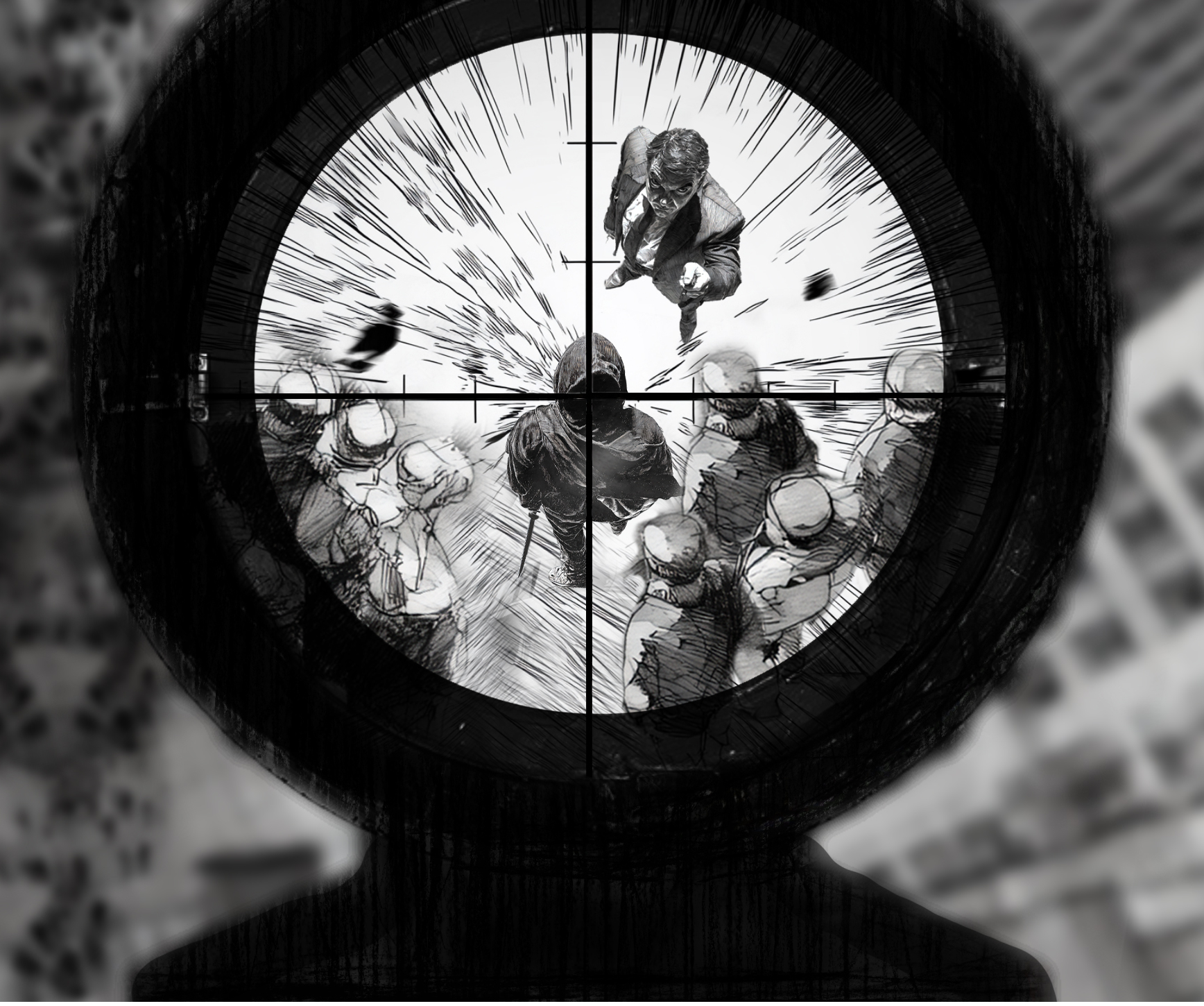
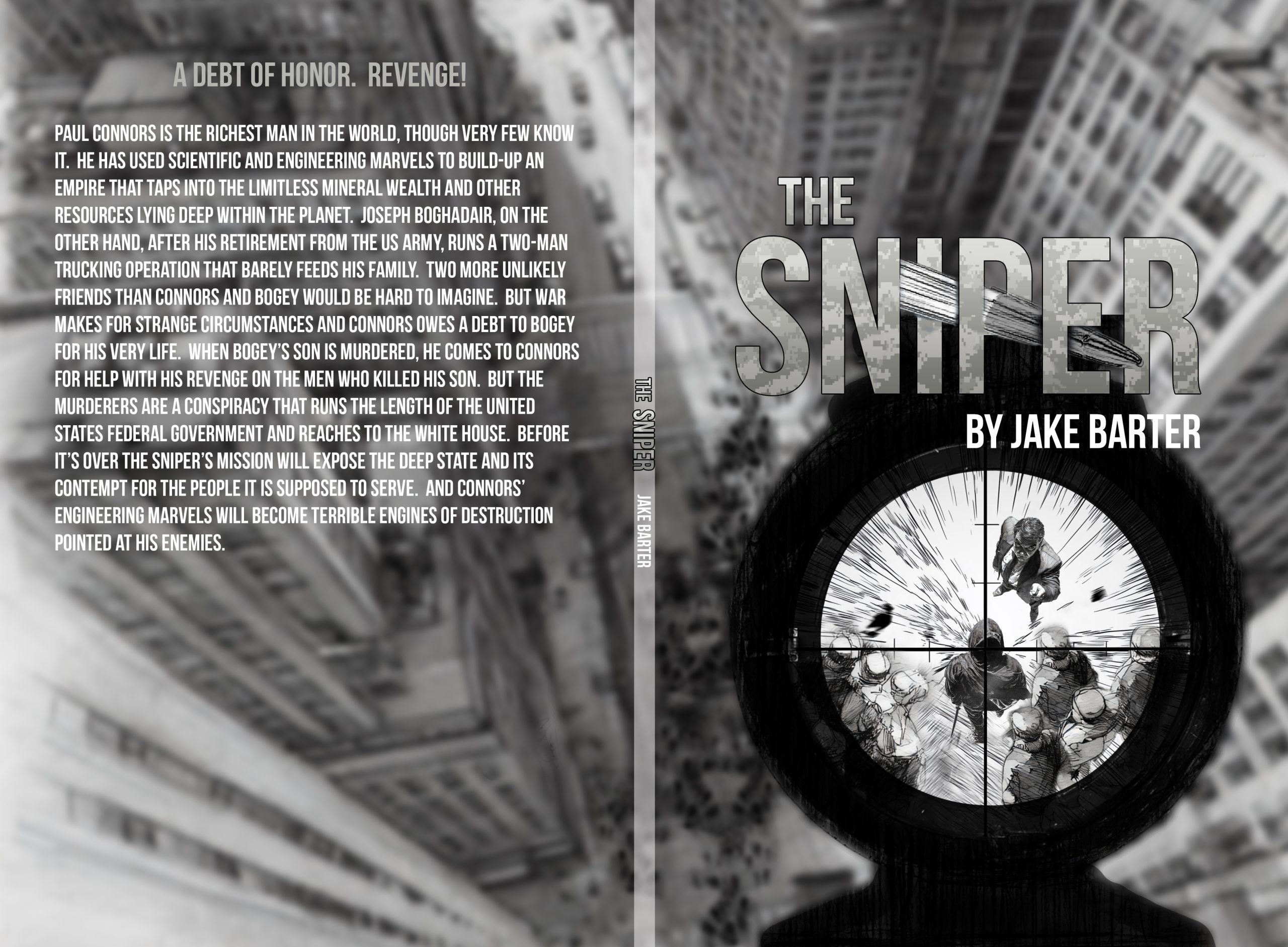
If a brutally long and tedious day starts and ends with good news, does that make it a good day? I would have to say yes. This morning started with the book cover for “The Sniper” arriving. And after returning from a long, grueling day trapped in the bowels of a drab New England city, bored almost to desperation, I finally have a deadline for the launch of my book. It will be out sometime between the middle and end of January. Now granted, that can be as much as two months from now but just putting a stake in the ground is what I need to coordinate the whole crazy flying circus of an effort. Covers and EPUB files and pdfs and key words and discount deals and reviews and project pages and pseudonyms and email lists and Amazon ads and heaven knows what else. Yes, a day that starts and ends well is a good day.
I was pleasantly surprised at just how accurately the cover art portrayed the scenario and the mood of the story. And the quality of the drawing exceeded my expectations completely. I’m extremely glad I went in the direction I did instead of a more generic cover. If for no one else than for myself. It makes the book real.


Now I have to confess that I have no idea whether what I’m trying to do makes any sense. Can a book from an unknown author with an extremely niche audience break out and find a generously sized audience? My rational engineering side says the odds against it are long. I’ll say one in a thousand.
But at the same time, a part of me is anxious to take the plunge. And that is exactly what I’m doing. It’s a roulette wheel spin with a big pot of my money plunked down on double zero. What could be more fun than that? Well, I guess winning would be more fun. But that’s well beyond my power to ensure. I’ll have to let fate have her say.
I guess now I know how every author since Homer has felt when his creation is about to be unveiled. And I’ll say it’s a good feeling. As Kipling said:
“When ’Omer smote ’is bloomin’ lyre,
He’d ’eard men sing by land an’ sea;
An’ what he thought ’e might require,
’E went an’ took — the same as me!”
Every teller of tales is part of the long tradition. You make up something in your head and you want to see if the audience resonates to the same vibration you felt. But the worst fate would not be if a lot of people didn’t like it. The worst is if no one ever hears it.
Achilles in the Iliad wanted to die for glory, for immortal fame. Well, I’d prefer to live but I’d forego any profit if I could guarantee that a million people read my story. That would be a form of immortality. Well, spin the wheel.

Thanksgiving 2025

Tomorrow is Camera Girl’s D-Day.  The family comes over for a twenty-six-pound turkey and all the trimmings.  I counted up the individual food courses and it came close to thirty.  So, this is ridiculous and I asked her if she wants to start cutting back on all this preparation or get the daughters to help and she shook off the suggestion as heresy.  Apparently, she lives for this.  And I’m glad.  I think we all would miss something if she didn’t put this particular menu together in the traditional way that everyone in the family now looks at as the only way to have dinner on Thanksgiving.  The grandkids have never known a different menu at Thanksgiving and that’s going back over twenty years for some of them.  All in all, that’s an amazing track record.

Of course, one day things will change.  One day the grandkids will start families of their own.  And they won’t be able to come to our house every year.  Or maybe we’ll just get too old to run Thanksgiving.  But for now, we live in that golden era where all the grandkids think this regime is eternal.  And I’ll let that be the party line.

Tomorrow we’ll gather for the feast and sit down at 2pm.  I’ll have the honor (!?!) of carving the turkey and sitting at the head of the table as pater familias but all the power is vested in Camera Girl as boss of the kitchen.  She will be scurrying around making sure that the various dishes are available to people at all sections of the table (or tables, the crowd spills over onto a couple of smaller tables added onto the main table) and truth be told I don’t think she even eats a mouthful of food for the first forty minutes of the campaign.  But once the table is completely stocked and everyone has filled their plates for the first time she will settle into her seat and stay there until dessert is needed.  And this will be an assortment of home-made pies and other desserts.  The only thing I always insist on is the availability of several gallons of good quality vanilla ice cream.  Inevitably there will be several other flavors represented; chocolate chip, strawberry, even heretical flavors like cookies and cream.  But for me the gold standard is vanilla.  It is a pure element, possibly the quintessence of the Thanksgiving dessert.  And my grandchildren agree with me vehemently.  There was an open revolt one year when vanilla ice cream wasn’t clearly visible on the dessert table.  I joined in their cries of protest and Camera Girl was forced to head into the basement to the back of the freezer where the vanilla was hiding.  Since then, there’s been no more nonsense about it.

And after we’ve stuffed ourselves with turkey and fixings and dessert, the grandsons and I will head into the living room to watch our holiday movies.  Typically, we’ll bust out the Laurel and Hardy version of “March of the Wooden Soldiers.”  Afterwards I’ll try to put on one of the versions of “A Christmas Carol.”  I think they feel that the Alistair Sim version is definitive.  But we’ll see.

So, the site may be kind of quiet tomorrow but it’s for a good cause.  Happy Thanksgiving to all you folks out there.  Enjoy the day.

The Crisis of Modernity

If you’ve been around for seventy years or so you know that the way we live in these United States has been in constant flux for almost your whole life.  But if you think about it didn’t start there.  In fact, when was the last time that life was wholly stable in form and detail?  Well in some backwater areas of the world it’s probably much as it ever was.  But for Europeans you might have to go all the way back to the mid-1200s.  Back before the age of sea exploration.  So, feudalism basically.

And what was going on back then?  I guess most of our ancestors were serfs living and working on the lands controlled by the aristocracy.  So, was that better or worse than today?  Well, I guess modernity has a bunch of advantages over the 1200s.  Today you mostly get to keep your teeth into at least your middle age.  And you actually get to live probably into your seventies.  And your children mostly won’t die at birth.  And you aren’t illiterate and you can call Pizza Hut on your cell phone and have dinner delivered (assuming you have a job, which isn’t that sure anymore).

But I think the question can still be asked, “Are we living in a better world than pre-renaissance Europe?”  If I were to give an opinion, I’d say yes.  But not because of the material progress that we have to show.  But because I think there is the chance that we might be closer to some kind of breakthrough.

And what I mean by a breakthrough is an analysis about what represents human happiness and how to maximize it.  “Okay,” you’ll say, “but what do you mean by human happiness?”  And that is a fair question.  Because human happiness is hard to define.  I don’t mean that we figure out a way to have the larges tnumber of people hooked up to a dilute fentanyl drip all the time.  What I mean is we should figure out what human beings are meant to be doing with their lives.

If I were to guess I’d say the optimal human activity is learning how to interact with other humans in such a way that everyone feels like their getting something out of the deal.  So, let’s say you’re a pretty good carpenter.  Okay maybe life would be optimal if you could get paid a decent wage to make chairs or tables or porch decks.  And maybe someone else would want to be a Walmart shelf stocker.  Sure, he’s not as bright as the carpenter, but he’s hard-working and cooperative and he’s not really interested in owning all the latest “stuff.”  So, the idea is that somehow all this “AI stuff” really does pan out and we figure a way to systematize the whole human race so that we can keep this whole multi-billion human juggling act in the air without needing a war or a revolution or a great depression.  Now that might be something to brag about.

Of course, this is all a pipe dream but if you think about it, that’s what all of the geniuses have been talking about for the last couple of hundred years.  That’s the French Revolution and the Russian Revolution and Mamdani and all the rest of the people who get all stirred up.  Now, we all know that socialism doesn’t work.  But maybe that’s because it’s run by socialists.  What if HAL9000 ran it?

Okay, never mind.  We know how that ends, “I’m sorry Dave, I can’t let you back in the door.  Have a nice day!”

The Middle Way

Lately my days have been filled with frustrating road blocks.  Things that should resolve themselves easily instead get bogged down in endless complication and delay.  Because of this I’ve been pretty stressed out.  So today while I was contemplating this it occurred to me that I shouldn’t allow days at a time to go by without any fun.  So, I’ve decided to try and add at least one fun thing into each of my days.

Sounds easy.  But what it means is that I have to first free my mind from the annoying things I’m trying to overcome and instead think up some small diversion that I can do in a short amount of time.  For instance, today I dragged out my camera, the Minolta 200mm f/4 macro lens and a bellows mount and started taking some macro shots of a dead preying mantis that I’ve had sitting on a house plant for a few months.

Now was this a terribly valuable use of my time?  No, not at all.  But it was fun and it got me thinking about what kind of a macro rig I’d like to set up.  The bellows device I was using had a bunch of problems associated with it.  It didn’t attach to my tripod very well and it was not rigid enough to avoid a lot of vibration.  But working around these issues was stimulating and fun.  And it made me think about something other than my problems.  It was a distraction and it lightened my mood brilliantly.

So, for the foreseeable future (meaning, until I get past my problems), I will be trying to add something fun to my days in order to stave off depression.  But in general, maybe I’ve hit on something worth pursuing.  I’ve never been someone who lived a balanced life.  My instincts have always been a sort of all or nothing strategy to most things in life.  Probably this was a matter of necessity caused by an almost pathological laziness that left me always forced into an eleventh hour, hail Mary effort to stave off disaster.

So maybe late in life I’ve discovered a miraculous unheard-of strategy; balance.

Tomorrow is a big family party.  But I think I’ll get up early and try to set up a focus bracket with the 90mm macro lens and some interesting macro subject.  I think I saw a dead spider down in the exercise area.  I think he might make an interesting target.  If not, I’ll find some still life thing; a feather or a coin or something.  And I’ll have some fun.

And that will leave Sunday to do some work.  I need to figure a few things out that have been stalled for a couple of weeks.  And then Monday and Tuesday are unavoidable hell.  I thought Tuesday would actually turn into a horrifying fiasco but blind luck stepped in and turned a horrifying nightmare into a merely tedious exercise in futility.  But just two days later and it will be Thanksgiving and that should be a wonderful way to recover.

Balance.  What did Siddhartha preach?  The Middle Way?

Plato Was a Dope

The original utopia was Plato’s Republic.  And in that hypothesized city-state one of the most important precepts for producing good citizens was proper education.  Now, if you’ve ever read “The Republic” you know it’s literally gibberish.  Plato proceeds from unsubstantiated statements to illogical conclusions throughout the argument he uses to design his state but one thing I think he was right about is the necessity for highly superior education.  So, my republics will incorporate the most scientific and practical methods for educating and testing the young in order to maximize their future value as workers and citizens and to provide a worldview that would allow them to harmonize with their fellow citizens.

Now, since I am not an educator or a psychologist, I have no fixed ideas about methodology or even the content of this educational regimen.  I will hazard a guess that mathematics should still have a very important place in these schools.  I think thousands of years of western educational practices has proven the link between mathematical learning and general mental fitness.  But beyond that I’ll say that identifying the curricula for the various levels and types of schooling is something that will be of the highest importance for these communities.  And by no means do I intend for schooling to be strictly academic.  Specific vocational training is something I see as extremely valuable for individuals of all types.  Even a particle physicist or a concert pianist could benefit from knowing how to solder a component onto his computer motherboard or snake a bathtub drain.  But all of this is tangential to the main reasons why education will be critical to making these communities successful.

The schools will identify the academic capabilities of the children and combining this with their interests the correct academic and vocational curricula will be provided as choices.  This should maximize the probability for a successful citizen.  But the schools will also educate children with the ethos and expectations that the community is based on.  In this way the young will align themselves with the goals that are expected from them as members in the association.  In this way, the likelihood that these later generations will fit in with the community is maximized.

As with every other aspect of the community, feedback from the testing will inform the goals and needs of the community.  For instance, suppose the community is lacking in machinists.  So, the forecasting will be used to increase the monetary incentives for machinists.  And so forth for whatever other imbalances occur.

And education can also apply to other aspects of life.  For instance, men and women need to find mates in order to produce the next generation.  Education can include counseling on adapting to married life and even providing a dating service to locate compatible mates.

Now, Plato had his citizens indoctrinated with myths that justified their strange lifestyle.  For instance, he did not want the nuclear family to interfere with the loyalties of his citizens and so the children were raised together as a pack.  And he had stories that supposedly reinforced this lifestyle.  I wouldn’t expect these optimized communities of mine to attempt to destroy families.  On the contrary, I would expect them to do everything possible to prove that their lifestyle and community provide the best human environment possible.

I wonder what aspect of my optimal communities I’ll talk about next?  Well, maybe that’s enough for a while.  I better post on something else tomorrow.

Utopia and Nukes

Okay, I said I’d get down to details in setting up “photopia.”  Well, where do we start?  The first question is how do you start such a thing from where we are now?  In the past the founder would be a prophet.  Moses, Jesus, Mohammad, Joseph Smith, L Ron Hubbard (!).  For my founding I’ll settle for a trillionaire with virtually unlimited resources of artificial intelligence.  Then he’ll have to be a humanitarian, a philanthropist, a lover of mankind.  Because he’s going to have to take the long view.  He’ll know that to save mankind he’ll have to start by rejecting a good chunk of humanity at the start.  Because as humanity currently exists, there is a definite percentage of the population that can’t be included in an optimized human environment.  There is a twenty percent group that is hopeless.  Some of them are uncontrollably violent.  Some are completely unwilling to do work.  Some are anti-social to the extent that they habitually commit various types of crime.  It goes without saying utopia has no place for such individuals.

The system that our founder builds must begin by trying to select a core of people that are unmistakenly outside of this 20%.  The only way that the system can be founded is to start with the best starting material.  So extremely careful biographical research into the initial candidates will have to be performed to rule out any unacceptable or even sub-optimal individuals.  Ideally, married couples and even families of the highest quality should be incorporated in the starting material.  This will build additional stability in the structure.

But one thing that will be true is that even within this foundation of selected individuals there will need to be a continuous weeding out mechanism for people who fail or for the offspring who will be identified as failures.  And if offspring are rejected, often the parents and siblings will find it impossible to stay inside the group.  And not because this community is a hermetically sealed bubble.  Everyone inside will be in contact with the outside world continuously.  But if children of group members become dangerous, they must be kept outside of the community and that is hard to enforce unless the rest of the family is ejected.  So, it becomes apparent that policing the group for anti-social activity will become one of the most important activities of the administrators.

And as I mentioned in the earlier installment of this essay, those who are ejected are given the equity that they’ve earned in the community when the leave so that they can find their own place in the world.  So, what exactly are the rules of this club?  Well, the founder gets to decide those.  If he’s wise, these rules are ones that will tend to increase stability, prosperity and social cohesion.  What exactly these rules are may be dependent on the values and personal traits of this “prophet.”  And ideally, there could be a number of different foundations to allow for the different but equally valid personality types that exist in our species.  And maybe some of these will be failures and some will thrive.  But over the course of time by trial and error a calculus for creating human communities could be derived.

Now, what happens to those who can’t be included.  Well, nothing.  They’ll be on their own.  This assumes that the larger human community still exists outside of these enclaves and that it has to deal with the full spectrum of human types.  And that is why prisons and welfare exist.  And that brings up another point.  How would these societies be viewed by the outside world.  My guess will be; poorly.  I believe many nations would try to destroy them or at least force them to accept members that they would reject.  And for that reason, the location of these societies may be one of the most important questions that the administrators will have to decide.  Of course, trillionaires can do wonders with the right amount of bribery.  But let’s just say that a nuclear weapons program may be a necessity for this utopia of mine.

When I write the next installment (and I may have to think about it for a while) I think I’ll talk about education.