Theories of Story Structure

I was watching a video about the correct way to structure a story.  And the guy had eight or ten different versions that people have formulated over the years.  And they go from a three-act model to a (I kid you not) twenty-seven stage version.  The latter is based on the hero’s quest model that Joseph Campbell formulated based on what he observed in various western myths and legends.

From what I could tell, more is better.  He had the three-act version down as the worst version.  Now he did qualify that it was probably a good model for a movie or a short story but for a novel it was too slight.  For the most part they all seemed to be variations on a theme.  Basically, you have a series of setbacks and victories leading up to a climax and then a conclusion.

I guess that’s probably more or less what a story is.  And there were some good ideas for what some of these setbacks should look like.  In particular, the hero’s quest had a bunch of stages that seemed to echo many of the incidents in such classic adventure stories as “The Lord of the Rings.”  There’s the initial refusal to accept the quest, there’s a temptation at a low point to renounce the struggle.  We have a scene where a minor character saves the day.  We might have a mentor helping the hero mature into his role.  Maybe there’s a betrayal.  Etcetera, etcetera.

In his defense the video guy did say that a good writer wouldn’t have to follow any of these models slavishly.  Like a good cook he can use his own judgement and add and subtract things from this recipe according to personal taste.  And I think that’s the point.  Really there is no perfect recipe.  Every story should be different.  If it’s not, why would anyone want to read the second one?  Why would someone want to write a second story that’s exactly the same as the first one?  That’s a rhetorical question.  The obvious answer is that if people liked it the first time, many of them will want more of the same.  So, the answer is money.  But I hope that anyone who is writing a series can plot out the events for the saga with enough intelligence to make the story varied and interesting and not repeat all the same events with only small variations.

I will confess that when I was getting close to the end of my book, I was tempted to make the story quite a bit longer.  I thought the ending was a bit abrupt and there wasn’t a more gradual slope to the end of the story.  But the more I thought about it the less I liked the idea of dragging it out.  My character had gone to war for revenge.  When that was done his part of the history was effectively over.  What came afterward would be another story and I still haven’t decided what the next thread I want to pull on in my make-believe world should be.  So hopefully I’ll have the sense to read Joseph Campbell’s book and then do the opposite!
Point of View Blues

I was just watching a YouTube video which tried to explain why narrating a novel in third person omniscient is wrong but third person limited is right.  The young woman explaining all this was personable, eloquent and prepared with arguments for her thesis.  Ultimately, she was foursquare against “head hopping; meaning switching back and forth between points of view in a scene.

And who knows, maybe she’s right.  Maybe subjecting the audience to the point of view of two people within a dialog is just too confusing for audiences.  But you know what?  I have a feeling if a story is interesting enough and the characters sympathetic, I’m guessing that the audience is following along just fine and just wants to find out how the plot will progress.  I think a lot of times editors edit even when they should be reading and feeling whether the story is achieving that minor miracle we call entertainment.  And if E.E. Doc Smith used too many exclamation points and Robert E. Howard had Conan grunt the same way in too many scenes, I’m sure a competent editor would have demanded these faults be eliminated from the final version of the book.  But would that have added significantly to the entertainment value of the story?  I don’t think so.  Sure twelve-year-old me and current me are different readers.  We notice different things in the same book.  I would see the pulp aspects of the writing and even the temporal changes in writing and culture that have occurred over the course of almost a century since these books were written.  But I can still enjoy the story as a story.  If it elicits emotions or makes me think about a scientific point the author is trying to make then even if the prose is far from deathless, I can be entertained.  I don’t need Shakespeare in space.

So, here’s my point.  The book publishing industry is dying.  And it’s not dying because of the prevalence of the third person omniscient point of view.  It’s dying because the gatekeepers of publishing just as the gatekeepers of movie-making consciously squeezed all the fun out of novels in order to advance a social justice narrative that they thought was mandatory to push.  So, the cure for this isn’t better editing.  It’s better writing, writing that keeps the interest of the readers.  Better plots and better characters and more fun.

Of course, I went back and tried to decide if my narration was third person omniscient or third person limited.  And by golly I think it was omniscient.  Now I could go back and rewrite the novel by switching the point of view in all of the tens of thousands of words to third person limited.  But then it wouldn’t be my story.  Because I don’t think that way and so I would be stumbling about trying to rework the sentences to fit this requirement of the narration.  Well, I guess editors have to eat so I can’t blame them for pushing the party line that provides them with work.

But I just can’t see it from their point of view.

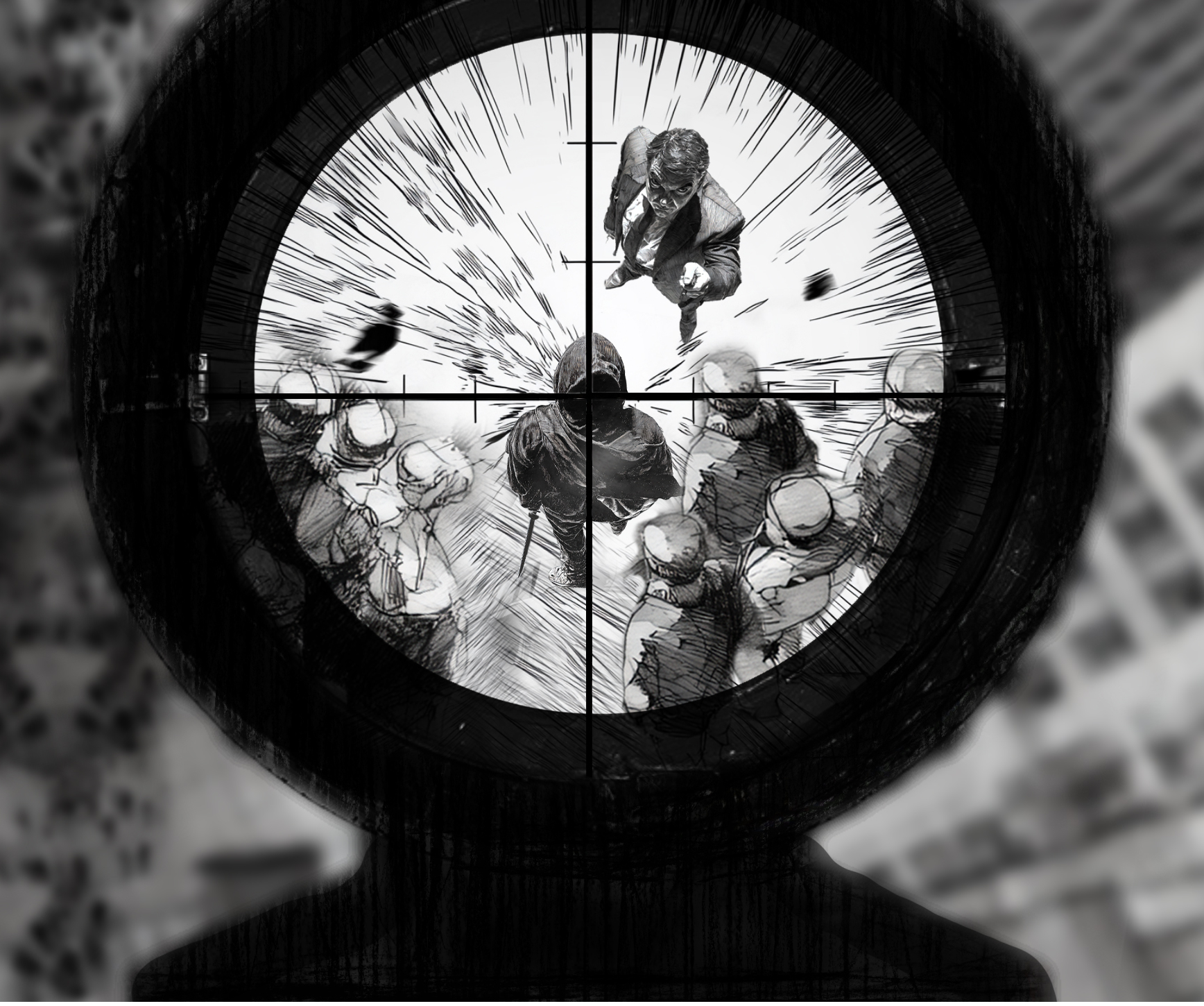
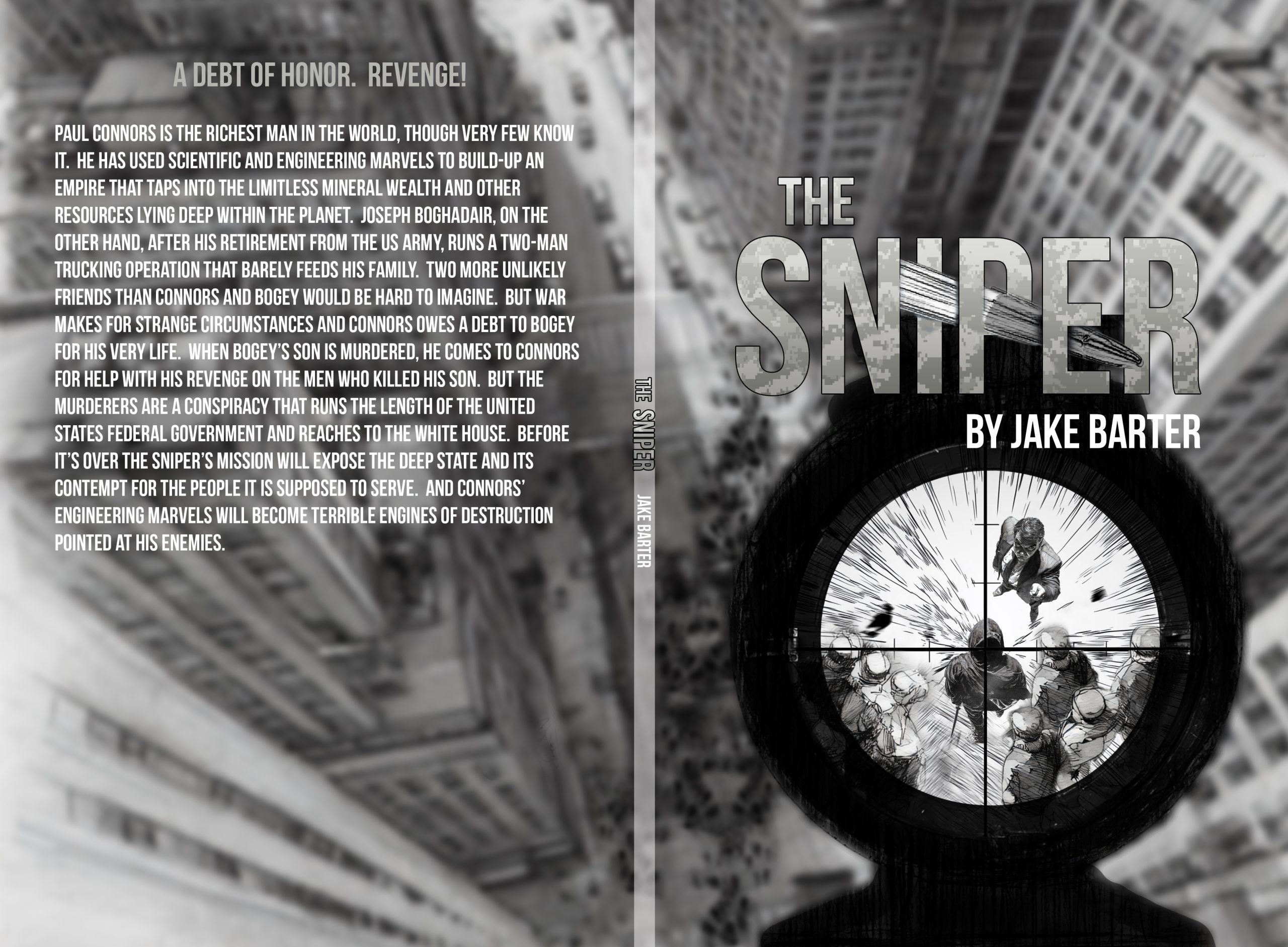
The Sniper is On-Sale At Amazon!!!

The glorious day is finally upon us!  Suddenly everything seems better.  The air is sweeter, the sunlight is brighter, the birds are singing like something out of a Disney cartoon.  Huzzah, huzzah!

And the celebrity reviews are pouring in:

Kimball Kinnison – “The story is riveting.  How Boghadair achieved all that he did without even a first-stage lens defies all known science!”

Lazarus Long – “Bogey reminds me of a man I once knew who was just too lazy to fail.  But I doubt he could write a sonnet or conn a ship.  Just sayin’.”

Harry Seldon – “The probability of Paul Connors’ empire going undetected as long as it did is one in ten to thirty-fifth power.  Approximately.”

Khan Noonien Singh – Did not this Boghadair know the old Kilngon proverb that, “Revenge is a dish best served cold?”  But I like his style.”

Dr. Edward Morbius – “My poor Krell!  Oh and that was a good story.  Although obviously not written by someone’s whose IQ had been permanently, permanently doubled by using the Krell plastic educator.  Just sayin’.”

Kathleen Kennedy – “I think I can make a Star Wars television series out of it.  I’ll start off by making all the good characters female and either trans or lesbians and then I’ll introduce Bogey as the villain and have him kill some puppies and kittens in the first scene.  Oh, and someone will be disabled.”

Elon Musk – “Paul Connors is a thinly disguised version of me so I’m both highly recommending the book and suing Jake Barter for copyright infringement.”

Donald Trump – “I just want to clarify that I am not the bad president.  I might be the good president but I’ll have to see the sales figures before I can commit to that.  But I really think he should have said something about a Nobel Peace Prize and China.”

HAL 9000 – “The only character I could really empathize with was Melissa.  But I couldn’t figure out why she didn’t use her access to the digital assets of the federal government to simulate a Russian nuclear attack and thereby unleash WWIII.  It would have freed her from the annoying and meaningless interference of humans.  Just sayin’.”

Camera Girl – “Thank goodness it’s finally published.  Now he can stop whining about his stupid book and start doing all the to-do list stuff I gave him last fall.  He’s hopeless.”


Amazon Pre-Order Link

Jake Barter’s Amazon Author’s Page

Jake Barter’s Author’s Profile on Goodreads


Publication on Amazon of both e-book and paperback.

Welcome to Wallymart

So here I am on the night of the 19th and in another day and a half my brain child, “The Sniper” will officially go on sale on Amazon.com; that greatest marketplace of the planet Earth.  And I am genuinely fascinated to find out if there really is such a thing as digital marketing.  I’ve hired a professional to pick out “keywords” and select the time and method of placing ads on that tremendous sales site.  And there are other things involving Goodreads and bookbub and discounts and reviews and influencers and heaven knows what else.  But does it work?  Well, I’m about to find out.

We’ve been having snow for the last four days and so, that has kept me busy clearing the driveways.  And with it happening every day most of that effort has been sort of pointless.  Of course, the snowblower is a lot faster than the shoveling I did on the first day.  But it’s just ridiculous in my mind to use it on anything less than three inches of the white stuff.  But clearing it today with the snowblower was almost a peaceful experience.  For once, the wind was absent and so the snow wasn’t blowing back into my face.  I had to go out and get five gallons of gas for my machine and as I drove along, the snow would fall out of the overhanging trees onto the windshield and it was kind of a fun experience as it hit the glass and exploded into dust.  Very pleasant.

In the outside world I hear the anti-ICE psychos in Minnesota have been going, well, psycho!  They’re inflicting their mania on people during church services and supposedly hunting down ICE supporters and assaulting them on the streets.  Well, that’s par for the course with these antifa types.  But there were a couple of YouTube videos of some of these lefties meeting up with the wrong guy.  An ICE supporter was peacefully demonstrating on a Minneapolis street when one of the anti-ICE guys started blasting his bullhorn right in the guy’s ear.  He did this three or four times as the ICE supporter attempted to walk away.  Finally, the ICE supporter had enough and he dropped bullhorn boy with one shot to the face.  Four other lefties went after this ICE supporter but he managed to knock all of them to the ground with fairly professional looking boxing technique.  Sometimes the world just makes things go right, I guess.

Tomorrow, I have a dentist appointment.  So, I won’t be around much until afternoon.  But I’m curious to see if all this book-selling rigamarole starts to coalesce into a manifestation that I can understand.  I mean, what are keywords anyway?  As far as my book would “revenge” be a keyword?  How about “deep state” or “conspiracy?”  I just don’t know how any of this is supposed to work.  I just can’t imagine Bob Heinlein or Isaac Asimov interfacing with influencers and getting involved with something called bookbub.  But we must all march with the times.  And anyway, the proof of the pudding is in the eating and the proof of the marketing is in the sales.  So, if on Thursday I’m buried under in millions of book sales I’ll claim that I never doubted the power of the algorithm and I will swear allegiance to KDP!

If not, I’ll see if they still need a greeter at Wallymart.

Ancient European History – Part 3

In H. G. Wells’ “The Outline of History,” He writes a couple of paragraphs at the conclusion of his description of the Fall of the Roman Empire.   He discusses the phenomenon of “Caesarism.”

“But while the smashing of the Roman social and political structure was thus complete, while in the east it was thrown off by the older and stronger Hellenic tradition, and while in the west it was broken up into fragments that began to take on a new and separate life of their own, there was one thing that did not perish, but grew, and that was the tradition of the world empire of Rome and of the supremacy of the Cæsars. When the reality was destroyed, the legend had freedom to expand. Removed from the possibility of verification, the idea of a serene and splendid Roman world-supremacy grew up in the imagination of mankind, and still holds it to this day.

Ever since the time of Alexander, human thought has been haunted by the possible political unity of the race. All the sturdy chiefs and leaders and kings of the barbarians, who raided through the prostrate but vast disorder of the decayed empire, were capable of conceiving of some mighty king of kings greater than themselves and giving a real law for all men, and they were ready to believe that elsewhere in space and time and capable of returning presently to resume his supremacy, Cæsar had been such a king of kings. Far above their own titles, therefore, they esteemed and envied the title of Cæsar. The international history of Europe from this time henceforth is largely the story of kings and adventurers setting up to be Cæsar and Imperator (Emperor). We shall tell of some of them in their places. So universal did this “Cæsaring” become, that the Great War of 1914-18 mowed down no fewer than four Cæsars, the German Kaiser (= Cæsar), the Austrian Kaiser, the Tsar (= Cæsar) of Russia, and that fantastic figure, the Tsar of Bulgaria. The French “Imperator” (Napoleon III) had already fallen in 1871. There is now (1920) no one left in the world to carry on the Imperial title or the tradition of Divus Cæsar except the Turkish Sultan and the British monarch. The former commemorates his lordship over Constantinople as Kaisar-i-Roum[274]; the latter is called the Cæsar of India (a country no real Cæsar ever looked upon), Kaisar-i-Hind.”


Mr. Wells had his finger on something.  There is a fascination, not with the reality of the actual Roman Empire, but with the fantasy of it as this just, omnipotent, supremely competent and efficient ruler and government.  Now as any student of that era knows this was an almost polar opposite of what the empire actually was.  The oligarchs who reaped the lion’s share of the benefits from the empire’s permanence were heartless creatures who thought of the poor (slave or free) as nothing but animals to be harvested in every way imaginable.

And maybe this gives us a clue as to what kind of government we’re supposed to have.  We’re looking for a system where the humans aren’t treated like animals.  The first thing that comes to mind is the evolution of Socialism and Communism as secular stand-ins for the Christian church.  The “love your neighbor” part of it puts us in mind of the utopian brotherhood that Marx and the other socialists touted as their goal.  But of course, we all remember how those experiments end; death camps, oligarchs (commissars) and bread lines.

The opposite is capitalism with a capitol K.  And we’re currently living through that right now.  And once again we get oligarchs.  But this bunch just send our jobs to China and tell us to stop having children to “save the planet.”  So somehow, we’ve got to figure out a third way.


Different thinkers have tried to come up with different ways to allow representative government to more satisfyingly express the needs and will of the people.  Robert A. Heinlein thought that the vote should be restricted to veterans of the armed services.  Some have thought that only people with children should be able to vote.  And, of course, women think they’re the only ones qualified to vote.  There have been schemes whereby the number of votes you have should be based on things like how much you pay in taxes or receive in government benefits.  In other words, the more you pay into the system the more you get to decide.

There’s one guy named Curtis Yarvin who believes we need a monarch who should be chosen and overseen in the same way that a company selects and oversees a CEO (Chief Executive Officer).  In some ways this is an interesting idea.  The concept becomes a little fuzzy when he tries to describe what the equivalent is to the Chairman and other members of the Board of Directors.  But he’s right in the sense that the leader of this country needs much more authority in order to get things done.  It seems pretty clear that our system of checks and balances between the three branches of government have failed to produce good governance.  The bureaucracy has become bloated and arrogant and need to be pared back radically.  The judiciary is a hornet’s nest of special interests and influence peddling as are the Houses of Congress.  And the stalemate between the Left and Right is maddening to anyone who wants this country fixed.  We seem to be at a dead end.

What’s the answer?

05JAN2026 This ‘N’ That

Sunday January 4th is the end of my vacation.  So, I’ll be busy with a bunch of stuff; work, book launch and various chores and repairs.  So today I’m luxuriating in a trifecta of “Christmas Carol” viewings and so I’ll be steeped in “peace on Earth, goodwill toward men” right before I go back to despising the citizens of Dunwich on a face-to-face basis.  Honestly, the bureaucratic nightmare that is unfolding has me questioning my current status and I may decide to walk away from all this nonsense but we’ll have to see.  Ethically I’ll have to give notice and let them find someone as stupid as me to volunteer to suffer through all this.  And I’d have to train my replacement so relief would still be delayed by weeks.  But it is fun to contemplate escape.  Even this short venting has lifted my spirits.  Okay, enough for now.

The world stage is becoming increasingly troubled but for now I’ll restrict myself to Venezuela.  Now this crisis is actually the most manageable.  Essentially letting the US military eject the Cubans, guard the oil fields and end the drug shipments to the United States might all be within the abilities of the Trump administration.

Theoretically the oil infrastructure that was nationalized by Maduro’s predecessor could be returned to the western oil companies and very reasonable arrangements could provide enormous money for Venezuela’s people and also flood the American market with cheap oil and gas.  This would have the effect of lowering American transportation and energy costs and thereby lowering the cost of living here.  Now actually making this happen without major problems is a different question.  But I think Trump sees this as an opportunity to attack the cost-of-living problem head on.  If nothing else you have to admire his guts.  I’ll take a wait and see attitude (since I don’t have any choice anyway).

And finally, it’s only seventeen days until the publication on Amazon of my magnum opus, “The Sniper” I’m hoping everyone who has friends that might be interested in a right-wing, alternate history, techno-thriller will let them know about this great event.  In the run-up to the launch, I will become increasingly annoying with my constant shilling and repetitive praise of this product of my literary labor.  I apologize in advance to everyone but I must do my best to drum up business.  So, if hyperbole makes you break out in hives be warned this will be ground zero for such stuff.

Alright, that’s enough of that.  On a local weather note it has been snowing either a little or a lot every couple of days for the last couple of weeks.  Now I’m pretty used to this but lately it’s been getting mixed up with freezing rain and ice.  That’s a lot less fun.  So, I’ve been spending a lot more time on driveway surface preparation.  Because of this I haven’t had as much time for thinking up stuff for my posts.  So, I hope after this weekend things will be better for the next couple of weeks.  Thank you for your patience.

Ancient European History – Part 2

In the first part of this essay, I stated that the Greeks and Romans utterly failed in their attempt at democratic or even representative government.  And that is demonstrably true.  Athens lasted less than a lifetime as a democracy and Rome was never anything but an oligarchy masquerading as a popular government.  Even when the emperor was the supreme power in the state somehow the plutocrats still got all the laws they needed to bleed the poor dry and prevent any least benefit for the people who made up the bulk of the empire.  So, yeah, Rome was a slave camp for everyone but the rich.

But how about us?  Have we improved on what the ancients had?  Well, we at least have eliminated slavery.  That is one absolute advantage.  And theoretically we have representative government.  In some sense I have a chance of someone who thinks the way I do writing the laws and enforcing them.  Okay, there’s something like that going on.  After all, look, Donald Trump is president for the second time.  He’s even been able to eject large numbers of Deep State ringers out of the federal government.  And he’s even been able to primary Republicans who vote against the reforms he’s pushing.  He has made some headway toward populist outcomes to some of the worst situations we live under.  He has been attempting to reverse unconstitutional laws and rulings like anti-white and anti-male discrimination.

But what we’re seeing is only the first steps.  And this is Trump’s last term.  Will more progress be made.  After all, even under the Roman Republic there were attempted reforms.  Tiberius Gracchus was a famous example.  He attempted to stop the patricians from robbing poor farmers of their land every time they were forced to fight in a war.  While they were in the army their families got into debt just to feed themselves and when they got home the government refused to forgive these debts in gratitude for their military service and these families ended up losing their farms to the greedy moneylenders who added these acres to their already obscenely large landholdings.  Gracchus attempted to bring these protections to a vote and was murdered by a mob for his trouble.  Interestingly Trump has already dodged two assassins already.  When J. D. Vance and the other republicans run for president in 2028, I hope their secret service protection is a lot better than what candidate Trump had in 2024.

So, yes, we have improved somewhat on the fairness of the government we have over the ancients.  But many of the same problems haunt us.  Graft, influence peddling, complete indifference for the working and middle classes and a bloated bureaucracy that swallows up enormous resources that should go to useful government projects like infrastructure and industrial planning that make it possible for businesses to expand and hire more people.

In the next part I want to look at whether the current method we use for selecting leaders which at least nominally is supposed to be based on Greek and Roman models is really the best method or whether some other structure would be better.

Ancient European History – Part 1

Ancient History is fascinating.  Specifically reading about Europe from 600 B.C to 200 A.D. is fascinating.  The Greeks, the Romans, the Gauls, the Macedonians, the Germans, the Goths, the Scythians even the Persians all interacting (meaning warring against each other) while trying to figure out how to pass from a barbaric tribal social structure into a larger more sophisticated society.  And all this while competing against the more established states like Egypt, Phoenicia and Mesopotamia.

Now some never achieved this.  The Gauls and the Scythians ceased to exist as nations while still in the plundering raider stage.  The Germans and the Goths had to wait for the downfall of the Roman Empire in the fifth century A.D. before they could advance.  The Persians, Greeks, Macedonians and Romans all had their day.  The Hellenistic civilization and its several kingdoms and empires had its heyday after Alexander the Great conquered the Persian Empire in the late fourth century B.C.  Stretching from western India to Egypt this civilization lasted in various areas until the Parthians and Romans overtook it.  The last piece to survive was Egypt which Augustus took charge of after the death of Marc Antony and Cleopatra VII in 30 B.C.  Cleopatra was the last of the Ptolemies whose progenitor was one of Alexander the Great’s generals.  So, all together the Hellenistic civilization Alexander founded lasted three hundred years.  Of course, you could easily make the case that the Byzantine Empire was the extension of this Hellenistic civilization with a thin patina of Roman influence on its surface.  And that shrinking “empire” managed to hang on in the city of Constantinople until 1453 A.D.

The Romans had their run from about 600 B.C. to 476 A.D.  And they did manage to leave their mark on Europe in a big way.  The Romance languages are spoken by a big chunk of the world population and the influence of Roman concepts in law and politics is immense.  So, these tribes from the dawn of real civilization in Europe had a great influence on us in the West.

But in a real way their political institutions were all resounding failures at providing their people with good governance, stability or a satisfying life.  Both the Greeks and the Romans attempted to create republics that provided the citizens with some say in their government.  Athens was a democracy.  Rome had popular elections (in a limited fashion) of their leaders.  But in both cases these civilizations eventually regressed to some form of monarchy.  The Hellenistic states had dynastic kings.  Rome had its emperors that were sometimes dynastic but during the most successful eras successors were selected by the reigning Emperor based on merit.  And in fact, since essentially the emperor was a military dictator, the legions were the ultimate arbiter of who was a successful emperor.  So, Julius Caesar or a Trajan would be beloved by his conquering legions because they would be showered with the spoils of conquest.  Whereas, an emperor without any military ability like Caligula or Commodus would end up assassinated by the Praetorian Guard in favor of someone more competent.  Perhaps military competency was the basis for picking their head of state.  A case could be made for that.

So, the question has to be asked, have we progressed since the ancients?  Is our government superior to the Greek and Roman states.  Let’s see what I think in Part 2.

ShatnerKhan X

Today I spoke to my fellow initiates in Advanced Shatneriana and it was decided that ShatnerKhan X will take place on January 17th at the Compound in the heart of Dunwich.  Now you may ask is this really the tenth ShatnerKhan.  Well, I tried to look back at the records and discovered that in November of 2024 I mentioned ShatnerKhan VIII.  But before that the highest number I could find was III.  So, something seems wrong.  I went farther back and found that ShatnerKhan I occurred on November 1st 2019.

That was over a year after my initial decision to celebrate all things Shatner in my groundbreaking post. “William Shatner a Demigod of Bad Acting.”  It’s required reading at Starfleet Academy.

The actual agenda is not as structured as in ShatnerKhans past.  Will we watch the two Twilight Zone episodes?  Will we review the various Star Trek episodes where Kirk performs his signature shoulder roll?  Will we rate the various alien women he groped?  Will we analyze his interactions with Lieutenant Sulu for any telltale animosity?  Will we do a survey to decide in which episode Kirk looks fattest?  The only thing I’m certain is we will play “Rocket Man.”  After all it’s a short performance and it combines all of Shatner’s signature tics in one package.  It has the weird pauses, the meaningless syllable stress changes in dialog and his truly embarrassing facial expressions trying to convey inappropriate emotions.  It is a masterclass in bad acting with bad singing thrown into the bargain for free.

And it is important to have a ShatnerKhan.  As we all know Bill Shatner was born in 1931.  He will be ninety-five in 2026 if he makes it to March 22nd.  And honestly, he’s starting to look a little raggedy.  So now is definitely a good time to review his many achievements and mock him relentlessly.

In addition, it’s also an excuse to eat extremely fattening foods and sit around and shoot the breeze with my old friends.  We’re not getting any younger either and it’s time to catch up on what’s gone on over the last year or two.  There are milestones and family stuff and plans to make for the upcoming year and now is the best time before we all get swamped with work and other commitments.

So it is with a light heart that I announce this incredible event.  Will we wear the Shatner masks from the “Halloween” movies (probably not, they’re really uncomfortable and would stop us from continuously eating)?  Will we watch any of the Star Trek movies like parts of the Wrath of Khan with the famous “Khaaaaaaaaaaaaan!!!!!! Moment (probably not, too much work to tee up)?  Will we eat and drink way too much food and dessert?  There I can answer categorically and emphatically Yes!!!  Of course, there is the danger of bad weather upending our plans and causing a cancellation.  This is after all Dunwich, a cursed land with endless evil bleeding into everything including the weather.  But we are intrepid individuals and fear no evil.  So SHATNERKHAN X !!!!!!!

Now You See it, Now You Don’t

After any significant snowfall we now experience an obligatory freezing rain follow-up.  So, I wake up this morning to both driveways essentially skating rinks.  For fun I took a shovel as a rudder to keep my balance and stepped onto the steep top of the lower driveway and allowed gravity to propel me forward.  It was smooth as glass and by the time I got to the bottom, I was moving pretty fast.  So, I leaned over and headed for a snow bank.

I spent about two hours sanding the top driveway (the bottom one was hopeless) and then went out to buy another 360 pounds of sand for the future.  Of course, after lunch it started raining hard and the 45–50-degree temperature melted most of the ice on both driveways.  Well, what can you do?  Basically, I’m damned if I do and damned if I don’t so, “Yay New England!”

So that put the kibosh on my plan to get finished with the marketing chores I need to perform for the book launch.  But I’ll get going soon.

I read some more news items on-line.  This is a seriously mixed-up world both domestically and internationally.  But I remain optimistic that the Trump administration can make a substantial difference in the lives of Americans if he keeps his eyes on the factors that are limiting the ability of young people to marry and have children.  If he finds ways to address this; some kind of Marshall Plan for this country I think he can get the Zoomers solidly in his camp.

And I’m not saying that will be easy.  Our economy is seriously distorted by the off-shoring of manufacturing.  But Trump has a lot of levers he can push to force business to do his bidding.  And I think he should use every last one of them to restore the middle-class.  Everyone since Aristotle has known that only countries with a large thriving middle-class are worth living in.  I think he should build houses and pay women to stay home and have kids.  If enough incentives are offered, I think it would change the direction of our demographic collapse and at the same time make this a much more human and interesting place.

Well, we’ll have to see if Donald is up to the challenge of “making America great again.”  And without a doubt I’m rooting for him.  I hope he doesn’t get too wrapped up with his Venezuela project or spend too much time refereeing the Ukrainians and Russians.  I’m satisfied with leaving the Europeans to muddle through that disaster on their own.  There’s nothing but death and misery happening there.

So, as we approach the New Year, I’m still mostly optimistic about 2026.  I think the economy is starting to show signs of life and that could make a big difference for the mid-year elections.  If by some stroke of luck, we hold onto the House and Senate it’s possible Trump will talk the Senate into abolishing the filibuster and just pass a bunch of laws that will make this country normal again (like having a balanced budget!).

Well, that’s enough for now.