Guest Contributor – Tregonsee – 10DEC2025 – Ray Bradbury


Bradbury is nearly sui generis amongst the 40’s/50’s/early 60’s SciFi Writers. His stuff often feels more like Lovecraft or Clark Aston Smith. My first “adult” scifi (not juvies like Tom Swift Jr. or young children scifi like Spaceship in the Apple Tree) were two of his collectionsThey were R is for Rocket and S is for Space that my 5th grade reading teacher found for me in the school library. I recently got a new audible version of his Martian Chronicles and although the technology doesn’t really make sense (maybe not even then) the stories themselves are beautiful and elegant in a fashion that the Asimov/Clark/Heinlein stories usually didn’t try for. Bradbury makes a lovely palette cleanser among other SciFi. Some moderns try at his style but honestly most of them are pale imitations like art students copying a Rembrandt or one of the pre Raphaelites.

The Sheldon Chronicles

Larry Sheldon (25,501 – 25,587 N.E.) – Founder of the science of psycho-cosmography, famously quoted as saying, “Look, we needed more space so we invented starships.  What’s the big deal?”  Creator of the Sheldon Plan whereby the new empire was replaced by the new, new empire and the outpost world Zero became the Bulwark for this new order.  He was a secretive and reclusive genius who suffered from acute fear of other people’s body odor.  Some historians now believe his existence may have been apocryphal.

(Encyclopedia Publicius Domainius, 1023 edition)

Here he stood in the center of the galaxy, the administrative capital of the new empire; Titantor!  A world that circled the central black hole of the Milky Way galaxy.  Only an incredibly powerful anti-gravity field prevented Titantor from being ripped to shreds and swallowed by the gravitational force of its evil black star.  A steady stream of planets and debris had to be fed into the anti-gravity generator to keep this horrific imbalance in existence.  But such was the power of this empire and its vanity that the whim of the emperor was enough to maintain this cosmic madness.

And here he stood Bob Goodfellow, a fresh graduate of the Arcturus Community College and Creamery here to put his knowledge of psycho-cosmography to good use assisting Larry Sheldon to save the new empire from the forces of entropy that threatened to tear it apart and bring on a trillion years of barbarism and low credit scores for everyone.  And he was nervous.  Meeting a genius like Larry Sheldon was intimidating.  He could feel sweat forming on his forehead.  He wiped it away with a handkerchief.  And suddenly there was Sheldon walking toward him smiling and looking him over nervously, “Bob, good to finally meet you.  Yeah, I’m not big on shaking hands or standing downwind of people.  So, let’s walk with the wind in our faces and you following me at about a six-foot distance.  Thanks!”

Within these strictures they covered the distance to the Titantor Senate building in about an hour and Goodfellow watched from the gallery as Dr Sheldon was cross-examined by the representatives of the Imperial Science Foundation.

The Pontifex Maximus grilled him, “Dr. Sheldon, you claim that using the energy output of fifty billion stars to turn the Smaller Magellanic Cloud into a jacuzzi for the emperor’s concubines will lead to the heat death of the galaxy.  Do you have any proof of this?”

Larry sat with his handkerchief clutched over his nose recoiling at the examiner’s overpowering cologne, “Well, the fact that the population of the empire has decreased from a million-billion-billion to seventy-eight would seem to be a relatively strong indicator, mathematically speaking.”  The Pontifex made a rude noise and scoffed, “What nonsense!  This mighty capitol; Titantor, on its own, is home to countless billions.  We see them all around us!”

Larry used his emergency inhaler and continued, “Yes, but they’re all robots.  In fact, it’s worse than the numbers indicate.  There are only thirteen women of childbearing age left and half of them are Vestal Virgins.  We’re going to have to really rethink a lot of priorities if this whole shebang is going to last past Wednesday.”

This sparked outrage and shouting among the senators.  The concomitant bad breath overwhelmed Larry and he swooned in the witness chair.       …     To be continued!!!!

A Great Science Fiction Story?

Lately I’ve been thinking about this topic.  What makes a great science fiction story?  Can it be a great science fiction story if the story’s not great?  How about if the science isn’t great?  I think you know what I’m saying.  A great story, meaning great fiction, has characters drawn in a way that makes them compelling.  It doesn’t have to be Shakespeare but it can’t be two-dimensional cut-outs that wouldn’t make it through a toothpaste commercial.  And by the same token, what if the science is just stupid?  Sure, you can just say it’s fantasy instead and then the sky’s the limit.  But let’s stick to science fiction.

When I was a kid, I would have said that “great” science fiction needed the science but the fiction was not that important.  If there were enough star cruisers and anti-matter bombs and giant amoebas then all was right with the world.  In fact, the fewer human relations involved in the story, the better.  I was much more interested in the non-human characters acting “realistic” than any dialog between humans.  And the male/female dynamic was completely off the table.  The last thing a Lensman needed before, during or after a battle was a woman getting in the way.

Suffice it to say that time changes things.  I look at some of the “classics” of the golden age and I see a flatness to the story.  Now, this isn’t an all-encompassing criticism.  There are plenty of stories from the day that have nuanced characters and plots that reflect actual human personality types.  So, it’s not black and white.

Now, the modern literary science fiction has been described as having the opposite problem.  It’s all about human feelings and relations.  What isn’t as important is the “science.”  When that’s the case I will just declare that if a story doesn’t have any science at all then it isn’t a great science fiction story because it isn’t science fiction.  Period.

And without a doubt if a story has an exciting plot and memorable characters and also a clever science fiction premise then without a doubt it’s great science fiction.

So that leaves the other extreme.  What if a story is built on incredibly imaginative science fiction plot devices but the characters are cardboard cut-outs of human beings?  Can that be a great science fiction story?  In this category the works of Arthur C Clarke comes to mind and specifically 2001: A Space Odyssey.  Here is an epic tale stretching all the way from the dawn of Man to the first human interstellar voyage.  And yet the most human character in the book is HAL9000; a schizophrenic homicidal computer.  Now, is it an interesting story?  Well, yeah.  There are cave men and monoliths and moon bases and worm holes.  But honestly, do you find yourself rooting for anyone?  There’s just something so inhumanly stolid and wooden about everyone in the story that I feel that each one being murdered by HAL might be his happiest moment.  At least liveliest.

But anyway, I want to pose this as a question.  Can a technically engrossing sf story be considered great if the characters are ciphers?  What do you think?

Short Fiction Collected

I have an old beat up collection of Ray Bradbury’s short fiction.  It’s called “The Stories of Ray Bradbury.”  It was published in 1980 and contains about a hundred of his stories.  These stories appeared earlier in a number of short story collections that came out over the years that Bradbury was writing.  And he also wrote after this collection came out so there’s nothing original or definitive about this collection but it contains most of the short stories that his reputation was based on.  And because it is such a large selection (almost nine hundred pages in a 9.5 X 6.5 hardcover volume), there are great stories and poor ones.  There is fantasy, horror, something like science fiction and even nondescript fiction.  And because it was written over the course of about forty years it changes.  The emphasis, the stylistic touches, the topics all change.  But the voice is always recognizably Bradbury.  For the most part he is interested in the people.  The science is not the story.  In fact, most of the time it’s just the excuse for poking and prodding the people and watching them react.  It’s a pleasure to walk through this old volume and relive old stories and find out how I’ve changed over the years.  Have my preferences changed?  Yes.  But my likes and dislikes have mostly remained the same.  Possibly I’m a little bit more sensitive to the quality of the prose rather than the surprise in the ending.

It’s interesting to consider that science fiction short stories have been declared a dead field.  No one buys the stories either in book collections or in magazines (paper or electronic).  And that strikes me as a sad situation.  So many of these short stories contain wonderful ideas and characters and images that stir the imagination.  But somehow, they no longer have any value in the present world.  Can that be the permanent state of literature?  I guess it could be.  Capitalism is ruled by the law of supply and demand.  So, there’s no demand for short stories.

Well, that’s too bad.  Maybe the future will include a manner for artists to exhibit their works for people similar to how musicians currently perform concerts.  A live presentation where the audience listens to the story or watches a video presentation of it in a format that can’t be pirated and therefore has value as a single use experience.  All that’s left is the memory of the story.  Of course, that’s what movies were but now they’ve also lost their value.  So maybe not.  But I find a book of short stories to be a treasure trove.  A hundred stories and maybe fifty are very good and ten are wonderful.  That’s a pretty impressive collection.  I think any prolific author would be satisfied with that track record.

One thing that Bradbury liked to do was string together some of his short stories into a larger framework.  He did this with turning his Green Town stories into “Dandelion Wine” and his dark carnival stories into “Something Wicked This Way Comes.”  And what that shows me is these short stories can be the seeds for longer fiction.  But if no one reads them and rates them how will these seeds ever sprout.  Oh well.

Let Jake Barter Work on That for a While

Now that I’ve assumed the persona of Jake Barter, my whole life has changed.  Jake Barter is no ordinary man.  At the very least he has the training of a double nought secret agent and the social connections of Bruce Wayne.  His resume is a combination of special forces operator and philosopher king.  And because of this I told Camera Girl that she needed to treat me with much greater respect and an almost religious awe.

I don’t think she “gets it” yet.  You know what they say about a prophet in his own country.  Well, that goes double for a pseudonymous author.  I think I may now begin to write the memoirs of Jake Barter in my spare time.  I think he will be a picaresque character who gets involved in serious situations like wars, revolutions and social movements and ends up causing things to go south in horribly predictable ways based on his sloth, greed and phenomenal incompetence.  His only redeeming qualities are monumental overconfidence, enormous likeability and unbelievable luck.  I’m thinking I’ll start him off as a special advisor to Trump on constitutional law and then take it from there.

But seriously, I am thinking about new characters for future stories and I think the next thing I do will have a strong humorous streak in it.  And this is because I do enjoy making fun of things I don’t like and combining that with a writing project should make it a lot of fun for me.  But what I must do is decide if it will be in the same “universe” as “The Sniper.”  So far there isn’t a lot of humor there and maybe it would be better to separate a new project from a place with so much trauma lurking around every turn.  And that’s fine.  Making up multiple fictional worlds allows the author to escape from any traps he’s gotten himself into in the old ones.  You can get tired of a scenario or you just need a break from figuring out how to keep your characters from either getting killed or solving all their problems.  After all, either of those paths ends the story.  So, you have to be constantly threading the needle to maintain the overall “problem” but still carve out a piece of plotline to make the present installment interesting.

I think I might want to do an extraterrestrial story.  I’ve played around with some short story / novella length things in the past but they just petered out.  I think this time I’ll try to storyboard a whole bunch of stuff first so I have a direction and enough plot lines and an overarching direction for the thing before I get really started.  And what is currently completely stymying me is deciding what kind of Earth this will be.  Will it be like the actual current day disaster we are living through or will it be some kind of “day after tomorrow” where we’ve gotten our act together and learned how to live like human beings.  Well, I’ll let Jake Barter work on that for a while.

Hailing Frequencies Open!

Back in the 1960s we had a tv show called “Star Trek.”  It starred William Shatner as James Tiberius Kirk, the captain of the starship Enterprise.  And for one hour every week Kirk and his crew of four hundred able-bodied men (and women) warped their way through the galaxy seeking out new life and new civilizations and boldly went where no men had gone before.

And wherever they went Lieutenant Uhura kept them (mostly) in contact with the Federation using a form instantaneous contact called sub-space communication.  I say mostly because something called sub-space interference would be invoked whenever it would be useful to the plot for the Enterprise to be incommunicado.  This would allow Kirk to show initiative and break with inconvenient policy like the Federation’s Prime Directive against interfering in the technological development of more primitive civilizations.  Of course, Kirk broke this rule about a million times in the course of the show.  But you know, there was dramatic tension while they sorted out their feelings about this rule.

But getting back to sub-space communication, it was instantaneous.  Which was needed to make the stories work.  After all, radio waves are electromagnetic waves and propagate at the speed of light.  The Enterprise travels many times the speed of light (maximum about 1000 times the speed of light).  So normal radio communication is essentially useless for them.  They could beat their radio message back to Earth by a factor of as much as a thousand-fold.

But here’s the thing.  Suppose you want to write a story where faster than light space travel is impossible but instantaneous communication with other stellar systems is possible?  What would be the dramatic possibilities of such an arrangement.  Well, basically, it allows the writer to imagine radically different cultures and organisms sharing ideas and information across the entirety of the cosmos.

You could have a supremely old race teaching a young one how to avoid all of the dangers that it experienced.  And they could teach them about their future.  Suppose a race on a planet is circling a star that is about to explode.  What would they want to pass on to the universe?  Maybe some religious insight or a supremely beautiful musical composition or maybe just their name; so, they would not be forgotten after they die.

Now of course instantaneous communication is as completely untethered to scientific reality as warp drive is.  But I can still see how using it in a story without FTL space flight would present story lines that aren’t as well-explored as ones where FTL space flight exists but “sub-space” communication does not.

Now all this being said, I will say that Lieutenant Tawny Madison, played by Sigourney Weaver in the movie Galaxy Quest really improved on Lieutenant Uhura’s performance as communications officer.  Her costume was significantly skimpier and showed much more cleavage than Lieutenant Uhura ever did.  And Madison didn’t need to wear an ear piece to hear the computer tell her what the ship was doing.  All she had to do was repeat what everyone else could hear over the ship’s speaker system.  Now that was progress.

Well, Spin the Wheel

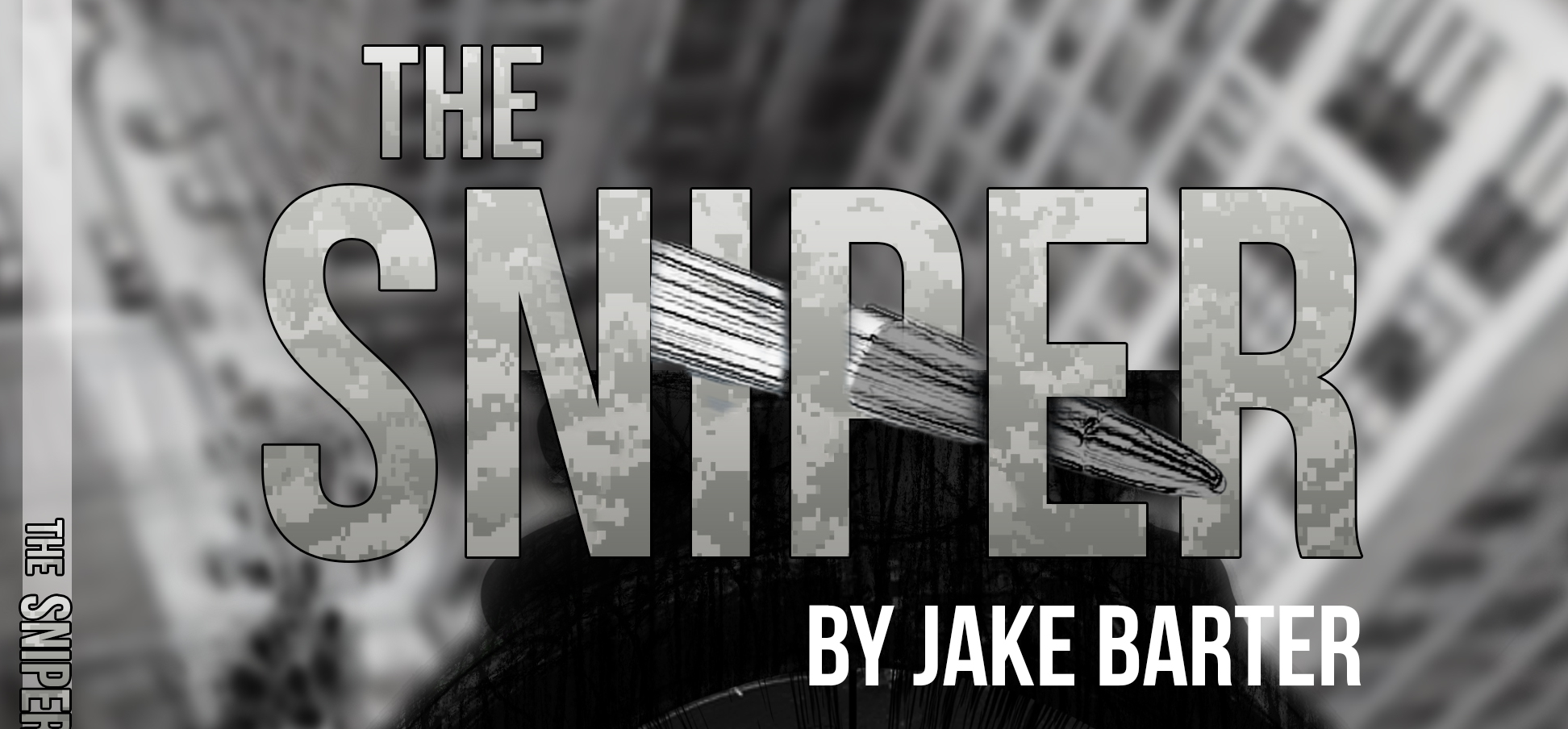
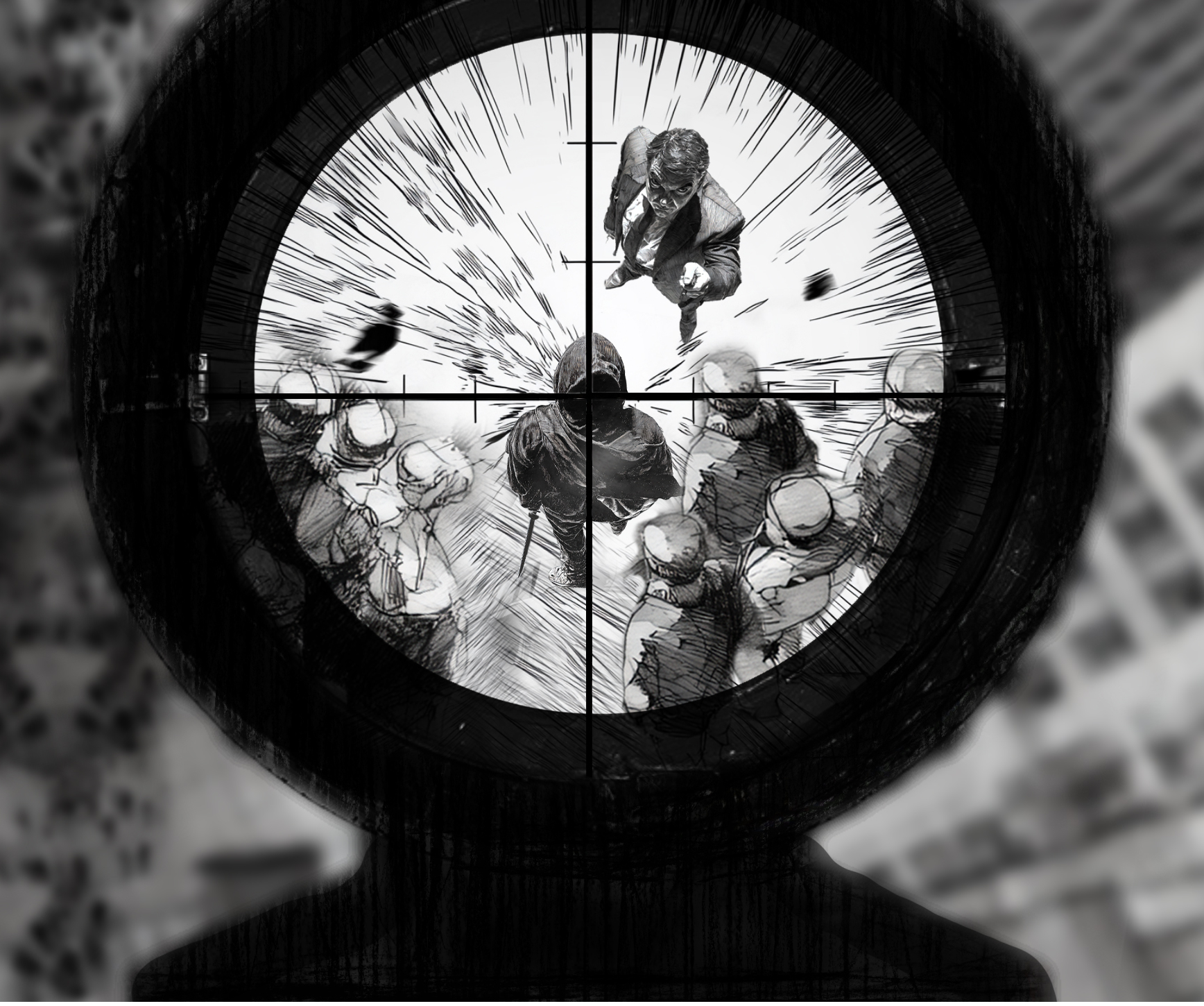
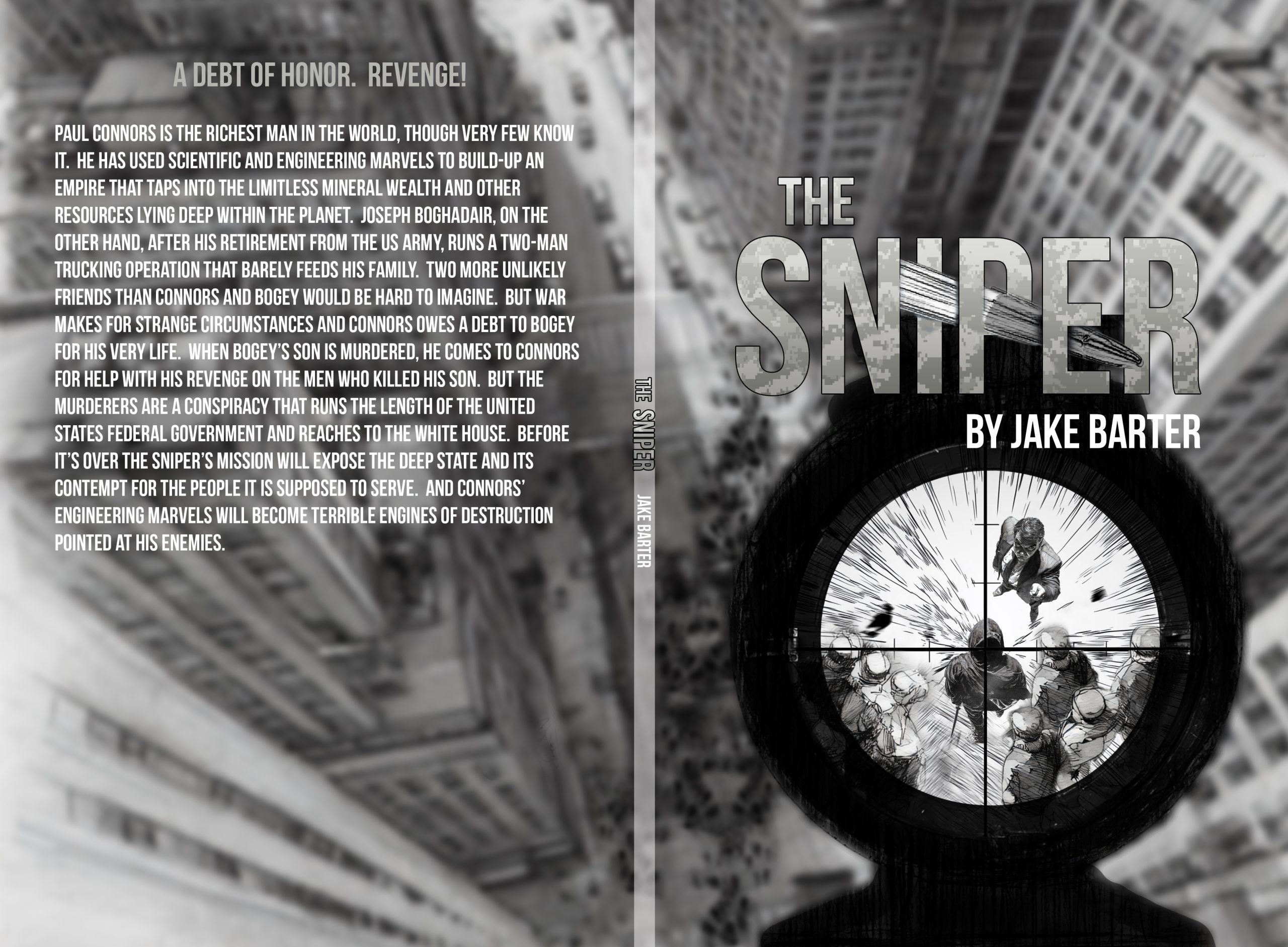
If a brutally long and tedious day starts and ends with good news, does that make it a good day? I would have to say yes. This morning started with the book cover for “The Sniper” arriving. And after returning from a long, grueling day trapped in the bowels of a drab New England city, bored almost to desperation, I finally have a deadline for the launch of my book. It will be out sometime between the middle and end of January. Now granted, that can be as much as two months from now but just putting a stake in the ground is what I need to coordinate the whole crazy flying circus of an effort. Covers and EPUB files and pdfs and key words and discount deals and reviews and project pages and pseudonyms and email lists and Amazon ads and heaven knows what else. Yes, a day that starts and ends well is a good day.
I was pleasantly surprised at just how accurately the cover art portrayed the scenario and the mood of the story. And the quality of the drawing exceeded my expectations completely. I’m extremely glad I went in the direction I did instead of a more generic cover. If for no one else than for myself. It makes the book real.


Now I have to confess that I have no idea whether what I’m trying to do makes any sense. Can a book from an unknown author with an extremely niche audience break out and find a generously sized audience? My rational engineering side says the odds against it are long. I’ll say one in a thousand.
But at the same time, a part of me is anxious to take the plunge. And that is exactly what I’m doing. It’s a roulette wheel spin with a big pot of my money plunked down on double zero. What could be more fun than that? Well, I guess winning would be more fun. But that’s well beyond my power to ensure. I’ll have to let fate have her say.
I guess now I know how every author since Homer has felt when his creation is about to be unveiled. And I’ll say it’s a good feeling. As Kipling said:
“When ’Omer smote ’is bloomin’ lyre,
He’d ’eard men sing by land an’ sea;
An’ what he thought ’e might require,
’E went an’ took — the same as me!”
Every teller of tales is part of the long tradition. You make up something in your head and you want to see if the audience resonates to the same vibration you felt. But the worst fate would not be if a lot of people didn’t like it. The worst is if no one ever hears it.
Achilles in the Iliad wanted to die for glory, for immortal fame. Well, I’d prefer to live but I’d forego any profit if I could guarantee that a million people read my story. That would be a form of immortality. Well, spin the wheel.

I Feel Therefore I’m Amused

What makes a good story?  And by story I’m including books, movies, songs, even a story being told by word of mouth.  What makes it a good story.  Simply, it has to make the audience feel something; satisfaction, recognition, joy, sorrow, anger, fear, horror, amusement, surprise or maybe even wonder.  In the absence of emotion can a story be good?  I’d say no.

So, when writing a story how do you ensure that the story checks some of those boxes?  Well, plot is one of the tools you can use to activate the reader’s emotions but more importantly, you have to build the characters so that they’re human.  Certainly, any generic female character being thrown into a scene where she is being stalked by a psychopath will elicit at least some emotion from the audience but if she is first made into a real woman with the requisite and recognizable emotions then the scene becomes harrowing.  Think of Agent Starling trapped in Buffalo Bill’s lightless room while he toyed with her in preparation for ending her life.  She is a trained law enforcement agent but she’s also a terrified young woman trapped by a predator.  The audience is on the edge of their seats.  Her fear is the fuel to make the scene real for the viewers.  It’s gripping.

And this is just as important for any emotion in any situation.  To be considered a success the reader has to feel something strong enough to make the story in some way real.  Let’s test my thesis.  Is the movie, “2001: A Space Odyssey,” a good story?  Does it make us feel anything?  Yes, there are scenes in the movie where we feel a sense of wonder at some of the things happening.  And there is a feeling of worry for Dave Bowman as he faces off against HAL9000.  I guess there is sadness over the death of Frank Poole.  But are any of these emotions particularly strong.  I guess on reflection the sense of wonder at the technological wonders we are shown in the flight to the Moon and aboard the Discovery One spacecraft are pretty interesting.  But none of the characters (except perhaps HAL) really activate our emotions.  In some ways Dave and Frank appear more robotic than HAL.  So, on the whole I wouldn’t call “2001” a successful story.  It’s almost like a travelogue to inform the audience about some interesting things that will be seen during a vacation trip.

Now compare this to the earlier science fiction movie, “Destination Moon.”  Technically, there’s no comparison.  “2001” is astonishingly beautiful and seems like a documentary shot in space.  “Destination Moon” appears woefully primitive in its special effects and graphics.  But the story has engaging characters and a plot that creates emotional interest.  The characters are placed in danger and the audience wants to see how the characters respond to this crisis.  Now surely, this isn’t some great work of art.  It’s melodrama and adventure.  But it works.  There’s enough there to make the characters real enough for us to care if they live or die.  Compare this to Dave Bowman at the end of “2001” travelling to the end of the universe through some kind of acid dream followed by him getting very old and then becoming some kind of “space embryo.”  To me all of that was meaningless from an emotional point of view.  It was boring.

So, the lesson is humans like stories that make them feel human.  Because it makes them feel.

Plato Was a Dope

The original utopia was Plato’s Republic.  And in that hypothesized city-state one of the most important precepts for producing good citizens was proper education.  Now, if you’ve ever read “The Republic” you know it’s literally gibberish.  Plato proceeds from unsubstantiated statements to illogical conclusions throughout the argument he uses to design his state but one thing I think he was right about is the necessity for highly superior education.  So, my republics will incorporate the most scientific and practical methods for educating and testing the young in order to maximize their future value as workers and citizens and to provide a worldview that would allow them to harmonize with their fellow citizens.

Now, since I am not an educator or a psychologist, I have no fixed ideas about methodology or even the content of this educational regimen.  I will hazard a guess that mathematics should still have a very important place in these schools.  I think thousands of years of western educational practices has proven the link between mathematical learning and general mental fitness.  But beyond that I’ll say that identifying the curricula for the various levels and types of schooling is something that will be of the highest importance for these communities.  And by no means do I intend for schooling to be strictly academic.  Specific vocational training is something I see as extremely valuable for individuals of all types.  Even a particle physicist or a concert pianist could benefit from knowing how to solder a component onto his computer motherboard or snake a bathtub drain.  But all of this is tangential to the main reasons why education will be critical to making these communities successful.

The schools will identify the academic capabilities of the children and combining this with their interests the correct academic and vocational curricula will be provided as choices.  This should maximize the probability for a successful citizen.  But the schools will also educate children with the ethos and expectations that the community is based on.  In this way the young will align themselves with the goals that are expected from them as members in the association.  In this way, the likelihood that these later generations will fit in with the community is maximized.

As with every other aspect of the community, feedback from the testing will inform the goals and needs of the community.  For instance, suppose the community is lacking in machinists.  So, the forecasting will be used to increase the monetary incentives for machinists.  And so forth for whatever other imbalances occur.

And education can also apply to other aspects of life.  For instance, men and women need to find mates in order to produce the next generation.  Education can include counseling on adapting to married life and even providing a dating service to locate compatible mates.

Now, Plato had his citizens indoctrinated with myths that justified their strange lifestyle.  For instance, he did not want the nuclear family to interfere with the loyalties of his citizens and so the children were raised together as a pack.  And he had stories that supposedly reinforced this lifestyle.  I wouldn’t expect these optimized communities of mine to attempt to destroy families.  On the contrary, I would expect them to do everything possible to prove that their lifestyle and community provide the best human environment possible.

I wonder what aspect of my optimal communities I’ll talk about next?  Well, maybe that’s enough for a while.  I better post on something else tomorrow.

Utopia and Nukes

Okay, I said I’d get down to details in setting up “photopia.”  Well, where do we start?  The first question is how do you start such a thing from where we are now?  In the past the founder would be a prophet.  Moses, Jesus, Mohammad, Joseph Smith, L Ron Hubbard (!).  For my founding I’ll settle for a trillionaire with virtually unlimited resources of artificial intelligence.  Then he’ll have to be a humanitarian, a philanthropist, a lover of mankind.  Because he’s going to have to take the long view.  He’ll know that to save mankind he’ll have to start by rejecting a good chunk of humanity at the start.  Because as humanity currently exists, there is a definite percentage of the population that can’t be included in an optimized human environment.  There is a twenty percent group that is hopeless.  Some of them are uncontrollably violent.  Some are completely unwilling to do work.  Some are anti-social to the extent that they habitually commit various types of crime.  It goes without saying utopia has no place for such individuals.

The system that our founder builds must begin by trying to select a core of people that are unmistakenly outside of this 20%.  The only way that the system can be founded is to start with the best starting material.  So extremely careful biographical research into the initial candidates will have to be performed to rule out any unacceptable or even sub-optimal individuals.  Ideally, married couples and even families of the highest quality should be incorporated in the starting material.  This will build additional stability in the structure.

But one thing that will be true is that even within this foundation of selected individuals there will need to be a continuous weeding out mechanism for people who fail or for the offspring who will be identified as failures.  And if offspring are rejected, often the parents and siblings will find it impossible to stay inside the group.  And not because this community is a hermetically sealed bubble.  Everyone inside will be in contact with the outside world continuously.  But if children of group members become dangerous, they must be kept outside of the community and that is hard to enforce unless the rest of the family is ejected.  So, it becomes apparent that policing the group for anti-social activity will become one of the most important activities of the administrators.

And as I mentioned in the earlier installment of this essay, those who are ejected are given the equity that they’ve earned in the community when the leave so that they can find their own place in the world.  So, what exactly are the rules of this club?  Well, the founder gets to decide those.  If he’s wise, these rules are ones that will tend to increase stability, prosperity and social cohesion.  What exactly these rules are may be dependent on the values and personal traits of this “prophet.”  And ideally, there could be a number of different foundations to allow for the different but equally valid personality types that exist in our species.  And maybe some of these will be failures and some will thrive.  But over the course of time by trial and error a calculus for creating human communities could be derived.

Now, what happens to those who can’t be included.  Well, nothing.  They’ll be on their own.  This assumes that the larger human community still exists outside of these enclaves and that it has to deal with the full spectrum of human types.  And that is why prisons and welfare exist.  And that brings up another point.  How would these societies be viewed by the outside world.  My guess will be; poorly.  I believe many nations would try to destroy them or at least force them to accept members that they would reject.  And for that reason, the location of these societies may be one of the most important questions that the administrators will have to decide.  Of course, trillionaires can do wonders with the right amount of bribery.  But let’s just say that a nuclear weapons program may be a necessity for this utopia of mine.

When I write the next installment (and I may have to think about it for a while) I think I’ll talk about education.